

In brief
A digital aircraft logbook should do more than display scanned pages. It should preserve originals, authenticate entries, connect aircraft and component history, maintain an audit trail, support retention and retrieval, and keep every structured fact traceable to source.
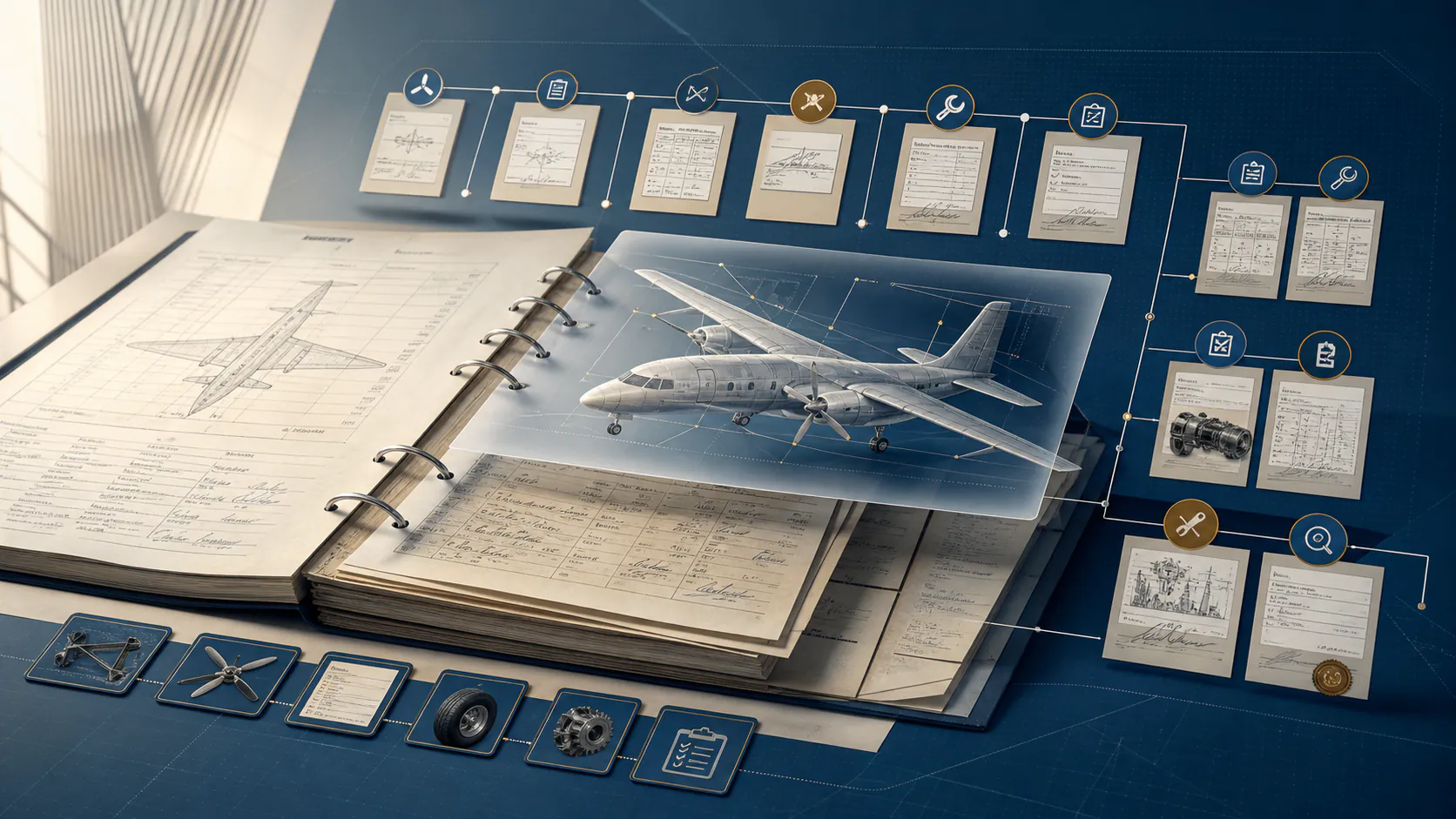
Digital aircraft logbooks turn a static archive into a working aircraft history. Maintenance teams can find entries faster, owners can package diligence without shipping originals, and reviewers can trace a status directly to the supporting page.
The transition must protect the legal, technical, and commercial value of the records. A searchable interface is useful only if the underlying evidence remains authentic, complete, and recoverable.
Four levels of digital aircraft records
| Level | Description | Limitation |
|---|---|---|
| File backup | Scanned PDFs stored in folders | Minimal structure and weak search |
| Searchable archive | OCR and metadata across documents | Search can surface text without understanding asset relationships |
| Connected aircraft history | Documents linked to aircraft, components, requirements, and events | Requires careful identity and review controls |
| Born-digital recordkeeping | Entries and signatures originate in an electronic system | Requires procedures, authentication, integrity, and applicable acceptance |
Organizations may operate across several levels at once. Historical paper can be scanned while new maintenance records are created electronically.
Regulatory foundation for electronic records
The FAA’s active AC 120-78B provides standards and guidance for electronic signatures, electronic recordkeeping, and electronic manuals. It describes an acceptable means, not the only means, and does not replace the underlying regulations.
The system and procedures should address:
- Who is authorized to create, sign, review, and correct records.
- How signer identity is authenticated.
- How changes are controlled and logged.
- How records remain legible, available, and reproducible.
- How retention periods are enforced.
- How backups and disaster recovery work.
- How regulators and authorized parties receive access.
- How the organization transitions into and out of the system.
Review 14 CFR 43.9, 14 CFR 43.11, 14 CFR 91.417, and the rules applicable to the operation.
The anatomy of a strong digital logbook
Original document layer
Preserve page images, born-digital files, attachments, and their original context. Do not crop away signatures, headers, handwritten notes, or adjacent entries.
Search layer
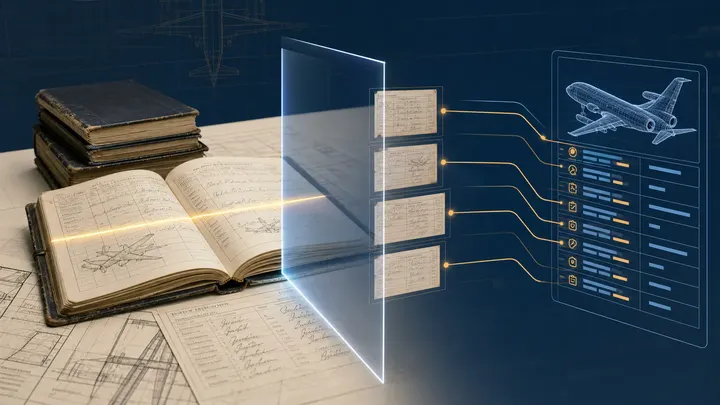
OCR and indexing should make typed and handwritten information discoverable. Search results need page previews and exact source navigation.
Structured aircraft layer
Connect dates, aircraft time, component identity, inspections, work orders, ADs, repairs, alterations, and signatures to the correct aircraft and event.
Verification layer
Show confidence, reviewer decisions, conflicts, missing periods, and the source supporting each conclusion. A corrected extracted field should not alter the original page.
Sharing layer
Create controlled views for maintenance vendors, auditors, buyers, lenders, insurers, and owners. Avoid emailing uncontrolled copies of an entire fleet archive.
Digital logbook migration plan
- Define scope and authority. Identify aircraft, record types, operating rules, controlling originals, and decision owners.
- Inventory the archive. Record each volume, asset, date range, condition, location, and gap.
- Stabilize and scan. Protect fragile documents and use defined capture standards.
- Quality-check every page. Verify completeness, order, orientation, focus, contrast, and legibility.
- Index aircraft and components. Tag the right tail, engine, APU, propeller, and serialized assets.
- Extract and connect. Build searchable facts and linked maintenance events.
- Reconcile critical status. Review times, LLPs, inspections, ADs, repairs, alterations, and program evidence.
- Establish new-record intake. Bring current shop and internal records into the system quickly.
- Test access and recovery. Prove authorized users can retrieve and export records during normal and contingency operation.
- Govern continuously. Monitor exceptions, access, backup, intake timing, and audit history.
The aircraft logbook digitization guide provides detailed scan acceptance criteria.
Source integrity and audit trail
A trustworthy platform distinguishes:
- Original record.
- OCR text.
- Extracted field.
- Machine-generated relationship.
- Human-reviewed conclusion.
- Corrected structured value.
- Superseded or duplicate document.
Each layer should be visible and auditable. A user should never confuse an automatically inferred date with the date visible in a signed entry.
Electronic signatures
Electronic signatures are not simply images of handwriting. Applicable systems should establish signer identity, intent, association with the record, integrity, and reproducibility.
The FAA also publishes separate guidance for digital signatures submitted to the Aircraft Registration Branch. Registration and recordation documents follow their own requirements, which should not be assumed identical to maintenance-record procedures.
Security and continuity
Digital records reduce physical-access constraints but create system risks. Evaluate:
- Encryption in transit and at rest.
- Organization and aircraft-level access.
- Multi-factor authentication.
- Audit logging.
- Secure sharing and revocation.
- Backup frequency and geographic separation.
- Recovery objectives and tested restoration.
- Vendor continuity and data export.
- Incident response.
- Protection from bulk deletion or silent alteration.
Keep contingency access for time-critical maintenance and return-to-service work.
Digital logbooks in a pre-buy or financing
A well-structured digital history can accelerate diligence because reviewers receive:
- Searchable original records.
- Current status tied to source.
- Component installation history.
- Indexed repairs, alterations, and STCs.
- Program evidence.
- Gap and exception report.
- Controlled sharing instead of duplicate data rooms.
Professional review still happens; the digital history makes it more focused and reproducible. See the aircraft pre-buy records checklist and aircraft financing guide.
Choosing a digital aircraft logbook platform
- Can it preserve and export original records?
- Does search work on your handwritten and degraded pages?
- Can every extracted fact open to source?
- Does it model components and installation history?
- How are low-confidence and conflicting facts reviewed?
- Are changes and signatures auditable?
- Can access be scoped and revoked?
- How does backup and disaster recovery work?
- Does it connect to maintenance tracking and work orders?
- Who owns the data and what happens at contract end?
Sources and further reading
Common questions
Frequently asked questions
What is a digital aircraft logbook?
It is an electronic system for preserving and using aircraft maintenance and operational record history. Capabilities may include scanned records, born-digital entries, electronic signatures, structured status, search, links, sharing, and audit history.
Can a scanned logbook replace the paper original?
That depends on the applicable rules, operating authority, procedures, authenticity, and acceptance of the electronic system. Preserve originals and obtain qualified guidance before changing custody or destroying paper.
What makes a digital logbook trustworthy?
Source integrity, signer authentication, controlled changes, complete audit history, reliable backups, clear asset identity, consistent review, and the ability to reproduce records accurately.
Does a digital logbook replace maintenance tracking?
Not necessarily. A digital logbook preserves history and evidence. A maintenance tracker forecasts what becomes due. An integrated operation connects the two.
Keep researching
Related aircraft guides
Run maintenance from connected evidence
Know what is due, and open the record that proves it.
Radar reads every logbook back to birth and builds the due list from the signed entries, with the page behind every line.