
VERYON AND FLIGHTDOCS ALTERNATIVE
Radar vs VeryonThe Veryon Tracking (Flightdocs) alternative built on your logbooks.
Veryon Tracking, formerly Flightdocs, tracks the work your team enters through work orders. Radar reads every logbook back to birth and builds the due list from the signed entries, with the page behind every line.
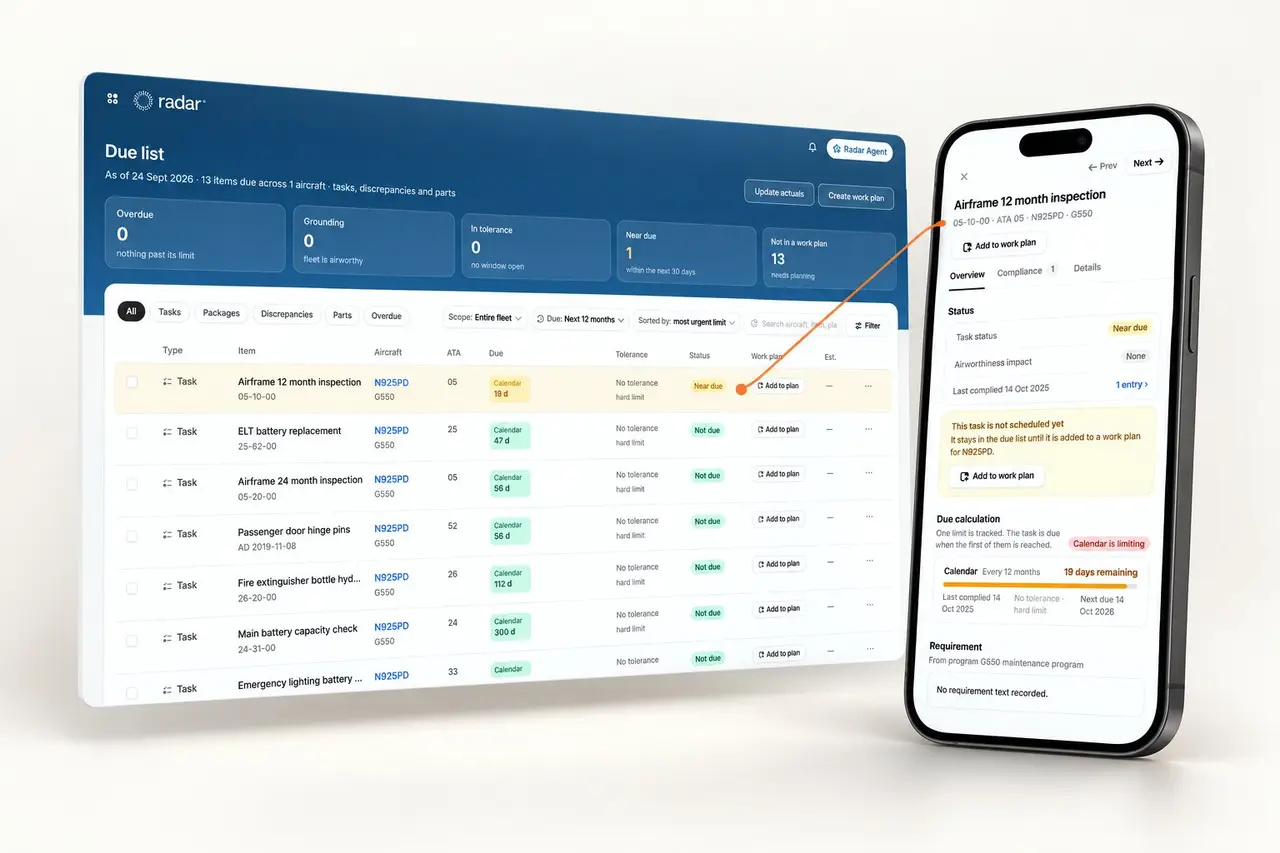
SIDE BY SIDE
What changes when you move from Veryon.
Veryon Tracking (Flightdocs) details are from its own public pages, checked October 2026 (sources below). Veryon publishes its pricing model, not its prices. Confirm current capabilities and quotes with Veryon.
PUBLISHED PRICING
Veryon Tracking (Flightdocs) pricing beside Radar's.
| Vendor and product | Published price | Pricing model | Source |
|---|---|---|---|
| RadarRecords | $2,400 to $4,800 per aircraft a year | Per aircraft, by aircraft size. Prepaid shipping labels for paper logbooks included. | useradar.com/pricing |
| RadarComplete (Records and Maintenance Tracking) | $6,000 to $13,500 per aircraft a year | Per aircraft, by aircraft size. Maintenance Tracking on its own is quoted for the fleet. | useradar.com/pricing |
| VeryonVeryon Tracking (formerly Flightdocs) | Quote only. Its Capterra listing shows a starting price of $1,750 a year. | Annual subscription per aircraft, by make and model, plus a one-time enrollment fee. Not priced per user. | veryon.com |
| CAMP SystemsCAMP Maintenance (MTX) | Quote only | Custom pricing by aircraft type, fleet size and the modules chosen. | campsystems.com |
| Traxxall (JSSI)Traxxall maintenance tracking | Quote only. Its Capterra listing shows a starting price of $1,800 a year. | Annual subscription, quoted by JSSI. Inventory and work plans are modules of the same platform. | jetsupport.com |
| Traxxall (JSSI)AviatorMX | $950 a year for a turboprop, $1,900 a year for a jet | Per aircraft, for Part 91 owner-operators of light jets and turboprops. | jetsupport.com/aviatormx |
| BluetailDigital records | From $75 per aircraft a month (piston), from $150 per aircraft a month (light jets, Fleet plan) | Per aircraft, monthly. Scanning is offered separately. | bluetail.aero/pricing |
| Savvy AviationSavvyMx (managed maintenance) | $899 a year (piston single), $1,199 a year (piston twin) | A managed service for piston owners. Not offered for Part 135 aircraft or turbine twins. | savvyaviation.com |
Prices as published on each vendor's site, checked October 2026. "Quote only" means the vendor does not publish a price. Capterra starting prices are shown as listed there. Confirm current pricing with each vendor.
MOVING FROM VERYON
How a tail moves from Veryon to Radar.
- Send the logbooksShip the binders with prepaid labels from Radar, or upload the PDFs you have. Records are ready in about two weeks.
- Keep the status beside itKeep Veryon running and its status report at hand while Radar builds its own from your program and the books.
- Check line by lineEvery due item in Radar opens the signed entry behind it. Compare it with Veryon and resolve the differences.
- Cut over, or keep bothMove the due list to Radar when the two agree, or keep Veryon and use Radar for the records.
KEEP IT OR SWITCH
Keep Veryon. Or switch over.
Radar reads the logbooks behind the tracker you have, or becomes your tracker when you are ready.
Keep Veryon
- Every logbook read back to birth
- Every entry searchable, with its page
- Move the due list over when you are ready
Or switch to Radar
- Due list, forecast, work plans and sign-offs
- Last compliance from the signed entry, with its page
- Run both until you cut over
RELEASE TO SERVICE
Release to service with every box checked.
Before the aircraft goes back into service, Radar checks the whole package. Anything open, unsigned, undocumented or unresolved holds the release and names the card it's on.
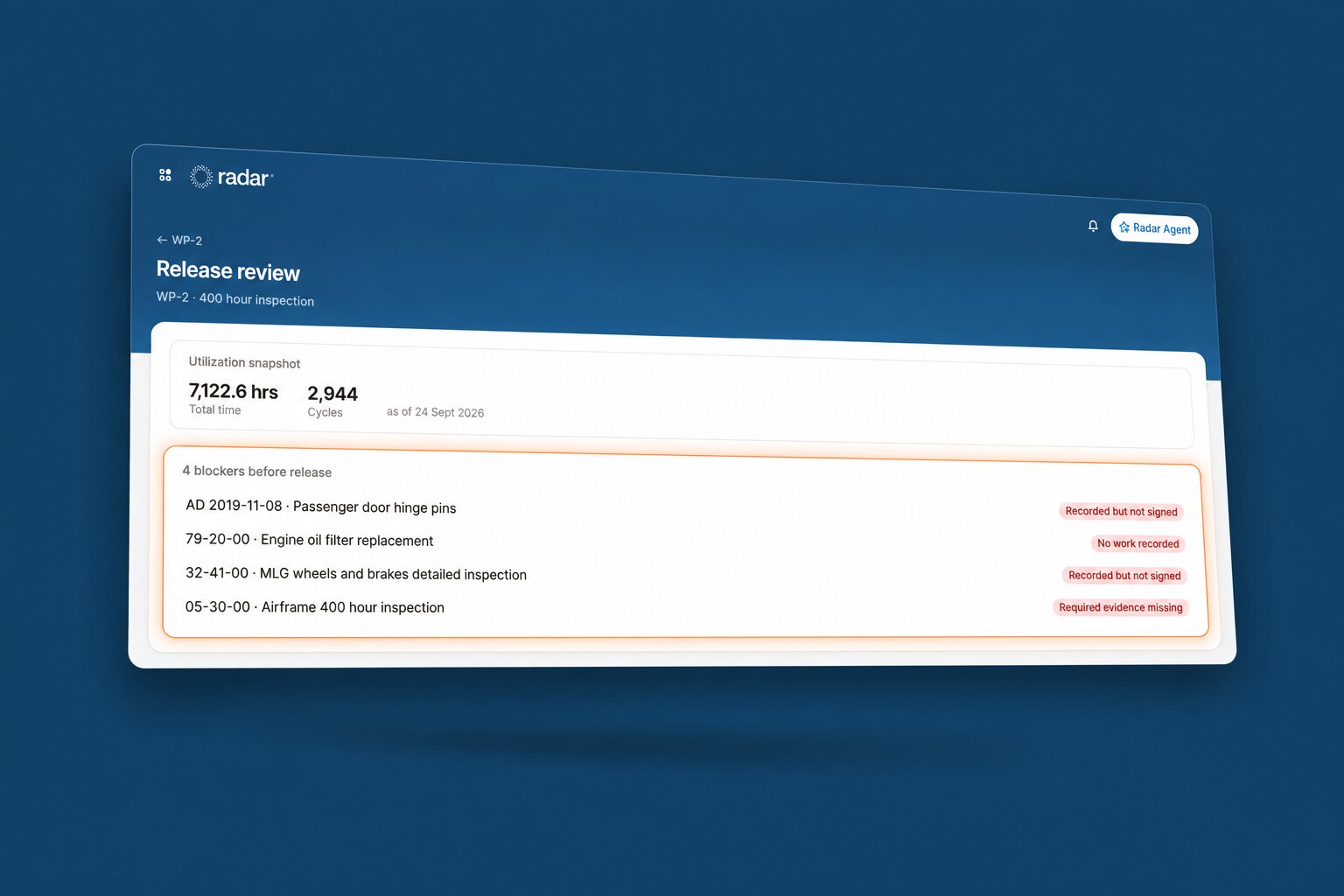
- Every task card recorded, with its result
- Every card signed off
- No missing or rejected documents
- No unresolved findings
“I was about to spend $20,000 on a part to get our airplane flying again. Radar showed me we had bought the same part 11 months earlier, still under warranty. Saved us $20,000, just like that.”
Izzy, Radar customer
Is Veryon the same as Flightdocs?
Flightdocs is now Veryon Tracking. The company behind it, Aircraft Technical Publishers (ATP), bought Flightdocs in 2020 and renamed itself Veryon in June 2023. Veryon also owns CaseBank, Rusada and EBIS.
How much does Veryon Tracking cost?
Veryon publishes its pricing model, not its prices: an annual subscription per aircraft that varies by make and model, plus a one-time enrollment fee, and no per-user charge. Its Capterra listing shows a starting price of $1,750 a year. Radar publishes its pricing: Records is $2,400 to $4,800 per aircraft a year, and Complete is $6,000 to $13,500.
What does Veryon make besides Tracking?
Veryon Publications (technical manuals and regulatory libraries), Veryon Diagnostics, Veryon Work Center for MROs, Veryon Tracking+ for larger fleets and Veryon GSE.
Can I keep Veryon?
Yes. Radar reads the logbooks behind your Veryon due list back to birth, with the page behind every entry. Move the due list over when you are ready, or keep both.
How do we switch?
Run Veryon and Radar side by side while Radar builds the status from your books, and cut over when the two agree.
What are the alternatives to Veryon Tracking (Flightdocs)?
See Veryon alternatives for the other trackers and records tools, with published pricing, or the aircraft maintenance software buyer's guide for how to evaluate them.
KEEP COMPARING
Other trackers, side by side.
GET A DEMO
Start with one tail.
Ship us its binders or upload its PDFs. We'll show you its maintenance status, with the page behind every line.
Product screens show sandbox data.