
RECORDS
Every logbook, searchable back to birth.
Radar reads every page, typed or handwritten, and turns each entry into data you can search, with the page behind every value. From $2,400 per aircraft a year.
“The average DOM spends two to four hours a day dealing with logbooks. With Radar, it's thirty minutes.”
Ty, Director of Maintenance, Craft
- 1 sign-off per task writes the logbook entry and moves the due list, in place of three separate write-ups
- 10 to 20%1 of a business jet's value rides on complete records
- $20,000 saved on one part a customer was about to re-buy
1 Asset Insight appraisers, cited in AvBuyer, 2021.
GETTING RECORDS IN
Send the binders. Get back every entry.
Ship us the books or upload the PDFs you already have. Radar reads every page back to birth, and new entries join the record as the work gets signed off.
- Ship the bindersRequest prepaid shipping labels in Radar and drop the books at any FedEx or UPS location. Records are ready in about two weeks.
- Upload PDFsAlready scanned? Upload the files and Radar reads them the same way.
- Google Drive and OneDriveConnect the folder where your team saves records, and new files come in on their own.
BACK TO BIRTH
Every logbook, searchable back to birth.
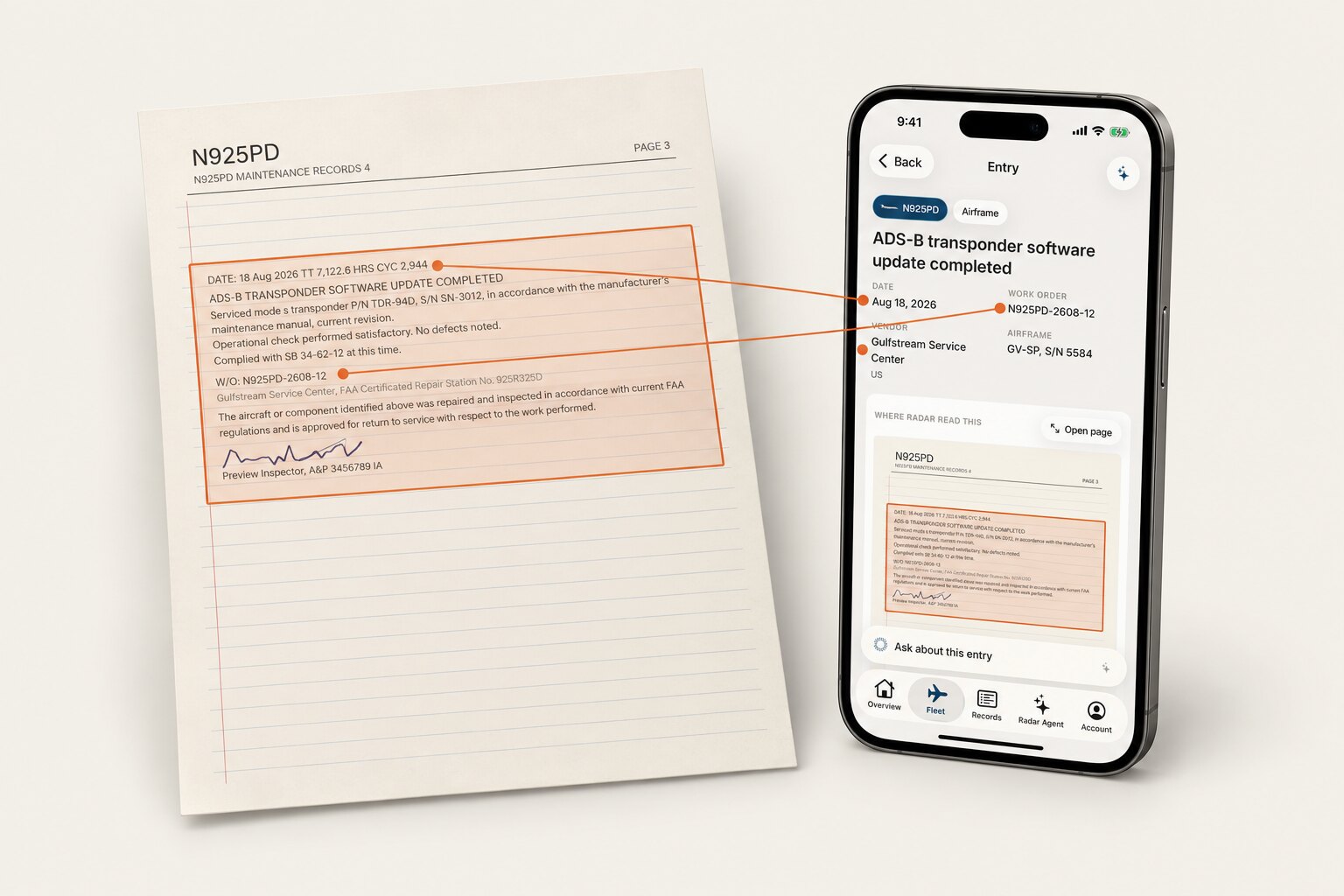
Every page, typed or handwritten, read into one record: times, cycles, parts, ADs and signatures, each linked to the page it came from.
STRUCTURED, CITED
What Radar reads from every entry.
Each value is stored as data and tied to the region of the page it came from. Search it, filter it, or open the page and check it yourself.
Read from every entry
- Date, work order and repair station
- Aircraft total time and cycles
- Each task, with its ATA and AMM reference
- Parts removed and installed, by P/N and S/N
- ADs and SBs complied with, and their revision
- Who signed, with certificate number and role
- 8130-3s and EASA Form 1s, linked to their parts
- Engine and APU times on the day of the work
THE RADAR APP, COMING SOON
Cradle to grave, in your pocket.
The Radar iPhone app is on its way. Wherever you are, find any entry by part or serial number and show anyone the page it came from. Your team on the ramp can scan new pages straight into the record.
-
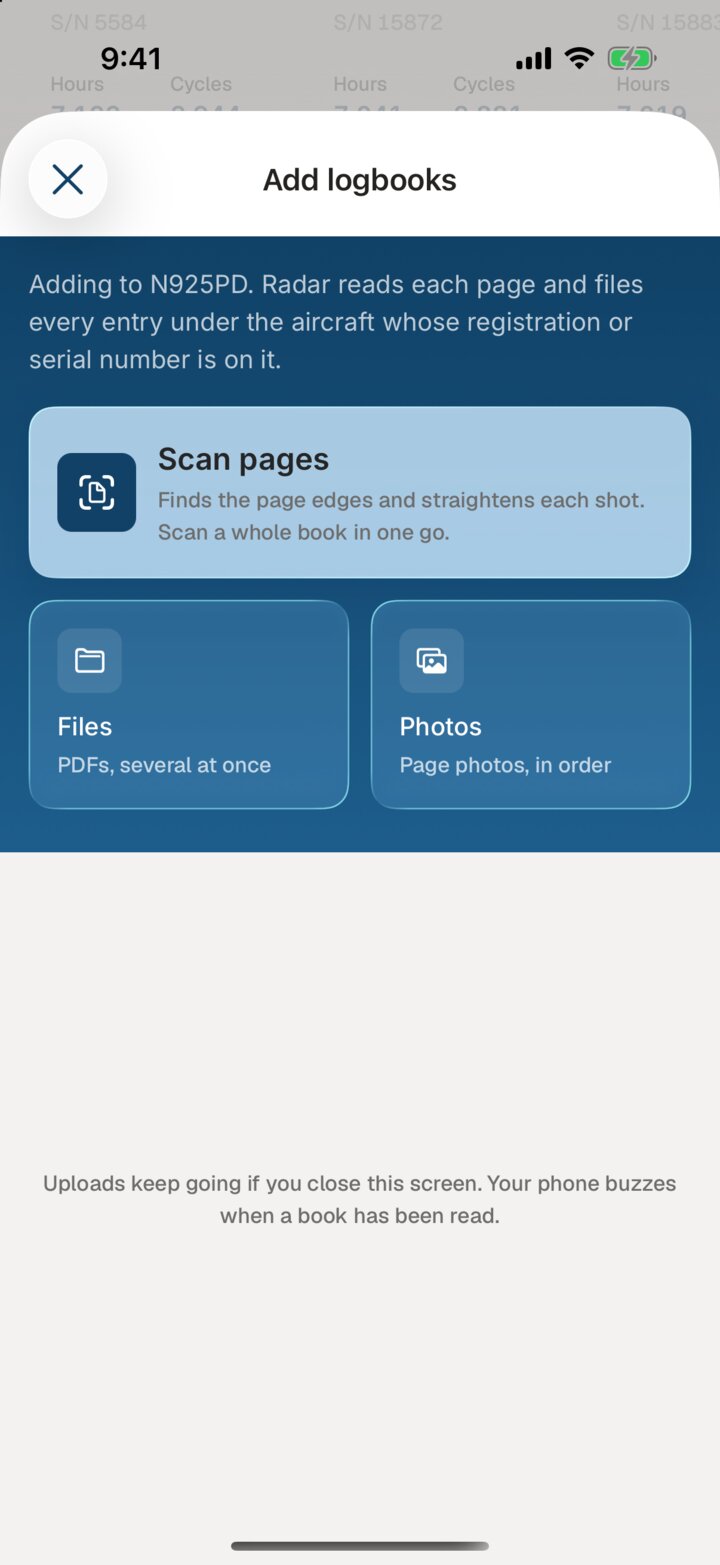
Scan it on the ramp.
Point the phone at a page or a whole book. The scanner finds the page edges and straightens each shot.
-
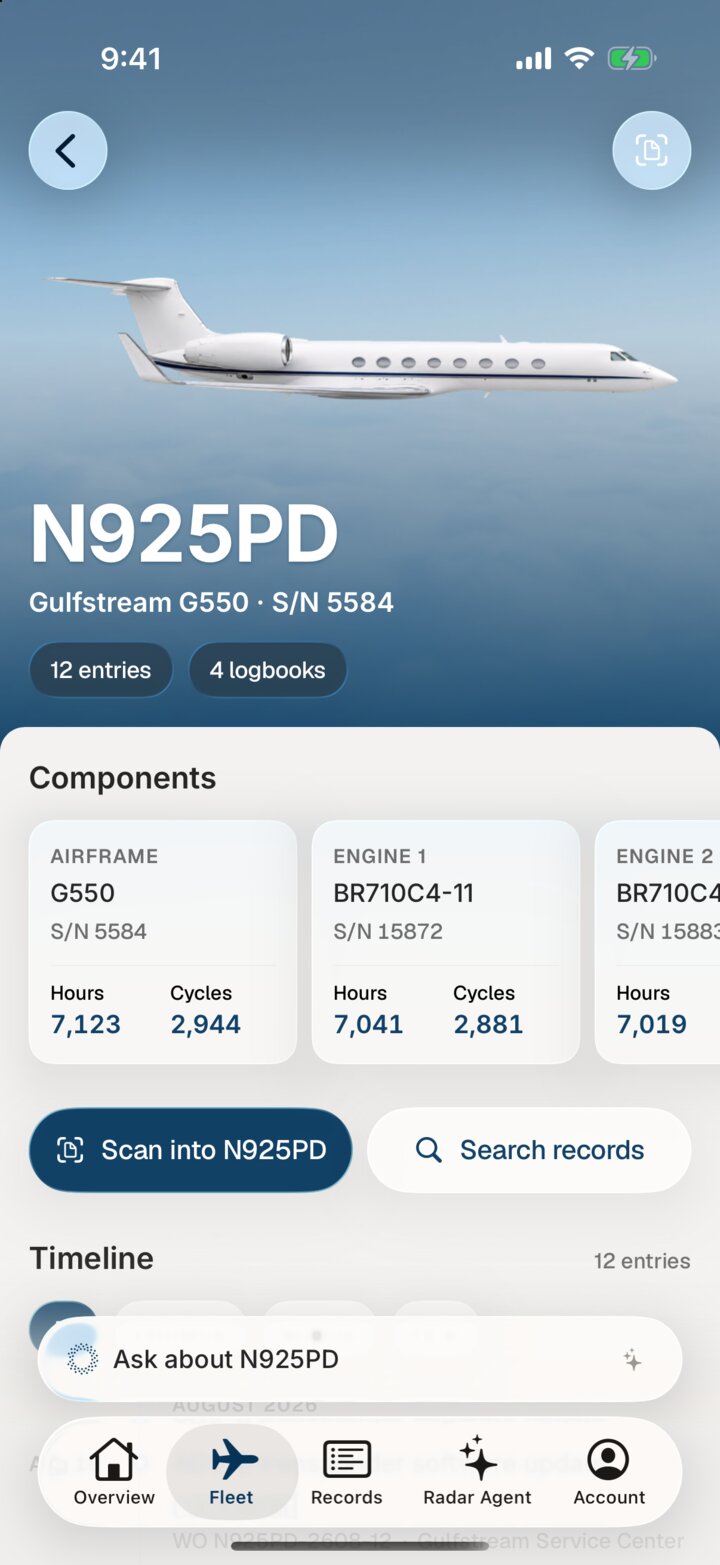
It files itself.
Radar reads each page and adds every entry to the aircraft's record, by logbook and date.
-
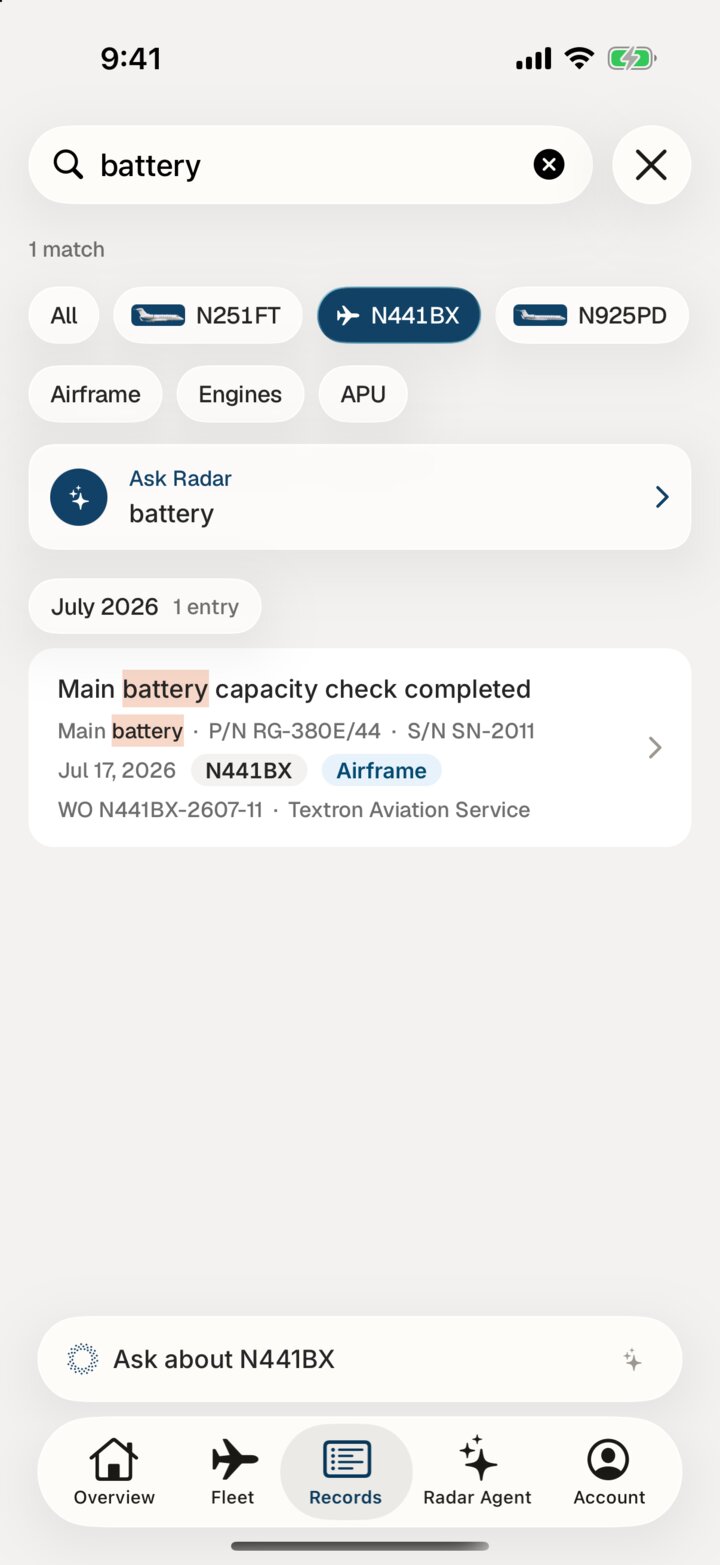
Find anything in seconds.
Search every entry by part number, serial, date or task.
-
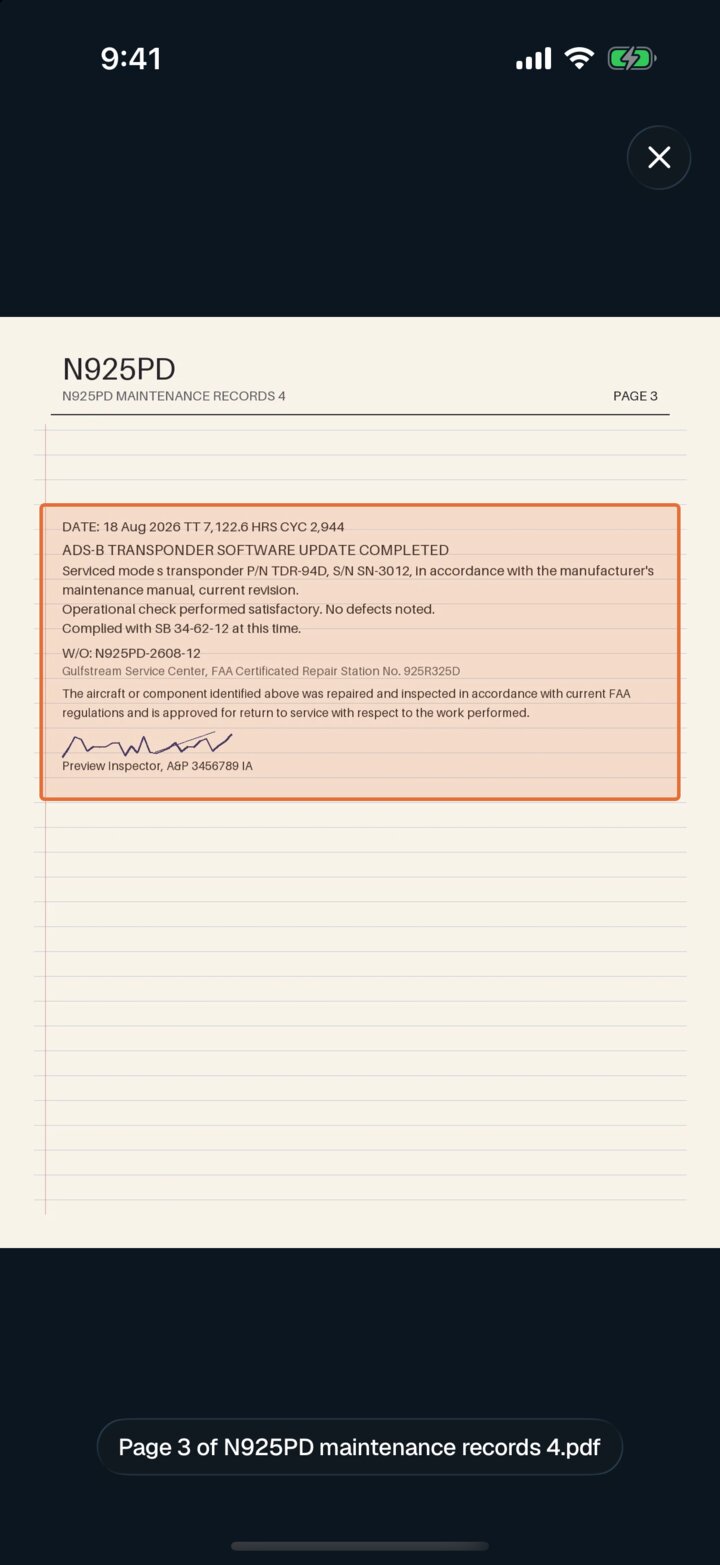
Open the page it came from.
Every entry opens the scanned page, with the lines Radar read outlined.
-
Ask about any entry.
Who signed it, what else was on the work order, the times on a part since then.
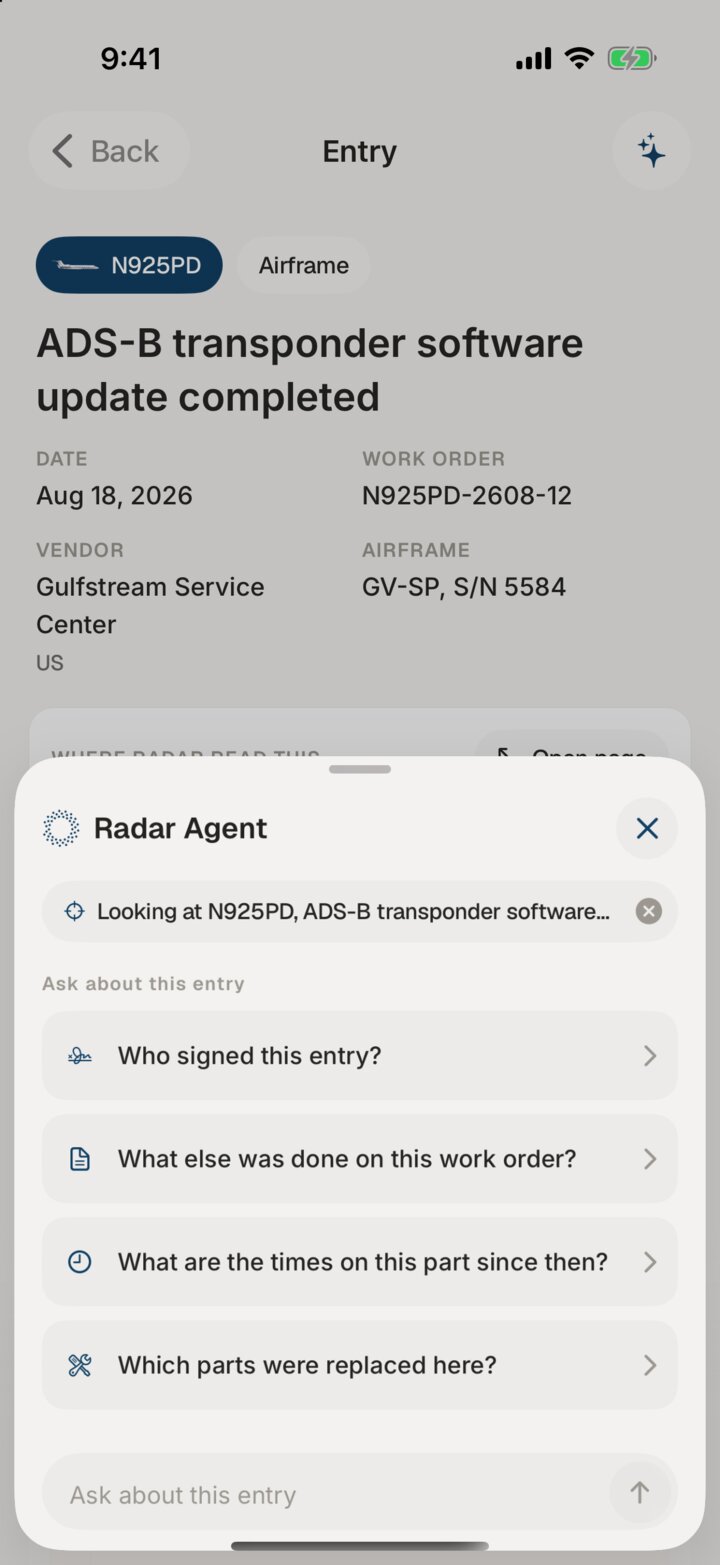
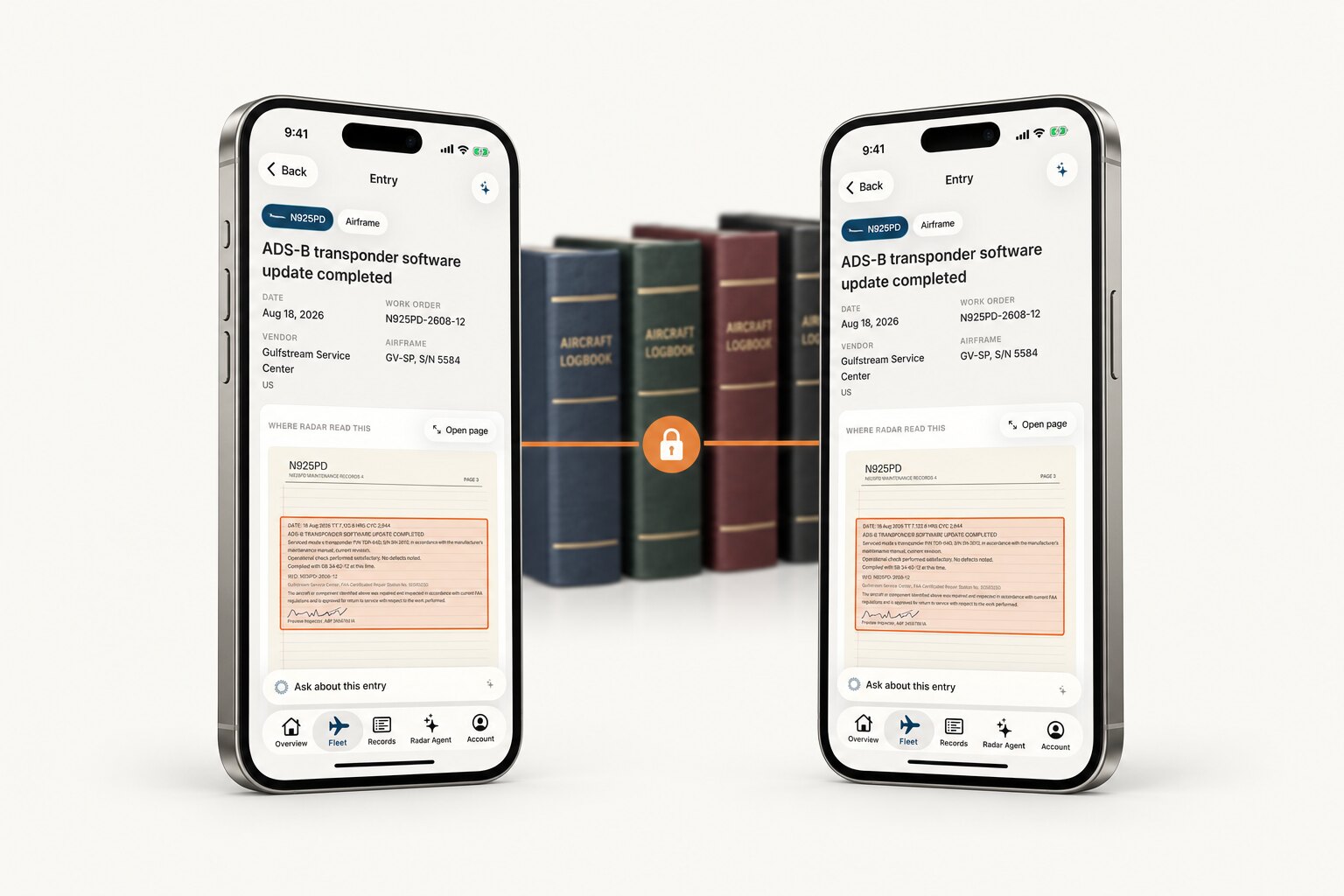
Screens from the Radar iPhone app, coming soon, with sandbox data.
AUDITS AND PRE-BUYS
Audits and pre-buys without the binders.
Every entry opens the page it was read from. When an auditor, the FSDO or a buyer's inspector asks, open the page instead of the binder, and the originals stay in your office.
How do my records get into Radar?
Ship the binders with prepaid labels from Radar, or upload PDFs you already have. Records are ready in about two weeks. Or connect the Google Drive or OneDrive folder where your team saves records, and new files come in on their own.
Can it read handwriting?
Yes, typed and handwritten entries. Every value links to the scan, so you can check it yourself.
Will my FSDO accept electronic records?
The originals stay the legal record, and every answer points to them. If you operate under Part 135, we help you write the manual language for electronic recordkeeping and apply for OpSpec A025.
What does it cost?
Records is $2,400 to $4,800 per aircraft a year, by aircraft size, with prepaid shipping labels included. Complete, Records with Maintenance Tracking, is $6,000 to $13,500.
GET A DEMO
Start with one tail.
Ship us its binders or upload its PDFs. We read it back to birth and show you every entry with its page.
Product screens show sandbox data.