

In brief
An airworthiness directive (AD) is a legally enforceable FAA rule, issued under 14 CFR Part 39, that orders inspections, repairs, part changes or operating limits to correct an unsafe condition in an aircraft, engine, propeller or appliance. Owners and operators must comply before the deadlines it sets and must keep a record of each applicable AD's status under 14 CFR 91.417.
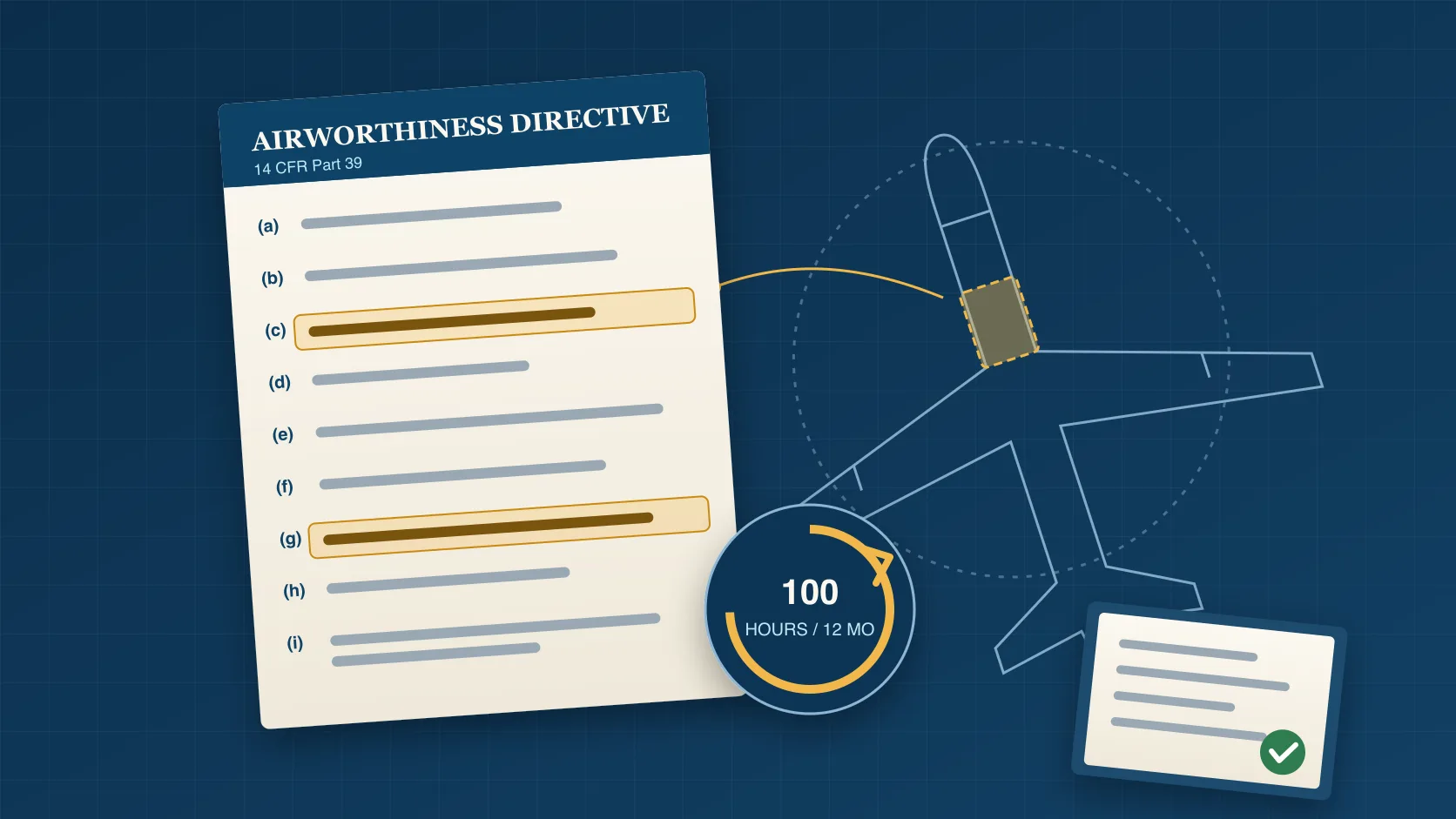
An airworthiness directive (AD) is a legally enforceable rule the FAA issues to correct an unsafe condition in an aircraft, engine, propeller or appliance. It names the products it applies to, says what must be done (an inspection, a repair, a part replacement, a new operating limit) and sets the deadline. Until the AD's requirements are met, the affected aircraft is not airworthy.
ADs are the FAA's main tool for fixing problems found after a product is certificated. They are issued under 14 CFR Part 39, and they bind every owner and operator, including private Part 91 owners. If you own, fly, maintain, buy or finance an aircraft, its AD status is one of the first records anyone will ask to see.
What an airworthiness directive is, in plain English
14 CFR 39.3 defines ADs as legally enforceable rules that apply to aircraft, aircraft engines, propellers and appliances. Under 39.5 the FAA issues one when it finds that an unsafe condition exists in a product and is likely to exist or develop in other products of the same type design.
Three rules in Part 39 decide how ADs work in practice:
- You must comply. Under 39.7, anyone who operates a product that does not meet the requirements of an applicable AD is in violation of that section.
- Modification does not get you out. Under 39.15, an AD applies to each product it identifies even if the product has been changed. If a change makes the AD's instructions impossible to follow, you need an approved alternative method of compliance.
- The AD wins. Under 39.27, when an AD and the service document it references disagree, you follow the AD.
Every AD has a number of the form year, biweekly period and sequence: AD 2011-10-09 was the ninth AD of the tenth biweekly period of 2011. Its amendment number (39-16690) identifies the change to 14 CFR 39.13, the section every AD is added to.
Who issues ADs, and foreign ADs the FAA adopts
The FAA issues every AD that binds a US-registered aircraft. Most begin as a notice of proposed rulemaking (NPRM) published in the Federal Register for public comment, then become a final rule with an effective date. When the risk will not wait for comments, the FAA issues a final rule with a request for comments, or an emergency AD.
For a product designed in another country, the civil aviation authority of the state of design (EASA for Europe, Transport Canada, ANAC in Brazil, and others) issues its own AD first. That foreign AD does not bind a US aircraft by itself. The FAA reviews it as mandatory continuing airworthiness information and, if the unsafe condition applies to US products, issues an FAA AD, often by incorporating the foreign AD's requirements by reference. A Pilatus PC-12 or a Dassault Falcon owner therefore complies with the FAA AD, which may point to the EASA text for the details.
The scale is large. Our dataset of FAA final-rule ADs from the Federal Register holds nearly 12,900 directives since 1994, about 8,900 of them on airplanes, and the FAA still publishes roughly 300 a year.
Types of AD: one-time, recurring, emergency and AMOC
ADs differ in what they ask and how often. The status line for each AD in an aircraft's records has to say which kind it is.
| Type | What it requires | Example from the record |
|---|---|---|
| One-time | A single action by a deadline, such as replacing a part or modifying a system | AD 2024-02-51 required each Boeing 737-9 with a mid cabin door plug to be inspected before further flight |
| Recurring (repetitive) | The same inspection again at an interval, until a terminating action or a superseding AD | AD 2011-10-09: Cessna seat rail inspections every 100 hours or 12 months |
| Emergency | Immediate action, sent to owners before Federal Register publication, effective on receipt | AD 2018-23-51 on the Boeing 737-8 and -9 angle of attack issue, later superseded by AD 2020-24-02 |
| Superseding | Replaces an earlier AD, often widening applicability or changing the fix | AD 2011-10-09 superseded AD 87-20-03 |
| AMOC | Not a type of AD: an FAA-approved alternative way to comply with one, under 14 CFR 39.19 | Approved by the office named in the AD's AMOC paragraph |
About one in three ADs in our dataset requires repeated action, and those are the ones that cause most findings in a records review: a recurring AD is only compliant if every interval since it took effect is accounted for. Our blog post on why recurring ADs have no grace period covers the arithmetic.
Some ADs also allow terminating action: a permanent fix that, once done, ends the recurring inspections. AD 2011-10-09 is explicit that replacing a seat rail does not terminate its repetitive inspections, which is why seat rail entries appear in Cessna logbooks every year.
How to read an AD: an annotated anatomy
Since about 2008 FAA ADs follow the same lettered layout, so once you know where to look, any AD can be read in a few minutes. The example below is AD 2011-10-09; newer ADs add a few paragraphs, so the letters shift, but the order is stable.
The two paragraphs that decide most questions are applicability and required actions. Applicability can narrow by model, serial number range, installed part number or modification status, so "this AD names my model" is only the first step. The required actions paragraph gives the compliance time, usually the earlier of hours time in service, cycles or calendar time, and for a recurring AD the interval.
A real recurring AD: Cessna seat rails, AD 2011-10-09
AD 2011-10-09 (amendment 39-16690, effective June 17, 2011) applies to all serial numbers of a long list of Cessna single-engine models, from the 150 and 152 through the 172 (up to the 172Q and 172RG), 182, 206 and 210, and the twin 336 and 337. It was prompted by reports of pilot seats slipping on their rails when the locking pin was not engaged, which can leave the pilot unable to reach the controls.
Its paragraph (g) requires inspection of the seat rails, rollers, roller housings and tangs, and lock pin engagement: first within 100 hours time in service after the last inspection done under the old AD 87-20-03, or within 12 months, whichever comes first, and then repetitively at intervals not to exceed every 100 hours time in service or every 12 months, whichever occurs first. It superseded AD 87-20-03 and carries over AMOCs approved for that AD.
For a records reviewer, a compliant history for this AD is a chain: an entry for each 100 hours or 12 months since 2011 (or since the airplane came onto the US register), each naming the AD, the method and the next due time. One missed year breaks the chain.
How owners and operators comply and record compliance
14 CFR 91.403 puts the owner or operator first in line for airworthiness, including compliance with Part 39. In practice a certificated mechanic or repair station does the work, and the owner keeps the records.
- Decide applicability. Check the airframe, each engine, each propeller and each listed appliance against the AD's applicability paragraph, including serial numbers and installed part numbers. Record a "not applicable" decision with the reason.
- Do the work by the AD's method, or an approved AMOC, before the compliance time.
- Make the maintenance entry required by 14 CFR 43.9: a description of the work, the date, the name and certificate of the person approving return to service, and the AD number.
- Update the AD status record. 14 CFR 91.417(a)(2)(v) requires the current status of applicable ADs, including for each the method of compliance, the AD number and revision date, and, if the AD involves recurring action, the time and date when the next action is required.
- Keep it with the aircraft. Under 91.417(b), the AD status record is retained and transferred with the aircraft when it is sold.
The AD status list is usually a table: AD number, revision, subject, applicable or not (with reason), method of compliance, date and hours or cycles at compliance, recurring interval, next due, and a reference to the logbook page. Aircraft maintenance records explains how that list relates to the logbooks behind it.
ADs at annual inspections and in a pre-buy
At an annual or 100-hour inspection, the inspector reviews the aircraft's AD compliance, and a recurring AD that has come due is part of the work. An aircraft with an overdue AD cannot be signed off as airworthy until the AD is complied with.
In a pre-buy, AD status is where records reviews most often find problems: a status list that has not been updated since a previous owner, a recurring AD with a gap in intervals, an AD marked "not applicable" without a reason, or an appliance AD missed because the list only covered the airframe. A buyer's reviewer should rebuild the list from a current FAA search and tie each line back to a logbook entry, rather than accept the seller's list as is. The pre-buy records review guide walks through that check.
An open or undocumented AD affects value as well as airworthiness: the buyer will price in the cost of doing the work, or of researching and re-recording compliance the seller cannot prove.
AD vs service bulletin vs alert service bulletin
| Document | Issued by | Legally required for Part 91? | What it is |
|---|---|---|---|
| Airworthiness directive (AD) | FAA | Yes, under 14 CFR 39.7 | A rule correcting an unsafe condition |
| Service bulletin (SB) | Manufacturer | No, unless an AD or operating rule requires it | Recommended inspection, modification or improvement |
| Mandatory service bulletin | Manufacturer | No, unless an AD or operating rule requires it | An SB the manufacturer considers essential; "mandatory" is its label, not the law's |
| Alert service bulletin (ASB) | Manufacturer | No, unless an AD requires it | An urgent SB on a safety issue; the FAA often follows with an AD that mandates it |
Many ADs work by requiring a service bulletin's instructions, so the SB number shows up in the AD's required actions and in the logbook entry. When the AD and the SB disagree, the AD controls (14 CFR 39.27). Operators under Part 121, 135 or an approved inspection program may be required to follow service information through their own programs or operations specifications even when no AD exists. Service bulletin tracking covers how to control SBs alongside ADs.
How to look up ADs for an aircraft
- FAA Dynamic Regulatory System (DRS). The official source: drs.faa.gov holds every current and historical AD with its full text, searchable by make, model and product type.
- Radar's free AD lookup. The FAA AD lookup takes an N-number or a model and lists the FAA ADs whose applicability names that make and model, newest first, marking which recur and which have been superseded, with links to the official text. Each model also has its own AD page, and AD burden by model ranks business jets and turboprops by ADs in effect.
- Search by product, not just by airframe. Engines, propellers and appliances (avionics, seats, oxygen equipment) each have their own ADs. A complete list needs the make, model and serial number of every installed product.
A lookup by make and model can only say that an AD may apply. Serial numbers, installed parts and modifications decide whether it applies to one aircraft, and that decision belongs to a qualified person with the records in hand.
Sources and further reading
Common questions
Frequently asked questions
What is an airworthiness directive?
An airworthiness directive (AD) is a legally enforceable rule the FAA issues under 14 CFR Part 39 when it finds an unsafe condition in an aircraft, engine, propeller or appliance that is likely to exist in other products of the same design. The AD says which products it applies to, what must be done, and by when.
Are airworthiness directives mandatory for private owners?
Yes. 14 CFR 39.7 makes it a violation to operate a product that does not meet the requirements of an applicable AD, and 14 CFR 91.403 makes the owner or operator primarily responsible for keeping the aircraft airworthy, including compliance with Part 39. Part 91 operators are not exempt.
What is the difference between an AD and a service bulletin?
A service bulletin is the manufacturer's recommendation. An AD is an FAA rule. For a Part 91 operator a service bulletin, even one the manufacturer labels mandatory, is not required by law unless an AD (or an operating rule or operations specification) requires it. Many ADs mandate a service bulletin's instructions.
What is a recurring AD?
A recurring (repetitive) AD requires an action again at a fixed interval, such as every 100 hours time in service or every 12 months, until a terminating action is done or the AD is superseded. 14 CFR 91.417 requires the record to show when the next action is due.
What is an emergency AD?
An emergency AD is issued when an unsafe condition needs action before the normal rulemaking process can run. The FAA sends it directly to known owners and operators, it is effective to them on receipt, and it is later published in the Federal Register. Emergency AD numbers usually end in 51 or higher, such as AD 2024-02-51.
What is an AMOC?
An alternative method of compliance (AMOC) is a different way of meeting an AD that the FAA office named in the AD approves under 14 CFR 39.19. It must be approved before it is used, and the approval should be kept with the aircraft's AD records.
How do I find the ADs for my aircraft?
Search the FAA Dynamic Regulatory System (DRS) by make and model, and check every engine, propeller and appliance installed, not just the airframe. Radar's free AD lookup lists the FAA ADs whose applicability names an aircraft's make and model, by N-number or model, with links to the official text.
Keep researching
Related aircraft guides




Make the aircraft history decision-ready
Turn aircraft paperwork into evidence you can use.
Radar digitizes, connects, and verifies the maintenance history behind buying, financing, operating, and selling an aircraft.