

In brief
Service bulletin tracking requires a controlled publication library, configuration-aware applicability review, technical and commercial disposition, revision management, and source evidence. A bulletin is not automatically mandatory merely because it exists, but an operator must separately account for AD incorporation, approved-program obligations, operating rules, contracts, and safety risk.
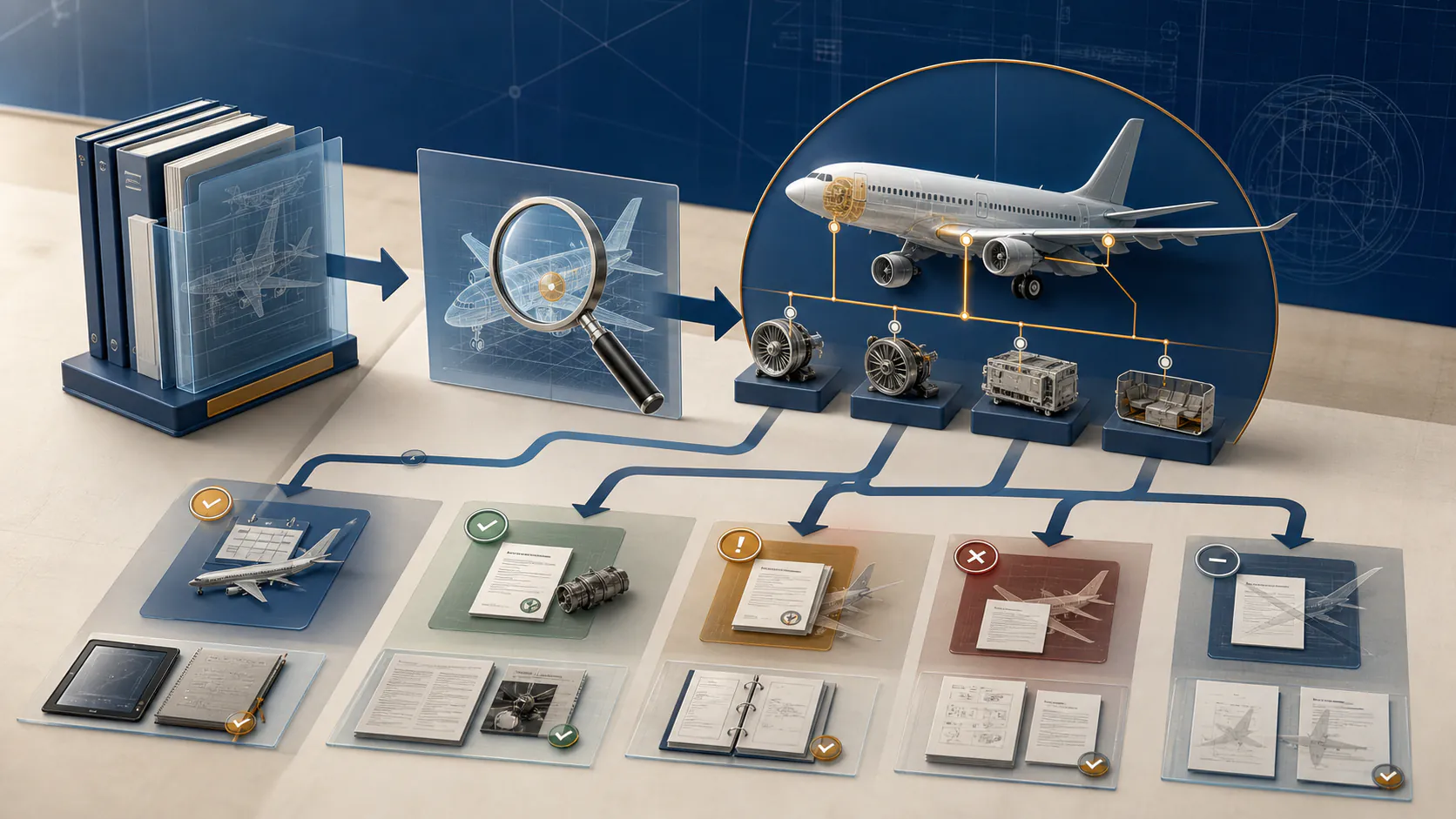
Manufacturers publish service bulletins to communicate inspections, modifications, replacements, operating changes, and other technical action. An operator may receive bulletins from the airframe, engine, APU, propeller, appliance, and component manufacturers for one aircraft.
The hard problem is not collecting PDFs. It is deciding which publication applies to the exact configuration, what obligation or risk it creates, whether the work was embodied correctly, and which source record proves the status.
Service bulletin, service letter, and Airworthiness Directive
| Publication | Typical issuer | Function | Binding effect |
|---|---|---|---|
| Service bulletin | Manufacturer or design approval holder | Inspection, modification, replacement, or technical instruction | Depends on AD incorporation, approved programs, rules, contracts, and context |
| Alert bulletin | Manufacturer or design approval holder | Higher-urgency technical action | Urgency does not itself determine legal status |
| Service letter / information letter | Manufacturer | Operational, maintenance, or support information | Context-specific |
| Airworthiness Directive | FAA | Legally enforceable unsafe-condition rule | Mandatory for affected products under Part 39 |
The FAA explains the distinction in its service bulletin guidance for aircraft owners. The FAA issues ADs under 14 CFR Part 39.
Do not use “mandatory,” “alert,” or “recommended” printed on a manufacturer document as the sole legal analysis.
For a worked example of a bulletin becoming mandatory through an AD, see How to Read Aircraft Logbooks. To see a real bulletin, a real AD and the logbook entry that records them, watch ADs, SBs and 8130s, on one real job.
When a service bulletin may require action
Evaluate whether the bulletin is:
- Incorporated by reference in an applicable AD.
- Required by an approved maintenance or inspection program.
- Required under applicable operating rules, operations specifications, or airworthiness limitations.
- Part of instructions for continued airworthiness with binding effect in the specific context.
- Required by an approved alternative method or special condition.
- Required by a lease, loan, insurance, warranty, power-by-the-hour, or maintenance-program agreement.
- Adopted by the operator’s safety or reliability program.
- Necessary to address a material safety, dispatch, supportability, or value risk.
Separate regulatory obligation from contractual obligation and from prudent technical action. All three matter, but they are not interchangeable.
Build the publication universe
Track publications for:
- Airframe make, model, series, serial range, and modification state.
- Each engine by model, serial number, build standard, and installed modules.
- APU.
- Propeller or rotor.
- Landing gear.
- Avionics, emergency equipment, and appliances.
- Serialized components whose manufacturers publish continuing-airworthiness information.
- Supplemental Type Certificates and other installed modifications.
Use controlled manufacturer portals and authoritative regulatory sources. Search results, old spreadsheets, and vendor summaries can help discovery but should not be the final source.
Core service bulletin fields
| Field | Why it matters |
|---|---|
| Issuer and publication number | Establishes identity |
| Title and subject | Supports review and search |
| Original and current revision dates | Shows revision history |
| Product and effectivity | Drives applicability |
| Category or recommendation | Adds manufacturer context |
| Related AD or regulation | Separates publication from legal obligation |
| Compliance recommendation | Frames timing, not necessarily legal mandate |
| Man-hours, material, and downtime | Supports planning |
| Applicability decision | Records whether the exact asset is affected |
| Disposition and rationale | Explains action, nonaction, or deferral |
| Embodiment evidence | Proves work performed |
| Follow-on or recurring action | Prevents a one-time closure from hiding future work |
Every status should have an owner, date, and source.
Applicability is configuration-aware
A model match is only the first filter. Review:
- Aircraft or component serial-number effectivity.
- Part number and modification status.
- Prior service bulletin embodiment.
- Installed optional equipment.
- Production incorporation point.
- STCs or field alterations.
- Engine build and module configuration.
- Geographic, environmental, or operating conditions.
- Concurrent or prerequisite bulletins.
- Whether an earlier or later revision provides credit.
“Not applicable by serial number” and “not applicable by configuration” are different decisions. Capture the basis precisely.
A defensible review workflow
- Ingest the authoritative publication and metadata.
- Identify affected product families and configurations.
- Screen the fleet using current serialized configuration.
- Review technical applicability for each uncertain asset.
- Check AD, program, contract, warranty, and lessor relationships.
- Disposition as applicable, not applicable, previously complied with, planned, deferred, or under review.
- Plan materials, engineering, downtime, and concurrent work.
- Embodiment through controlled maintenance.
- Verify the maintenance entry and supporting work package.
- Monitor revisions, supersedure, recurring work, and fleet changes.
Automate discovery and comparison. Keep qualified judgment and approval visible.
Disposition categories
Use categories with unambiguous meanings.
| Status | Required support |
|---|---|
| Not applicable | Effectivity/configuration rationale and reviewer |
| Open review | Owner, missing facts, and target date |
| Applicable, planned | Obligation/risk, planned package, timing |
| Deferred | Approved rationale, constraints, review date |
| Previously complied with | Exact evidence and revision/credit analysis |
| Complied with | Work record, date, time/cycles, configuration result |
| Recurring | Last completion and next due |
| Superseded | Successor publication and migration decision |
Avoid a bare “closed.” It does not say why no further action is expected.
Revision control
A new revision can:
- Expand or narrow effectivity.
- Change compliance thresholds.
- Revise material or instructions.
- Add a terminating action.
- Change credit for earlier work.
- Introduce concurrent requirements.
- Correct unsafe or impractical instructions.
On revision:
- Preserve the prior publication and decision.
- Compare effectivity, compliance, and work instructions.
- Identify previously screened or embodied aircraft.
- Determine whether earlier work receives credit.
- Reopen records that require review or follow-on work.
- Record the reviewer, date, and rationale.
Never replace the PDF in place and leave the old disposition attached to a new revision.
Relationship to Airworthiness Directives
The FAA’s AC 20-176A discusses service bulletins related to ADs.
When an AD references a bulletin:
- Determine applicability from the AD.
- Follow the AD’s required actions and compliance times.
- Use the exact incorporated material and permitted revisions.
- Check exceptions, differences, and definitions in the AD.
- Record the method of compliance to the AD itself. A bare “SB complied” entry does not document it.
- Track recurring action or terminating action under the AD.
- Document an approved alternative method of compliance when applicable.
The bulletin can contain the procedure; the AD defines the legal obligation.
Evidence of embodiment
A reliable completed status connects to:
- Signed maintenance entry.
- Work order and task card.
- Removed and installed part numbers and serial numbers.
- Accomplishment instructions and revision.
- Measurements, findings, or test results.
- Engineering or repair data.
- Required inspection or independent inspection.
- Weight and balance, equipment list, manual, or placard changes.
- Date and aircraft/component time or cycles.
- Follow-on inspection or continued-airworthiness task.
An invoice line is not a substitute for technical completion evidence.
Fleet-level control
For multiple aircraft, report:
- New publications awaiting screening.
- Applicable open bulletins by risk and recommended window.
- Aircraft with uncertain configuration.
- Materials and kits at risk.
- Bulletins efficient to combine with planned checks.
- Revisions that reopen prior decisions.
- Embodiment rate by fleet type.
- Repeat findings and reliability outcomes.
- Contractually required bulletins near redelivery.
Use the data to prioritize engineering and maintenance capacity, not to inflate a compliance percentage.
Transaction and lease review
Service bulletin status affects:
- Near-term maintenance spend.
- Aircraft commonality and marketability.
- Engine and component program coverage.
- Lease return conditions.
- Warranty and support.
- Modification standard.
- AD exposure.
- Downtime and parts availability.
A pre-buy review should compare the seller’s status report with current publications, exact configuration, and source evidence. “No open mandatory SBs” does not answer the broader commercial question.
Common failure modes
One spreadsheet for every revision
Rows lose the publication and decision history that made the status defensible.
Applicability by model only
Serial number, installed part, prior embodiment, and modification state can change the answer.
Closing an SB because a related AD is closed
The bulletin may contain work beyond the AD, while the AD may contain exceptions beyond the bulletin.
Accepting shop or vendor status without evidence
Reconcile the status to aircraft configuration and signed records.
Losing follow-on requirements
An initial inspection may lead to repetitive inspection, replacement, or life reduction.
Failing to review new installations
A component change can introduce publications that were previously not applicable.
Service bulletin audit checklist
- Publication universe covers aircraft and installed serialized products.
- Source and current revision are authoritative.
- Effectivity is checked against actual configuration.
- AD and approved-program relationships are explicit.
- Contractual and commercial obligations are separate fields.
- Not-applicable decisions include rationale.
- Embodiment status links to source evidence.
- Recurring and follow-on actions have next-due values.
- Revision changes reopen affected decisions.
- Configuration changes trigger rescreening.
- Fleet reporting exposes unknowns instead of counting them closed.
Sources and further reading
Common questions
Frequently asked questions
Are aircraft service bulletins mandatory?
Not automatically in every context. A bulletin may become mandatory through an Airworthiness Directive, an approved maintenance or inspection program, operating requirements, or another binding obligation. Contracts, warranties, lessors, and safety policy can also make accomplishment commercially or operationally necessary.
What should a service bulletin status report contain?
It should identify the publication and revision, affected product, applicability determination, technical and commercial disposition, compliance evidence, embodiment date and utilization, recurring or follow-on actions, and reviewer approval.
How are service bulletins different from Airworthiness Directives?
A service bulletin is generally manufacturer-issued technical information; an AD is a legally enforceable FAA rule under Part 39. An AD may reference or incorporate a bulletin, but compliance must satisfy the AD as written.
Should superseded service bulletins be deleted?
No. Preserve revision and decision history. A later revision can change effectivity, instructions, credit, or follow-on work, and reviewers need to understand which version supported an earlier disposition.
Keep researching
Related aircraft guides




Run maintenance from connected evidence
Know what is due, and open the record that proves it.
Radar reads every logbook back to birth and builds the due list from the signed entries, with the page behind every line.