

In brief
Aircraft records management software should preserve original documents, make their contents searchable, connect facts to the correct aircraft and component, maintain an audit trail, and let every extracted answer open directly to its source evidence.

Aircraft records are both an operating system and a chain of evidence. They show what work was performed, who approved it, which component was affected, what requirement was satisfied, and what becomes due next.
A file repository can store PDFs. A records management system goes further: it connects the pages into an aircraft history that maintenance, compliance, finance, and leadership can interrogate without losing the source.
What aircraft records management includes
The system should accommodate more than airframe logbooks:
- Airframe, engine, APU, and propeller logbooks.
- Work orders, task cards, discrepancy and corrective-action records.
- Inspection signoffs and maintenance releases.
- Airworthiness Directive and Service Bulletin evidence.
- Component cards and life-limited-part history.
- Major repairs, alterations, and FAA Form 337 records.
- Supplemental Type Certificates and instructions for continued airworthiness.
- Weight and balance and equipment lists.
- Approved maintenance program and manuals.
- Engine and APU program statements.
- Registration and FAA airworthiness records.
- Photos, borescope reports, teardown findings, and technical correspondence.
- Purchase, pre-buy, valuation, and lender diligence packages.
The exact retention obligations depend on aircraft, operation, authority, and record type. Build the system around the applicable requirements, not a generic folder template.
Records management versus document storage
| Basic document storage | Aircraft records management |
|---|---|
| A PDF lives in a folder | Each document is tied to aircraft, asset, date, and document type |
| Search depends on filename | Search finds text, fields, components, events, and related records |
| A spreadsheet carries status | Status links back to original evidence |
| Duplicate files proliferate | Versions and provenance are controlled |
| Sharing exposes a whole drive | Access can be scoped to tail, transaction, or task |
| Missing records are discovered late | Coverage and gaps are visible |
| Handoff is a bulk export | Review packages are assembled around the decision |
Folders are still useful, but they should not be the only structure holding the history together.
The core capabilities to evaluate
Source preservation
Keep the original scan or digital record intact. Preserve page order, image quality, signatures, stamps, and surrounding context. A derived summary should never replace the source.
Search and extraction
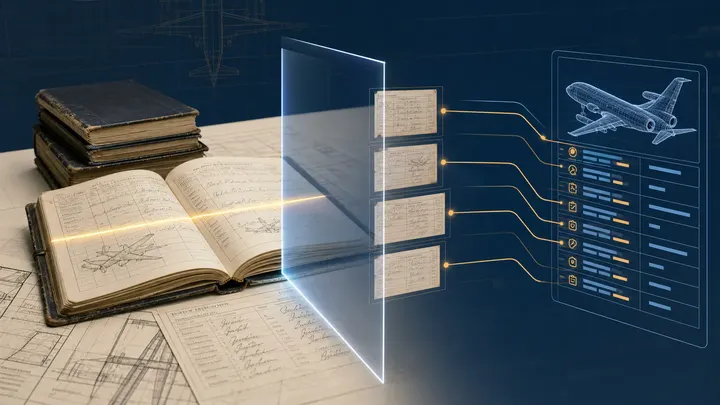
Search should work across handwritten and typed records alike; born-digital PDFs are the easy case. Extracted fields need confidence and reviewer workflow. Important facts should open to the exact supporting page.
Aircraft and component identity
The platform should distinguish the aircraft, each engine, APU, propeller, landing gear, and tracked components. Serial-number changes and installation history must not collapse into one ambiguous timeline.
Linked history
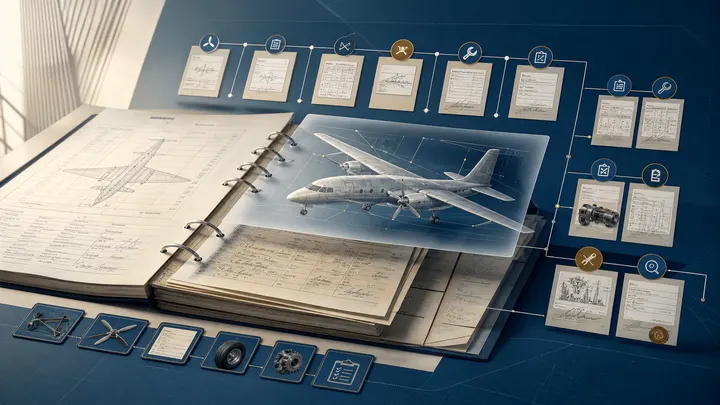
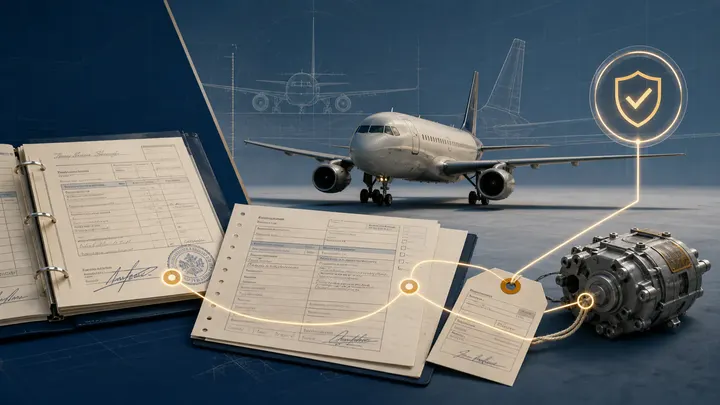
Maintenance often spans multiple documents: a work order, task card, repair approval, parts release, log entry, and return-to-service signature. Link them as one event without discarding their separate identity.
Exception management
Missing, conflicting, illegible, or unsupported information should remain visible. Reviewers need an owner, status, consequence, and resolution evidence for each exception.
Controlled sharing
An operator may share one tail with a repair station, a diligence package with a buyer, or a collateral view with a lender. Access should be explicit, time-bounded where appropriate, and auditable.
Export and continuity
Customers should be able to export original records and useful structured data. Avoid a system that creates lock-in by making the aircraft history difficult to retrieve.
Regulatory and recordkeeping foundation
14 CFR 43.9 describes the content and form of maintenance entries for work performed under that rule. 14 CFR 91.417 addresses maintenance-record retention and transfer for owners and operators under Part 91.
The FAA’s active AC 120-78B provides standards and guidance for electronic signatures, electronic recordkeeping, and electronic manuals. The advisory circular is guidance, and users must evaluate the rules and approvals that apply to their operation.
A practical aircraft records taxonomy
| Level | Examples | Why it matters |
|---|---|---|
| Aircraft | Registration, airworthiness, weight and balance | Defines the controlled asset |
| Powerplant | Engine and APU status, shop visits, programs | Major value and reliability exposure |
| Component | Part and serial, installation/removal, time | Establishes identity and life |
| Requirement | AD, inspection, ICA, program task | Defines why work is due |
| Event | Work order, finding, repair, test, return to service | Shows what happened |
| Evidence | Log page, task card, approval, release document | Proves the conclusion |
| Exception | Gap, conflict, illegible page, unsupported status | Focuses review effort |
This structure lets one source document support several connected facts while preserving the exact page.
Choosing aircraft records management software
Ask vendors to demonstrate a difficult real-world workflow, not a polished sample:
- Import an out-of-order, mixed-quality records package.
- Find a specific component serial number across multiple installations.
- Open an AD status item and trace it to the compliance entry.
- Show a conflicting total-time value and the review history.
- Assemble a pre-buy package without exposing unrelated aircraft.
- Export the source documents and structured index.
- Restore access after a simulated outage or accidental change.
Evaluate:
- OCR quality on the records you actually have.
- Human-review and correction workflow.
- Source traceability.
- Security, encryption, access control, and audit logging.
- Backup, recovery, and data portability.
- Integration with maintenance tracking and enterprise systems.
- Onboarding capacity and quality controls.
- Clear responsibility for original-record custody.
Implementation roadmap
Phase 1: inventory and protect
Identify every aircraft and records location. Stabilize fragile originals, define custody, and create backups before reorganizing.
Phase 2: digitize and index
Scan to a consistent quality standard, preserve order, classify documents, and connect them to the correct tail and component. Use the aircraft logbook digitization guide for acceptance checks.
Phase 3: normalize and review
Extract important dates, times, serial numbers, work orders, signatures, and statuses. Route low-confidence or conflicting facts to qualified review.
Phase 4: connect systems
Integrate maintenance tracking, work-order intake, vendor collaboration, valuation, and lender reporting. Decide which system owns each field and how corrections propagate.
Phase 5: operate the control
Assign records owners, intake deadlines, quality measures, access reviews, exception aging, and periodic recovery tests. A one-time migration will decay if new records arrive by email and stay outside the system.
Records-management operating checklist
- One accountable owner for records policy.
- Defined source-of-truth system by data type.
- Intake process for every shop and internal team.
- Scan and metadata acceptance criteria.
- Source links for status and extracted facts.
- Review queue for low confidence and conflicts.
- Role-based access and periodic access review.
- Tested backup and recovery.
- Portable exports.
- Gap and exception register.
- Retention schedule tied to applicable rules.
- Transaction and audit package templates.
Sources and further reading
Common questions
Frequently asked questions
What is aircraft records management software?
It is a system for storing, organizing, searching, linking, reviewing, sharing, and preserving the documents and structured facts that make up an aircraft’s operational and maintenance history.
Is records management the same as maintenance tracking?
No. Maintenance tracking focuses on requirements and due dates. Records management preserves the evidence that work occurred and connects documents, entries, components, approvals, and history. The two systems should work together.
Can aircraft records be kept electronically?
Electronic records can be used in aviation, but the applicable regulations, operating authority, company procedures, authenticity, accessibility, retention, backup, and FAA guidance must be evaluated for the operator and record type.
What should happen to the original scanned documents?
Preserve them. Structured data and summaries should link to the source page so reviewers can verify signatures, dates, certificate numbers, context, and return-to-service language.
Keep researching
Related aircraft guides

Run maintenance from connected evidence
Know what is due, and open the record that proves it.
Radar reads every logbook back to birth and builds the due list from the signed entries, with the page behind every line.