

In brief
Aircraft logbook digitization is a controlled records-conversion process. It should preserve every original page, prove capture completeness and legibility, index the correct aircraft and component, surface gaps, and produce a searchable system that still opens to source.
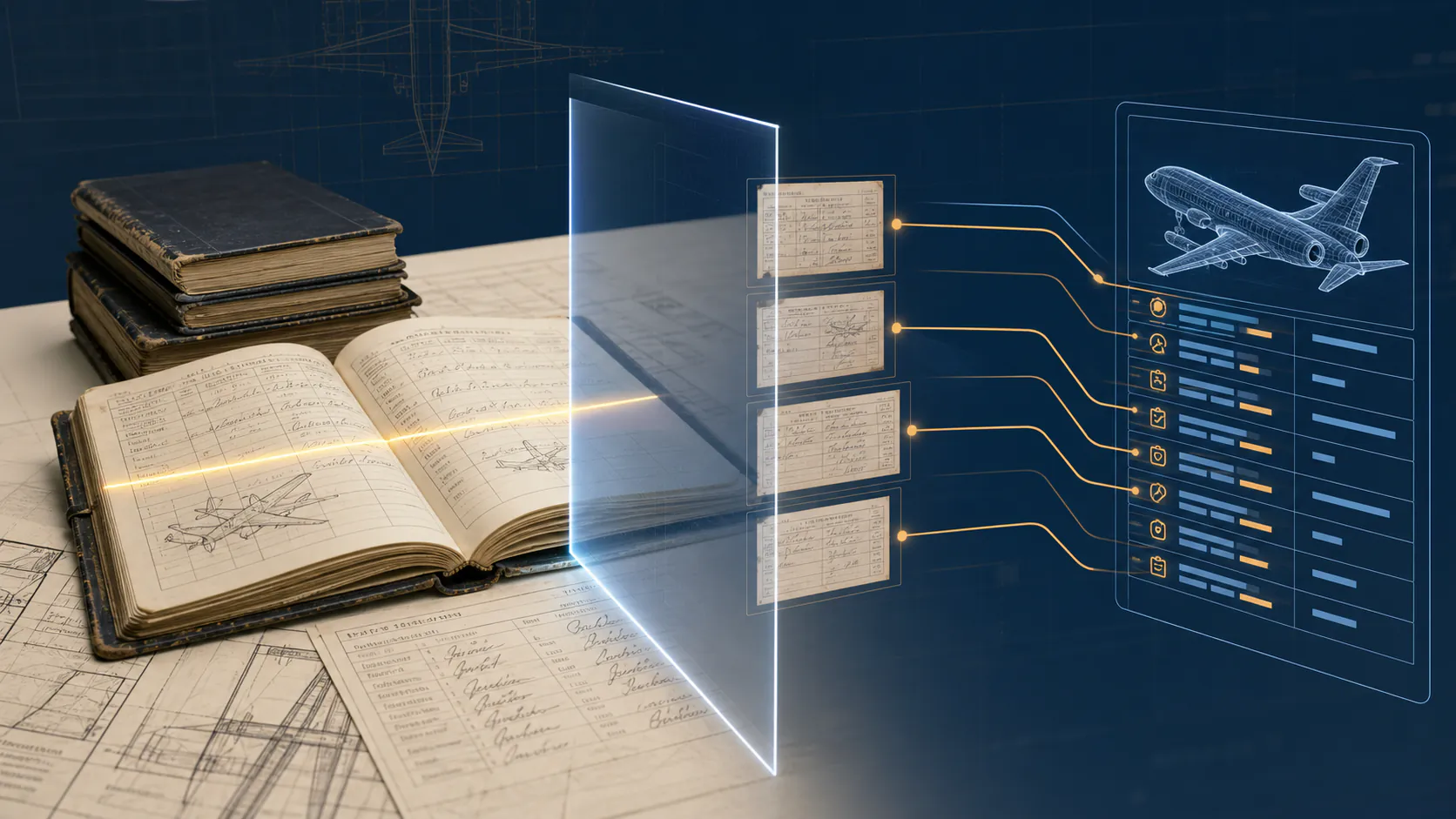
Aircraft logbook digitization protects fragile history and makes it usable. The process can support daily maintenance, audits, pre-buy diligence, financing, valuation, and resale, but only when capture quality and provenance are controlled.
The objective is a complete digital aircraft history with proof that no material page, component, signature, or context was lost. A folder of delivered PDFs falls short of that.
What a digitization service should deliver
- Inventory of received logbooks, binders, folders, and digital files.
- Chain of custody from pickup or shipment through return.
- Page-complete, legible images in preserved order.
- Searchable OCR text.
- Aircraft and component indexing.
- Document-type classification.
- Date, work-order, serial-number, time, signature, and event extraction where in scope.
- Gap, duplicate, conflict, and quality exceptions.
- Source-linked digital access.
- Secure backup and export.
- Return of original records under documented custody.
Radar digitizes more than bound logbooks, including manuals, STCs, FAA documents, work orders, task cards, and supporting technical evidence.
Before scanning: inventory and chain of custody
Assign each physical item an identifier before it leaves its current location. Record:
- Aircraft registration and serial number.
- Asset type, such as airframe, engine, APU, propeller, or component.
- Volume or binder label.
- Visible date range.
- Page or section count where practical.
- Physical condition and special handling needs.
- Existing gaps, loose pages, media, or inserts.
- Custodian, transfer date, carrier, and receiving confirmation.
Photograph the package and any damaged bindings. Use tamper-evident packaging and track every handoff for irreplaceable originals.
Preserve context and original order
Do not “clean up” the archive before documenting it. Dividers, tabs, envelope labels, handwritten cover notes, attached releases, and blank separator pages may establish context.
When pages are removed for capture, the process must preserve:
- Front and back.
- Exact page sequence.
- Attachments and foldouts.
- Bound-volume identity.
- Relationship between a small tag and its parent document.
- Original marks, stamps, colors, and signatures.
Scan-quality standard
Set acceptance criteria before production. Test representative difficult pages, including faint pencil, carbon copies, colored stamps, thermal paper, glossy photos, small certificates, edge writing, and damaged originals.
Quality control should verify:
- No clipped text, punch-hole obstruction, or missing edge.
- Correct focus and sufficient resolution.
- Readable handwriting, signatures, certificate numbers, and dates.
- Accurate color where color carries meaning.
- Correct orientation and deskew.
- Front and back captured where relevant.
- No fingers, shadows, glare, or page curvature obscuring content.
- Page count reconciled to the inventory.
- Files open, render, and export correctly.
OCR and searchable text
OCR makes records discoverable but should remain a derived layer. Aviation records contain handwriting, stamps, abbreviations, forms, part numbers, serial numbers, and low-contrast copies that challenge generic OCR.
Use search to find candidate evidence, then open the source page. Important extracted values should carry confidence and review status.
Indexing the aircraft history
At minimum, tag:
- Aircraft registration, manufacturer, model, and serial number.
- Asset: airframe, left or right engine, APU, propeller, component.
- Document type.
- Date or date range.
- Organization or repair station.
- Work order or tracking number.
- Part and serial numbers when relevant.
- Source volume and page.
Advanced indexing connects a log entry to its work package, component release, repair approval, AD requirement, and return-to-service evidence.
Quality control in three passes
Capture QC
Did every source item and page get captured in order and at accepted quality?
Content QC
Is the document attached to the right aircraft, component, date range, and type? Are pages grouped correctly?
Technical QC
Do critical times, serial numbers, inspections, ADs, LLPs, repairs, alterations, and signatures reconcile? This pass requires qualified aviation review for the intended use.
Handling common records problems
| Problem | Digitization treatment |
|---|---|
| Duplicate copy | Preserve, identify relationship, avoid double-counting an event |
| Faint or damaged page | Capture using approved settings, flag legibility, retain original |
| Mixed aircraft in one binder | Preserve order, index pages to the correct tail, flag ambiguity |
| Missing date range | Record the exact gap and search other record sources |
| Conflicting total time | Preserve both values, link sources, route for review |
| Loose certificate | Capture both sides and connect to its component/event |
| Oversize drawing | Capture at readable scale and preserve full-sheet context |
| Native digital file | Preserve original format and a stable viewable copy |
Security and privacy
Aircraft records may contain owner information, signatures, addresses, financial material, and operational detail. The service should use:
- Encrypted transfer and storage.
- Least-privilege access.
- Logged custody and system access.
- Controlled subcontractors.
- Secure temporary storage.
- Documented deletion of working copies after acceptance.
- Tested backup and recovery.
- Clear ownership and export rights.
Review the provider’s security practices before sending originals or a full fleet archive.
Delivery and acceptance checklist
Before accepting the project:
- Reconcile every inventory item as returned or intentionally retained.
- Confirm page counts and quality exceptions.
- Search representative names, serial numbers, dates, and handwritten entries.
- Open source pages from extracted results.
- Verify aircraft and component indexing.
- Export a complete records set.
- Test access roles and sharing.
- Review gap and conflict reports.
- Confirm backup and retention.
- Document the process for new records after cutover.
Digitization for a pre-buy or financing deadline
When a transaction is active, prioritize the material that controls the decision:
- Aircraft and component identity.
- Current times and cycles.
- Inspection status.
- AD status.
- LLP traceability.
- Engine and APU status and programs.
- Major repairs, alterations, and STCs.
- Damage and corrosion history.
- Title and registration coordination.
Keep the broader archive moving while the priority review produces an exceptions register for the buyer or lender. See Radar’s aircraft pre-buy records review and aircraft financing guide.
Sources and further reading
Common questions
Frequently asked questions
What is included in aircraft logbook digitization?
A strong service inventories the records, scans or imports every page, performs quality control, creates searchable text, indexes aircraft and component identity, organizes document types, surfaces gaps, and delivers source-preserving access.
Should aircraft logbooks be organized before scanning?
Preserve the original order and context first. Do not discard dividers, envelopes, blank pages with meaning, or duplicate-looking records until the digitization team has documented what they are.
What scan quality is required?
Quality should be high enough to reproduce fine print, handwriting, stamps, signatures, certificate numbers, and reverse-side bleed without clipping. Acceptance should be tested on the most difficult pages, not only clean samples.
What happens to the paper aircraft logbooks after digitization?
Custody depends on the operator’s procedures and applicable requirements. Preserve and return originals unless a qualified, documented process authorizes another disposition.
Keep researching
Related aircraft guides

Make the aircraft history decision-ready
Turn aircraft paperwork into evidence you can use.
Radar digitizes, connects, and verifies the maintenance history behind buying, financing, operating, and selling an aircraft.