

In brief
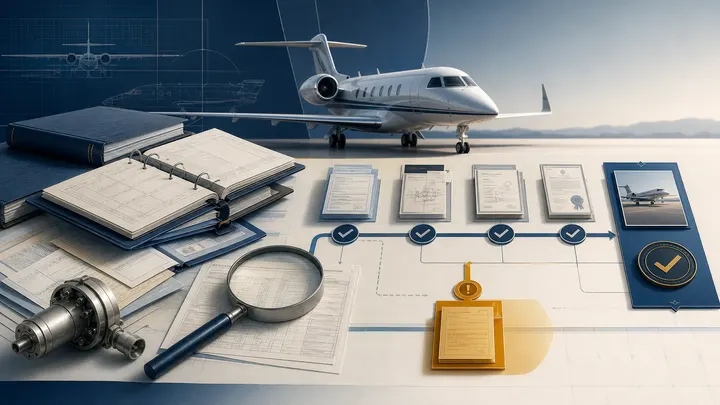
An aircraft records audit tests completeness, consistency, required status, and source support. It should produce a verified baseline, an exception register, a source index, and prioritized actions, not merely a reorganized data room.

An aircraft records audit asks a harder question than “Are the files organized?” It asks whether the aircraft’s identity, time, maintenance, compliance, component, and configuration history can be supported by retrievable evidence.
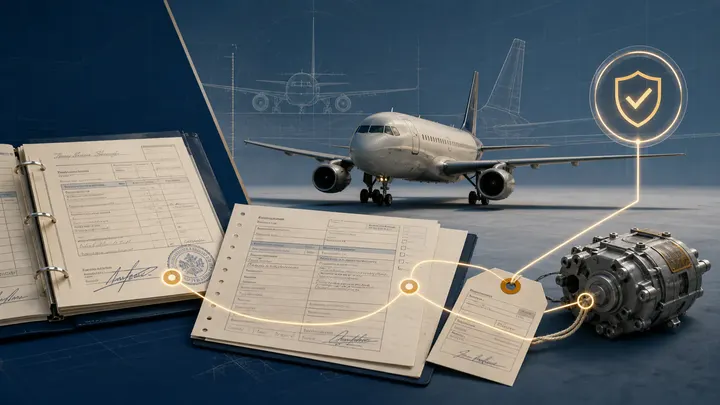
The audit should preserve the original records while producing a usable control layer above them. Every conclusion must open back to source, and every gap must remain visible until resolved or consciously accepted.
Define the audit objective
Scope changes with the decision:
| Trigger | Primary audit objective |
|---|---|
| Acquisition | Identify condition, status, value, and acceptance exceptions |
| Financing | Support collateral value, marketability, and closing conditions |
| Sale | Build a buyer-ready data room and resolve preventable gaps |
| Lease return | Test return conditions, records delivery, and compensation |
| Operator onboarding | Establish configuration and maintenance baseline |
| Program enrollment | Prove engine, APU, component, and utilization history |
| Internal control | Confirm current status and records-process performance |
| Recovery | Reconstruct fragmented or missing history without hiding uncertainty |
Write down the aircraft, components, date range, rules, program, transaction, and materiality threshold before review starts.
Stage 1: inventory every source
Create a custody and completeness inventory:
- Physical logbooks and binders.
- Scanned logbooks and indexed PDFs.
- Maintenance tracking exports.
- Work orders and task cards.
- Engine, APU, and component records.
- Parts tags and release documents.
- AD, SB, and inspection status reports.
- Major repair, alteration, STC, and engineering packages.
- Weight and balance and equipment lists.
- Program statements and shop-visit reports.
- FAA registry records and title material.
- Electronic records from shops, operators, and OEM portals.
Do not de-duplicate by deletion. Record duplicates and determine whether each copy has annotations, signatures, stamps, or page context that the other lacks.
Stage 2: prove aircraft and component identity
Verify:
- Registration and manufacturer serial number.
- Aircraft make, model, and series.
- Engine, APU, propeller, and major-component part and serial numbers.
- Installation and removal dates.
- Ownership or operator names used across the record.
- Registration-mark changes.
- Records accidentally belonging to another tail or component.
Identity errors cascade. A perfectly extracted engine time is useless if it belongs to the wrong serial number.
Stage 3: reconcile chronology, time, and cycles
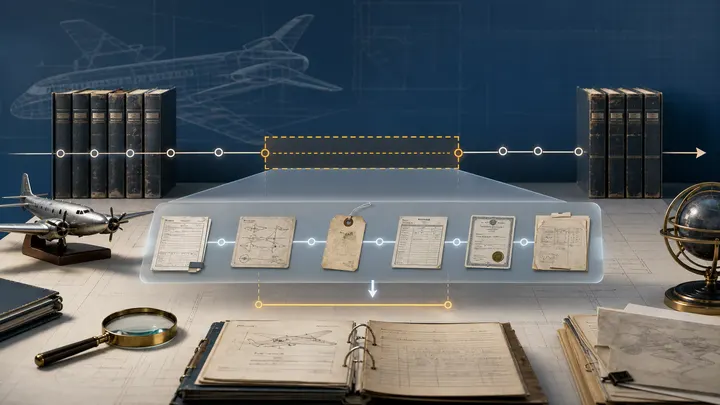
Build a timeline without forcing conflicts into one clean total.
For each relevant asset:
- Capture dated time and cycle observations.
- Identify increases that are physically impossible or unexpectedly flat.
- Reconcile shop-visit resets, replacements, and meter changes.
- Separate aircraft total time from component time since new or overhaul.
- Preserve source and calculation method.
- Escalate conflicts rather than averaging them.
Classify a value as source-stated, derived, corroborated, estimated, or unknown.
Stage 4: verify maintenance and inspection status
Review the applicable inspection or maintenance program and confirm:
- Current inspection status.
- Last accomplishment date, time, and cycles.
- Next due threshold.
- Grace or tolerance use where authorized.
- Out-of-phase tasks.
- Calendar, hour, cycle, landing, and event controls.
- Deferred discrepancies and corrective actions.
- Return-to-service evidence.
The tracker is an index to the status. The maintenance entry and work package are the evidence behind it.
Stage 5: Airworthiness Directive audit
For each applicable AD:
- Confirm exact product applicability.
- Record revision and supersedure.
- Identify method of compliance.
- Link accomplishment evidence.
- Determine recurring or terminating status.
- Calculate next due from the correct utilization basis.
- Identify any approved alternative method of compliance.
- Confirm incorporated service information.
Use current FAA sources, including the Dynamic Regulatory System, rather than relying only on a legacy spreadsheet.
Stage 6: life-limited parts and components
Audit:
- Part and serial number identity.
- Controlling life limit.
- Accumulated time and cycles.
- Each installation and removal.
- Prior aircraft or engine exposure.
- Remaining life calculation.
- Release certificates and trace documents.
- Repairs, overhauls, and modifications.
- Missing back-to-birth segments.
Do not present “remaining life” without the source chain that proves accumulated life. See the life-limited-parts tracking guide.
Stage 7: repairs, alterations, damage, and configuration
Reconcile:
- Maintenance entries.
- FAA Form 337 documents.
- STCs and approved data.
- Engineering orders and drawings.
- Instructions for continued airworthiness.
- Weight-and-balance revisions.
- Equipment list and flight-manual supplements.
- Physical installed configuration.
- Damage and incident references.
A modification is not complete in the records until its continuing requirements are reflected in maintenance planning.
Stage 8: programs and commercial status
For engines, APU, parts, warranties, and maintenance programs:
- Confirm contract holder and covered asset.
- Verify serial numbers.
- Review utilization reporting.
- Confirm payment and account standing.
- Identify excluded events or parts.
- Understand transfer, assignment, and termination conditions.
- Reconcile shop-visit invoices and credits.
“Enrolled” is not the same as fully paid, transferable, or fully covered.
Exception register
Every material issue should include:
| Field | Purpose |
|---|---|
| Identifier | Stable issue number |
| Asset | Aircraft, engine, APU, or component |
| Question | Exact fact or status at issue |
| Evidence | Source documents reviewed |
| Finding | Verified fact, conflict, or missing item |
| Consequence | Compliance, safety, value, finance, operation, or resale |
| Severity | Critical, high, medium, low, informational |
| Owner | Person responsible for resolution |
| Action | Research, inspect, correct, accept, reserve, or monitor |
| Due date | Transaction or operating deadline |
| Closure evidence | Source that proves resolution |
Closing an issue should require evidence, not a comment that someone “checked it.”
Audit deliverables
A best-in-class aircraft records audit produces:
- Signed scope and limitations.
- Source inventory and custody log.
- Aircraft and component identity table.
- Reconciled time and cycle timeline.
- Current inspection and maintenance status.
- AD status review.
- Life-limited-part and major-component review.
- Repair, alteration, damage, and configuration index.
- Program and contract observations.
- Exception register with priority and ownership.
- Source-linked evidence package.
- Acceptance baseline and review history.
Sources and further reading
Common questions
Frequently asked questions
What is an aircraft records audit?
It is a structured review of aircraft and component records to verify identity, continuity, maintenance and inspection status, AD compliance, life limits, repairs, alterations, configuration, and source support while documenting exceptions.
How is a records audit different from digitization?
Digitization captures and organizes source documents. An audit evaluates what the records prove, where they conflict, and what is missing. A well-scanned archive can still contain an unsupported status.
When should an aircraft records audit be performed?
Common triggers include acquisition, sale, financing, refinance, lease return, conformity, program enrollment, operator transition, fleet onboarding, insurance, and recovery from fragmented records.
What should an aircraft records audit deliver?
Deliverables should include scope, inventory, verified status, source links, exception register, risk classification, recommended actions, reviewer history, and a defined acceptance baseline.
Keep researching
Related aircraft guides

Run maintenance from connected evidence
Know what is due, and open the record that proves it.
Radar reads every logbook back to birth and builds the due list from the signed entries, with the page behind every line.