In brief
Missing aircraft logbooks are not one problem. A lost historical volume, missing current status, absent life-limited-part traceability, or unsupported major repair creates different regulatory, operational, value, and financing consequences. Recovery must distinguish verified evidence from assumptions.
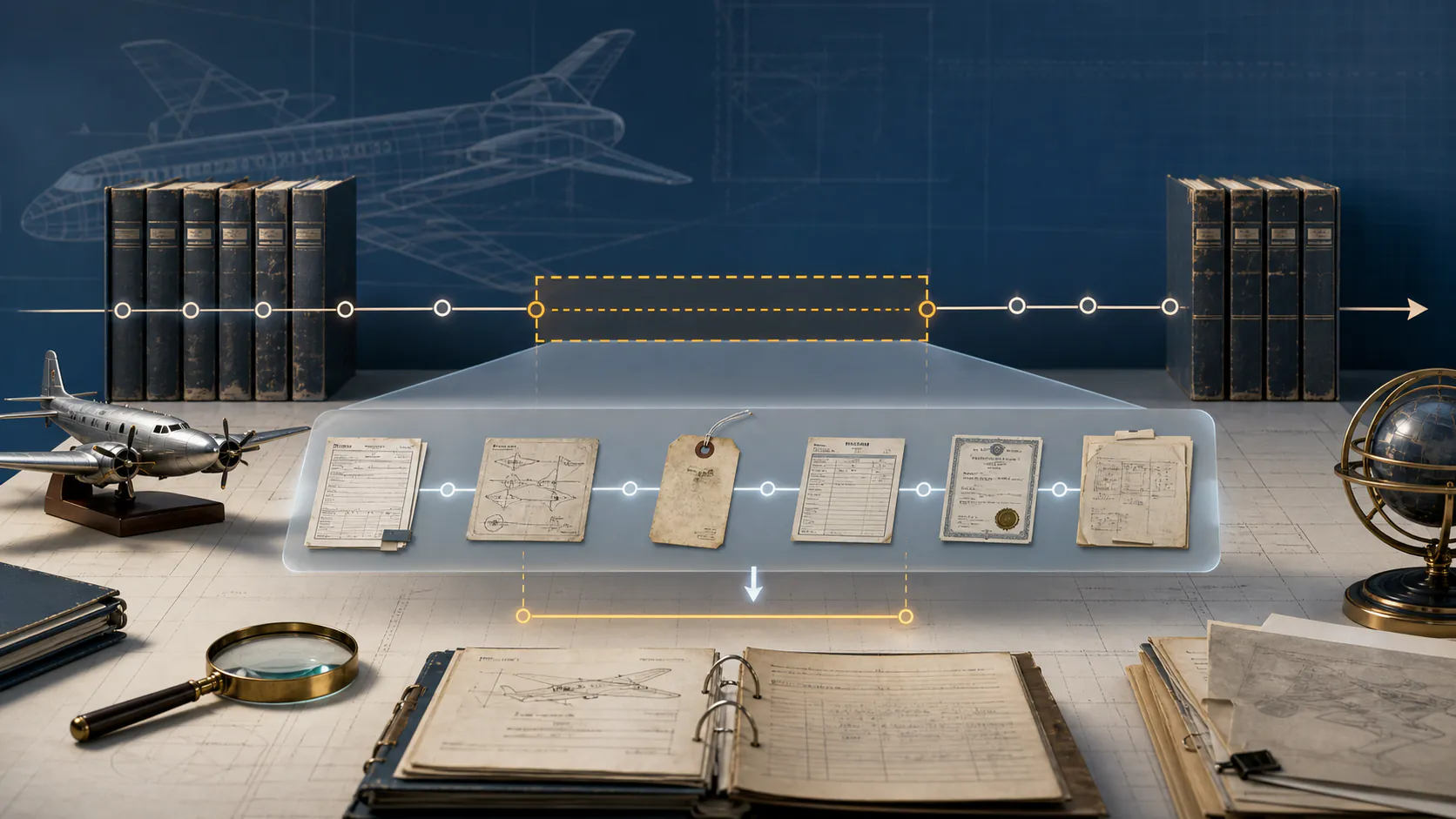
“Missing logbooks” can describe anything from one misplaced historical volume to an inability to prove the current status of a life-limited component. Those cases should not be treated alike.
The first task is to classify exactly what is absent, what the applicable rules require, what the market expects, and which facts can be independently verified. A reconstruction is an evidence project—not permission to fill a blank with the most convenient assumption.
Classify the records gap
| Gap type | Example | Primary concern |
|---|---|---|
| Historical continuity | Early airframe volume missing | Damage, time, repair, and ownership uncertainty |
| Current required status | Current AD or inspection status unavailable | Compliance and continued-operation risk |
| Component identity | Engine or part serial history incomplete | Wrong asset or unsupported installation |
| Life-limited-part traceability | Cycles or prior installation absent | Remaining life cannot be established |
| Major repair or alteration | Form, approved data, or support missing | Configuration and approval uncertainty |
| Work-package support | Summary entry exists but task evidence absent | Depth of proof and future diligence |
| Digital-capture gap | Original exists but scan omitted pages | Search and sharing problem, potentially recoverable |
Write a records exception that names the aircraft or component, date range, expected record, last known custodian, facts affected, and recovery owner.
Regulatory record requirements
For U.S. general operating and flight rules, 14 CFR 91.417 distinguishes records with different retention periods and identifies specified continuing-status records that must be retained and transferred at sale.
Relevant status includes, among other items described by the rule:
- Total time in service of the airframe, engines, and propellers.
- Current status of life-limited parts.
- Time since last overhaul for items required to be overhauled on a specified basis.
- Current inspection status.
- Current status of applicable Airworthiness Directives.
- Certain major-alteration forms.
Other operating rules, approved programs, contracts, and authority requirements may apply. The fact that a buyer wants more history than a narrow regulatory minimum does not make that market requirement legally identical to the rule.
Why missing records affect aircraft value
Aircraft value reflects expected future cash flow, cost, risk, and marketability. Missing records can create:
- Uncertainty about damage and major repairs.
- Inability to prove time or cycle accumulation.
- Reduced component or engine value.
- Additional inspection and research cost.
- Fewer willing lenders, insurers, buyers, or programs.
- Longer resale diligence and closing.
- A conservative assumption that work must be repeated.
Avoid generic claims that missing logs always reduce value by a fixed percentage. A valuation should identify the specific uncertainty and compare how the market treats that uncertainty for the aircraft and component involved.
Financing consequences
A lender may respond by:
- Requesting a deeper aircraft records audit.
- Requiring physical inspection or specialist review.
- Reducing accepted value.
- Lowering LTV or requiring more equity.
- Shortening maturity or amortization.
- Requiring correction, escrow, reserve, or covenant.
- Declining the aircraft.
A strong borrower may still receive credit approval while the aircraft fails collateral approval.
Build a recovery plan
Preserve what exists
Stop records from moving across email, boxes, and data rooms without control. Create an inventory, scan originals, record custody, and preserve page order and file metadata.
Contact prior custodians
Potential sources include:
- Prior owners and operators.
- Maintenance shops and repair stations.
- Aircraft management companies.
- Engine, APU, and component shops.
- OEM and program providers.
- Brokers, appraisers, and prior lenders.
- Title and escrow companies.
- Insurers and adjusters.
Request complete copies and supporting identifiers, not isolated screenshots.
Obtain FAA aircraft records
The FAA Aircraft Registry provides aircraft records and an electronic document retrieval service. Registry files may contain registration, airworthiness, security, and FAA Form 337 material, but they are not a replacement for the complete maintenance history.
Reconcile independent evidence
Compare recovered entries with:
- Work orders and invoices.
- Parts tags and authorized release certificates.
- Engine trend and program records.
- Flight and utilization records.
- Inspection status.
- Physical serial numbers and configuration.
- Logbook references in later entries.
Agreement across independent sources can strengthen confidence. It does not turn a later reconstruction into the missing original.
Life-limited parts require special care
When a life-limited part’s accumulated history cannot be established, the consequence may be more severe than a missing narrative logbook entry. Review 14 CFR 43.10, applicable life limits, maintenance instructions, and operating requirements with qualified professionals.
Never calculate remaining life from an unsupported “best estimate” and then present it as confirmed status. Track:
- Part and serial number.
- Life limit and controlling source.
- Each installation and removal.
- Accumulated time and cycles.
- Source document for each movement.
- Gaps, assumptions, and disposition.
Major repairs, alterations, and damage
Search FAA records for filed Form 337 documents, then reconcile them with log entries, approved data, STCs, instructions for continued airworthiness, weight and balance, equipment lists, and physical configuration.
An absence of a known damage entry is not proof that damage never occurred. Use the aircraft damage-history review to separate:
- Verified no-record search results.
- Documented repairs.
- Physical evidence without complete support.
- Allegation or oral history.
- Unknown periods.
Record reconstruction standard
A defensible reconstructed record should state:
- The question being answered.
- Original records that are missing.
- Sources located.
- Exact facts each source supports.
- Conflicts and unresolved gaps.
- Reviewer and review date.
- Confidence classification.
- Operational, valuation, financing, or maintenance consequence.
Use labels such as verified, corroborated, reported, estimated, and unknown consistently. Do not let polished formatting erase uncertainty.
Buying an aircraft with missing logbooks
Before signing or accepting:
- Define the gap precisely.
- Determine whether required current status can be established.
- Complete records and physical diligence.
- Obtain maintenance, appraisal, lender, insurer, and legal input.
- Price the known cost and residual uncertainty.
- Negotiate correction, credit, escrow, rejection, or acceptance.
- Preserve all recovered evidence and the buyer’s decision record.
- Assume a future buyer will repeat the same questions.
The purchase is not safer because the missing history is old. It is safer only when the current conclusion is supported and the remaining uncertainty is consciously accepted.
Sources and further reading
Common questions
Frequently asked questions
Can an aircraft fly with missing logbooks?
The answer depends on whether the owner or operator can establish and retain the records and current status required by the applicable rules and operation. Missing historical paper is different from being unable to prove required inspection, AD, life-limit, or return-to-service status.
How much do missing aircraft logbooks reduce value?
There is no universal percentage. The effect depends on what is missing, aircraft type, age, market, required status, component traceability, damage uncertainty, reconstruction quality, and buyer or lender appetite.
Can missing aircraft logbooks be reconstructed?
Some evidence may be recovered from prior owners, maintenance providers, FAA aircraft records, program providers, engine shops, parts records, invoices, and inspections. Reconstruction should identify source and confidence; it should never present an estimate as an original record.
Will a bank finance an aircraft with incomplete records?
Some lenders may, but missing records can reduce accepted value, require more equity or diligence, limit the structure, or make the collateral ineligible. The exact effect depends on the gap and lender policy.
Keep researching
Related aircraft guides



Make the aircraft history decision-ready
Turn aircraft paperwork into evidence you can use.
Radar digitizes, connects, and verifies the maintenance history behind buying, financing, operating, and selling an aircraft.