

In brief
A records problem should be evaluated by the facts it prevents a reviewer from proving, not by a universal missing-logbook discount. Classify the gap, current status, life-limit and repair support, corroborating evidence, inspection, reconstruction confidence, and market depth.
Tools for this decision
Run the numbers while you read.

A records exception is valuable when it states what is missing, which facts are affected, what evidence has been found, and which decision remains exposed.
“Logs missing” does none of that.
Use the assessment below to classify the gap and produce a recovery plan. The model intentionally avoids a fixed discount. Its value range is a sensitivity that helps size the diligence question; it is not an appraisal or airworthiness conclusion.
Interactive records-risk assessment
Translate a records exception into a diligence plan.
Classify what is missing, what can still be proven, and which transaction decisions remain exposed. The value range is a sensitivity, not an appraisal adjustment.
Priority recovery actions
This model intentionally avoids a universal “missing logs discount.” Its range is an illustrative sensitivity based on entered conditions. Airworthiness, remaining life, value, eligibility, and legal consequences require qualified aircraft-specific review.
Interpret the output correctly
The risk score is an ordering device. It increases when the entered conditions make important facts harder to establish:
- Current required status is unsupported.
- Life-limited-part history is incomplete.
- Known repairs or alterations lack support.
- A large part of relevant history is affected.
- Few independent sources exist.
- Physical inspection has not been scoped.
- The reconstruction depends on reported or estimated facts.
- The aircraft trades in a thin or specialized market.
The score decreases when source evidence, reconciliation, and inspection constrain the uncertainty. It cannot determine whether a specific record satisfies a rule, maintenance program, lender, buyer, insurer, or appraisal requirement.
Classify the exception before discussing value
| Exception class | Question it prevents | Possible consequence |
|---|---|---|
| Historical continuity | What occurred during the missing period? | Damage, repair, time, configuration, and market uncertainty |
| Current required status | Is the aircraft currently compliant with applicable inspections and directives? | Operational and eligibility problem |
| Life-limited-part traceability | What life has the controlled part accumulated? | Remaining life may not be established |
| Major repair or alteration support | Was known work performed and approved under the required data? | Configuration, continued airworthiness, and marketability issue |
| Component identity or time | Is the installed component the item described by the records? | Wrong asset, unsupported time, or maintenance exposure |
| Digital scan or organization gap | Does the original exist but remain hard to retrieve? | Review friction that may be recoverable without historical uncertainty |
Do not let a low-consequence scan omission and an unsupported life-limited part share the same exception label.
The aircraft records exception register
Create one row per distinct problem.
| Field | Required entry |
|---|---|
| Exception ID | Stable identifier used in reports, estimates, and closing documents |
| Aircraft or component | Registration, serial number, engine position, or part identity |
| Missing or conflicting evidence | Exact record, date range, event, or fact |
| Fact affected | Time, cycles, inspection, AD, repair, configuration, ownership, or condition |
| Last known custodian | Owner, operator, shop, program, OEM, broker, lender, or other source |
| Evidence located | Document name, date, source, and location |
| Confidence | Verified, corroborated, reported, estimated, or unknown |
| Physical follow-up | Inspection, serial verification, test, sampling, or disassembly |
| Transaction consequence | Value, eligibility, credit, correction, escrow, rejection, or acceptance |
| Owner and due date | Person responsible for the next evidence action |
| Disposition | Open, recovered, accepted exception, replaced work, or rejected |
This register should accompany the aircraft through diligence. Do not bury material exceptions inside a narrative report.
Recovery sources by question
| Question | Potential sources | What the source may establish |
|---|---|---|
| Aircraft and component identity | Physical plates, installation entries, shop records, program accounts | Serial identity and installation |
| Time and cycles | Later entries, utilization systems, flight logs, engine monitoring, program statements | Accumulation or boundary evidence |
| Inspection status | Status reports, signoffs, work orders, task cards, maintenance provider files | Scope, date, and approval |
| AD compliance | Current status, method references, work records, recurring-control evidence | Applicability and compliance history |
| Life-limited parts | Birth records, authorized release documents, movement history, shop packs | Identity and accumulated life |
| Repair or alteration | Log entries, Form 337, approved data, STCs, ICA, shop files, FAA records | Scope, approval, and continuing instructions |
| Damage | Repair files, physical inspection, insurance, prior appraisal, seller disclosure | Event and repair evidence |
| Engine or APU programs | Contracts, coverage statements, invoices, account standing, shop history | Enrollment, coverage, and economic exposure |
One source may prove only one fact. An invoice can support that work was billed without proving the approved return-to-service entry. A later summary can repeat a time without establishing the entire earlier accumulation.
A worked historical-continuity case
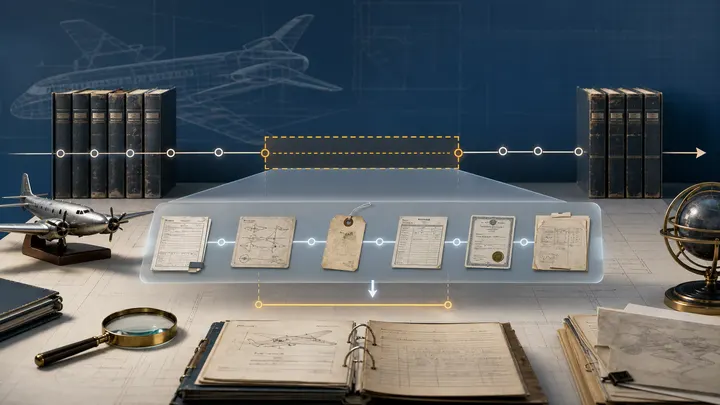
An aircraft has a missing early airframe volume. Current inspection and AD status are supported. Engine and life-limited-part histories are complete. FAA records and later log references identify one repair during the missing period, and the repair data has been recovered. A physical inspection finds the repaired area consistent with the documentation.
That is still a records exception, but the evidence constrains several important uncertainties. The correct output is not “complete logs” and not an automatic model-wide discount. It is:
- Early airframe volume absent.
- Current required status established.
- Controlled parts unaffected.
- Known repair recovered and physically reconciled.
- Residual uncertainty accepted or priced by the specific buyer, lender, and appraiser.
A worked life-limited-part case
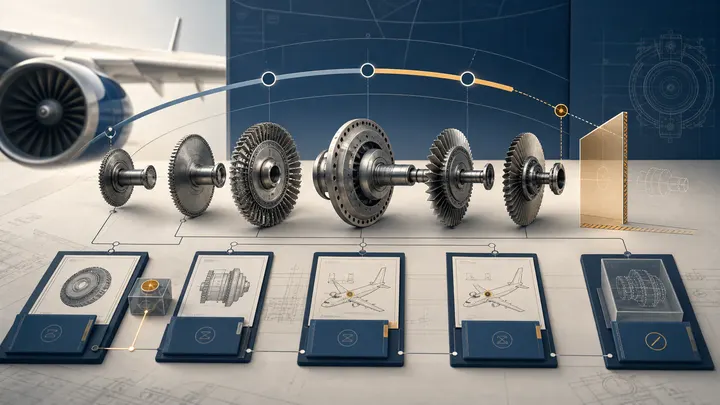
An engine has a life-limited part with incomplete prior installation history. A spreadsheet supplies an accumulated-cycle number, but the source documents for one movement are absent.
The exposure goes beyond value. Remaining life may be unsupported. The response may require source recovery, shop and program research, engineering or maintenance review, part replacement, or rejection. A clean physical inspection cannot reconstruct accumulated cycles.
The tool should show a high-consequence posture because the affected fact controls more than buyer comfort.
From risk score to transaction action
| Posture | Minimum response |
|---|---|
| Controlled exception | Preserve the exception, sources, reconciliation, and written acceptance |
| Material diligence required | Expand records and physical scope; obtain estimates; test value and lender structure; make the item a closing condition |
| High-consequence records risk | Stop relying on the affected fact; obtain qualified maintenance, legal, appraisal, lender, and insurer decisions before acceptance |
Possible commercial dispositions include:
- Seller correction before closing.
- Purchase-price credit.
- Escrow tied to a defined deliverable.
- Reperformance of unsupported work where appropriate.
- Component replacement.
- Reduced lender advance or additional equity.
- Specific acceptance of residual uncertainty.
- Buyer rejection.
The purchase agreement controls which remedies are available. The exception register should link the technical finding to the negotiated disposition.
The reconstruction standard
A defensible reconstruction package includes:
- The exact question being answered.
- The original evidence that is missing.
- Every source reviewed.
- The fact each source supports.
- Conflicts and unresolved periods.
- Physical observations.
- Confidence classification.
- Reviewer, date, and limitations.
- Operational, maintenance, financing, insurance, and value consequences.
- Written disposition by the authorized decision-maker.
Polished formatting must not upgrade evidence. Keep “verified,” “corroborated,” “reported,” “estimated,” and “unknown” visible in the final record.
What to do next
Download the assessment brief and attach it to the live exception register. Then use the missing aircraft logbooks guide to run the source-recovery process and the aircraft valuation guide to test the exception against current market evidence.
Sources and further reading
Common questions
Frequently asked questions
How much do missing aircraft records reduce value?
There is no universal percentage. The effect depends on what cannot be proven, aircraft and component type, current status, life-limit traceability, repairs, reconstruction quality, inspection results, market depth, and buyer or lender requirements.
Is the tool an aircraft appraisal?
No. The displayed range is an illustrative sensitivity for planning diligence. A qualified valuation must use current market evidence and aircraft-specific facts under stated assumptions.
Can reconstructed records replace original logbooks?
Recovered and corroborating evidence may support particular facts, but a reconstruction should identify its sources and confidence. It should not be presented as the missing original record.
What aircraft records gaps are most serious?
Inability to establish current required status, life-limited-part accumulation, component identity, or approval for known major work can have more direct consequences than a missing historical narrative volume. Every case requires aircraft-specific review.
Keep researching
Related aircraft guides


Make the aircraft history decision-ready
Turn aircraft paperwork into evidence you can use.
Radar digitizes, connects, and verifies the maintenance history behind buying, financing, operating, and selling an aircraft.