

In brief
Life-limited-part control is an identity-and-evidence problem before it is a calculation problem. A defensible status connects the exact part and serial number to its approved life limit, accumulated hours or cycles across installations, source records, current configuration, and controlled disposition when removed.
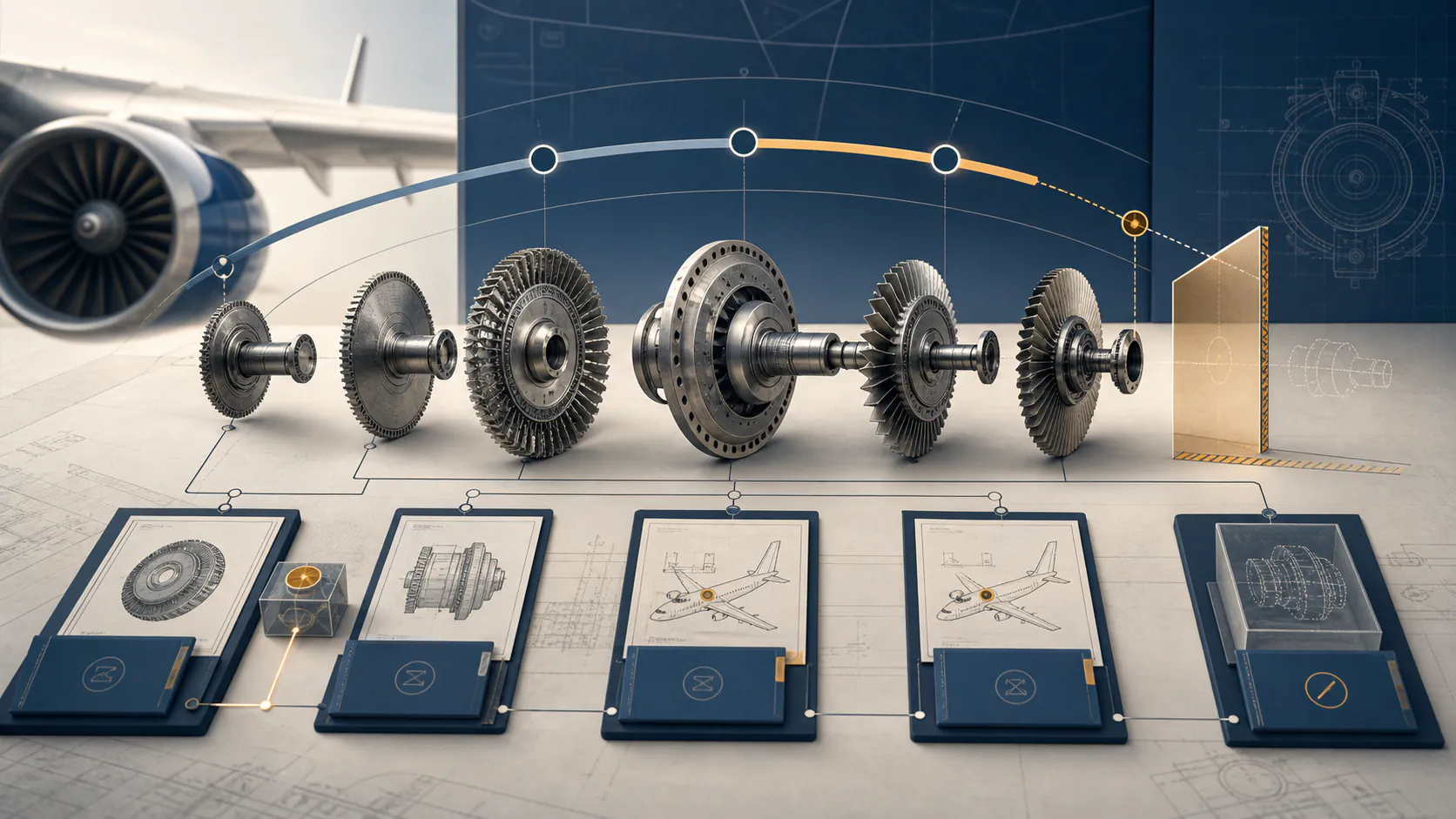
Life-limited parts deserve a higher standard than ordinary inventory. If identity or accumulated life cannot be established, a remaining-life calculation can look precise while resting on an unsupported assumption.
The control chain is:
approved limit → exact part identity → complete accumulated life → current installation → remaining life → controlled removal and disposition
Every link should resolve to source evidence.
What makes a part life-limited
A life-limited part has a mandatory retirement or replacement limit established in applicable approved airworthiness limitations or other approved data. Limits may be expressed in:
- Flight hours.
- Flight cycles.
- Landings.
- Starts.
- Calendar time.
- A combination or whichever-occurs-first rule.
- Mission, temperature, or severity-based usage where approved data establishes the method.
Do not infer a regulatory life limit from a recommended overhaul interval, commercial program threshold, or maintenance planning interval. Identify the governing approved source.
Life-limited versus time-controlled
| Category | Core control | Typical endpoint |
|---|---|---|
| Life-limited part | Mandatory approved life limit | Permanent removal before limit |
| Hard-time component | Overhaul, inspection, or replacement interval | Approved maintenance action resets or advances status as permitted |
| On-condition component | Continued service based on condition criteria | Removal when criteria are not met |
| Condition-monitored item | Performance or reliability trend | Maintenance decision under approved program |
The label changes the math and the permitted next action. Keep category and governing data explicit.
Minimum status fields
For each controlled part, capture:
| Field | Control question |
|---|---|
| Nomenclature | What is the article? |
| Part number and modification level | Which approved configuration? |
| Serial number | Which exact physical part? |
| Governing product | Airframe, engine, rotor, propeller, appliance |
| Approved life limit | What is the mandatory ceiling? |
| Limit source and revision | Where is the ceiling established? |
| Accumulated life | How much life has the part consumed? |
| Unit and basis | Hours, cycles, landings, calendar, or other |
| Current installation | Where is it installed now? |
| Installation date and utilization | When did current service begin? |
| Remaining life | Limit less supported accumulated life |
| Evidence status | Which records support identity and life? |
| Exceptions | Gaps, repairs, conversions, concessions, or unresolved facts |
Show the as-of date and parent-asset utilization alongside every remaining-life value.
The evidence hierarchy
Depending on the product and history, support may include:
- Original manufacturing or birth record.
- Airworthiness approval or authorized release certificate.
- Engine, module, or component log card.
- Installation and removal entries.
- Aircraft and engine utilization records.
- Shop visit and build records.
- Back-to-birth trace package.
- Prior operator status reports with their supporting records.
- Approved conversion or usage-factor records.
- Current physical part marking.
- Applicable life-limit source and revision.
No single document automatically proves the entire chain. Reconcile identity, time, and configuration across sources.
Back-to-birth trace
“Back to birth” is a commercial term often used for an unbroken record history from manufacture through current status. Exact expectations vary by asset, market, program, lessor, and jurisdiction.
A useful trace review asks:
- Does the chain begin with credible manufacturing identity?
- Is every installation and removal accounted for?
- Can parent-asset utilization be assigned to the part?
- Are overlapping, duplicated, or missing periods resolved?
- Do shop records preserve pre- and post-shop identity?
- Did any repair, modification, or part-number change affect the limit?
- Does the current physical marking match the records?
- Are all source documents legible, attributable, and internally consistent?
A stack of certificates is not an unbroken life history unless the periods connect.
Reconstructing accumulated life
Use a controlled reconciliation, not a single spreadsheet overwrite.
| Segment | Installed on | Start value | End value | Part usage | Source |
|---|---|---|---|---|---|
| 1 | Parent asset A | 1,240 cycles | 2,115 cycles | 875 | Installation/removal records |
| 2 | Shop/storage | n/a | n/a | 0 or documented | Shop records |
| 3 | Parent asset B | 4,100 cycles | Current | Calculated | Installation plus current utilization |
Validate:
- Units are consistent.
- Parent-asset meters did not reset or change basis.
- Dates do not overlap.
- Storage and shop periods are represented.
- Utilization is assigned only while installed.
- Conversion factors come from approved data.
- Previous-life values are not silently treated as zero.
If a segment is unsupported, flag the status. Do not manufacture continuity with an estimate presented as fact.
Remaining-life calculation
For a simple single-unit limit:
remaining life = approved life limit − supported accumulated life
Operational planning should also consider:
- Forecast utilization.
- Removal lead time.
- Planned shop-visit interval.
- Access opportunity.
- Mate or shipset policy.
- LLP kit availability.
- Lease return or sale horizon.
- Approved maintenance-program packaging.
The system should preserve both the regulatory remaining life and any earlier planning threshold.
Configuration changes and part-number evolution
A repair, modification, reidentification, or conversion may:
- Change the part number.
- Change the approved life limit.
- Require usage conversion.
- Add inspection requirements.
- Affect installation eligibility.
- Preserve or alter accumulated life.
Keep the pre-change identity, approved instruction, work evidence, post-change identity, and life-status calculation together. Never assume a new dash number creates a new part life.
Current-status record requirements
14 CFR 91.417 includes current status of life-limited parts among records retained and transferred with the aircraft. The rule describes status information including:
- Total time in service.
- Current status of each life-limited part.
- Time in service since last overhaul for items required to be overhauled on a specified basis.
- Other current status records identified by the rule.
Use the exact current regulation and applicable operating rules. A summarized report should link back to the records that support it.
Removal and disposition
14 CFR 43.10 governs disposition of life-limited parts removed from a type-certificated product. The purpose is to prevent installation after the mandatory life limit.
Depending on the circumstances and rule, acceptable controls can involve:
- Recordkeeping systems.
- Tagging or marking.
- Nonpermanent marking.
- Segregation.
- Mutilation.
- Other approved methods.
Review the exact rule before action. Preserve the part’s identity, status, removal event, and final disposition evidence.
Receiving inspection
Before accepting or installing a controlled part:
- Verify physical part and serial number.
- Compare part number, modification, and effectivity.
- Review release certification in context.
- Reconcile accumulated life and last parent asset.
- Confirm approved limit and source revision.
- Check AD, service bulletin, and repair status.
- Validate chain of custody and trace expectations.
- Look for altered, inconsistent, or duplicate records.
- Resolve gaps before the part enters available inventory.
Quarantine is a valid data status. “Received” should not imply “eligible.”
Engine and module control
Engine LLP tracking adds complexity because:
- Parts move between engines and modules.
- Shop visits can split and rebuild assemblies.
- Engine cycles may differ from aircraft cycles.
- Thrust rating or operational severity can affect approved calculations.
- Records can span operators, jurisdictions, and repair organizations.
- Lease and program terms may impose additional trace requirements.
Maintain the hierarchy from engine to module to part without losing the individual part’s history.
Transaction and valuation impact
LLP status directly affects:
- Remaining economic life.
- Upcoming shop-visit scope.
- Engine value.
- Maintenance reserve exposure.
- Lease return.
- Program enrollment and reimbursement.
- Parts eligibility and remarketability.
- Lender collateral assessment.
A transaction review should sample source trace rather than accept a color-coded LLP sheet at face value.
Common failure modes
Status without source
A remaining-life number is only as defensible as the identity and utilization chain beneath it.
Confusing release with full trace
A release certificate serves a specific purpose; it does not necessarily document all prior life.
Zero-time assumptions
Missing prior time must not become zero accumulated time.
Parent and child serial-number mismatch
An engine status sheet can be correct for the engine and wrong for an installed module or part.
Lost shop-visit continuity
Parts removed, inspected, repaired, and reinstalled need pre- and post-shop identity continuity.
Uncontrolled spreadsheets
Formula changes, overwritten cells, and multiple masters obscure the calculation history.
LLP audit checklist
- Exact part and serial number physically or independently verified.
- Life-limited classification and approved source confirmed.
- Current approved limit and revision captured.
- Manufacturing or earliest required identity evidence present.
- Installation/removal chain reconciled.
- Parent utilization supports every installed segment.
- Units and conversion methods controlled.
- Repairs and modifications reflected.
- Current installation matches the configuration.
- Remaining life includes an as-of date.
- Gaps are explicit and not converted into zero time.
- Removed-part disposition is controlled.
Sources and further reading
Common questions
Frequently asked questions
What is an aircraft life-limited part?
A life-limited part is a part for which a mandatory replacement limit is specified in applicable airworthiness limitations or other approved data. It must be removed from service before the approved life is exceeded.
What records are required for a life-limited part?
Under 14 CFR 91.417, the current status of each life-limited part must include specified life information and is retained and transferred with the aircraft. Exact requirements depend on the part, product, operator, and applicable rules.
Can an FAA Form 8130-3 prove a part’s full life history?
Not by itself. A release certificate can support specified identity and work facts, but full life status may require birth records, utilization and installation history, removal records, shop records, and reconciliation to the current configuration.
What happens when a life-limited part is removed?
14 CFR 43.10 requires controlled disposition to prevent the part from being installed after its life limit. Permitted methods and records should be reviewed under the current rule and organizational procedures.
Keep researching
Related aircraft guides



Run maintenance from connected evidence
Know what is due, and open the record that proves it.
Radar reads every logbook back to birth and builds the due list from the signed entries, with the page behind every line.