

In brief
Aircraft records OCR converts page images into searchable text and candidate structured fields, but quality varies by document and field. Operationally useful systems preserve source images, test representative records, expose confidence and conflicts, and add human review where consequences warrant it.
Tools for this decision
Run the numbers while you read.

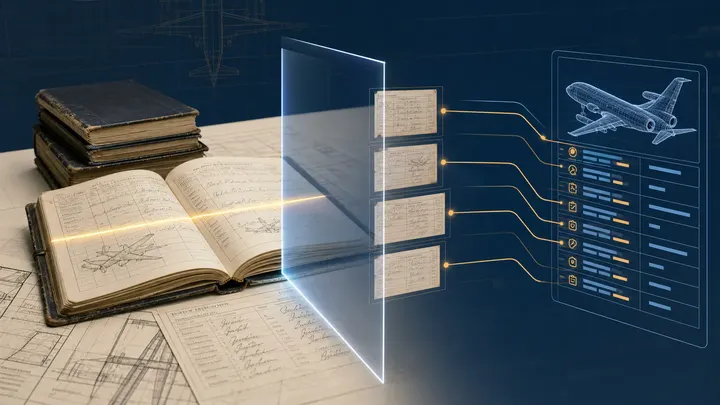
Aircraft records OCR solves a real but narrow problem: it converts pixels on a scanned page into machine-readable text. That makes search possible and can feed classification, extraction, and linking. It does not, on its own, understand the aircraft’s history or certify that a recorded fact is true.
A trustworthy implementation treats OCR as one stage in an evidence workflow. It accounts for every source page, measures the fields that matter, preserves context, and makes uncertainty reviewable.
What happens between paper and a searchable record
| Stage | Purpose | Common failure |
|---|---|---|
| Capture | Create a legible image of each page | Omitted reverse, blur, crop, glare, or wrong sequence |
| Preprocessing | Correct orientation, skew, contrast, and noise | Enhancement removes faint marks or separates context |
| OCR or handwriting recognition | Produce machine-readable text | Similar characters, spacing, and handwriting errors |
| Layout analysis | Understand tables, fields, checkboxes, and columns | Text is correct but attached to the wrong label |
| Classification | Identify log entry, work card, release, form, or report | Related pages are split or mixed document families collapse |
| Extraction | Identify dates, identifiers, times, and events | A plausible but wrong value becomes structured data |
| Linking | Connect related pages and events | A certificate is attached to the wrong work package |
| Review | Resolve uncertainty and accept results | Reviewers see a field without enough source context |
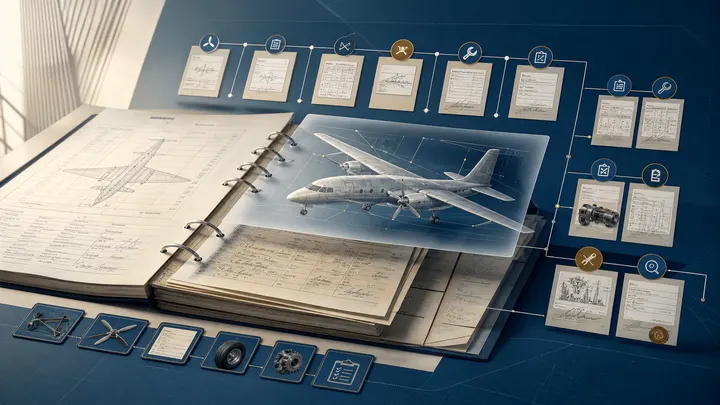
A dependable evidence workflow must address the later steps as well as search: structuring and connecting maintenance records while retaining access to their source evidence.
Why aircraft records are unusually difficult
Maintenance archives combine decades of formats and physical conditions:
- cursive and block handwriting from many authors;
- abbreviations, maintenance vocabulary, and compressed notation;
- faint carbon copies, thermal paper, microfilm, and photocopies;
- stamps, signatures, strikeouts, and margin notes;
- tables, checkboxes, multipart forms, and ruled log pages;
- similar part numbers, serial numbers, N-numbers, and certificate references;
- mixed airframe, engine, APU, propeller, and component records;
- repeated templates where the important meaning depends on a marked box; and
- work packages whose pages only make sense together.
A general OCR engine may read ordinary prose well while failing on 0/O, 1/I, decimal points, slashes, and handwritten serials. Those errors are small at the character level and large at the maintenance-decision level.
Accuracy should be measured around decisions
An overall character-recognition rate does not tell a records manager whether the system will find a component or preserve the correct total time.
Use a scorecard such as:
| Measure | What it asks | Why it matters |
|---|---|---|
| Page coverage | Was every source page captured and processed? | Missing text often begins with a missing page |
| Search recall | Are relevant pages found for representative queries? | A false negative can hide the evidence |
| Search precision | How much irrelevant material is returned? | Noise increases review time |
| Critical-field accuracy | Are dates, times, serials, and work orders correct? | These fields drive identity and chronology |
| Document grouping | Are pages belonging to one record kept together? | Context is lost when work packages fragment |
| Source-link accuracy | Does each result open the right page and region? | Review depends on traceability |
| Exception recall | Are low-confidence and conflicting values surfaced? | Silent certainty is more dangerous than an explicit gap |
Break results down by typed versus handwritten, document family, scan condition, and critical field. Report false positives and false negatives rather than averages alone.
OCR, extraction, and verification are different
Suppose a log page says a component with a particular serial number was installed at a recorded aircraft time.
- OCR converts the marks into text.
- Extraction proposes the serial, date, event, and time as fields.
- Linking associates the event with the component and related work order.
- Verification checks whether the source and surrounding evidence support the proposed facts.
Each stage can fail independently. Correct OCR does not prove the extracted field belongs to the correct label. Correct extraction does not prove the entry applies to the engine currently installed. A well-designed system preserves these distinctions.
Source evidence is the control
Every important search result or extracted value should preserve:
- the original page image or born-digital document;
- the page and surrounding record context;
- aircraft or component association;
- matched text or region;
- automated confidence or reason for review;
- reviewer correction and history; and
- related records supporting or contradicting the value.
Do not discard source images merely because searchable text has been generated. Retain or dispose of them under the applicable records, contract, and data-governance requirements; signatures, stamps, layout, corrections, and qualifiers may not survive plain-text conversion.
FAA AC 120-78B provides current guidance for electronic records and signatures. OCR of an old paper record is not the same as originating a controlled electronic record or electronic signature.
Human review should follow consequence and uncertainty
Review every character manually and automation saves nothing. Review nothing and consequential errors become invisible. A practical policy uses both uncertainty and consequence:
| Result | Example | Review treatment |
|---|---|---|
| High confidence, low consequence | Common typed vendor name used for search | Sample quality control |
| Low confidence, low consequence | Faded note that does not drive status | Queue if useful; preserve source |
| High confidence, high consequence | Typed life-limit value | Independent source and context check |
| Low confidence, high consequence | Handwritten serial or AD compliance date | Mandatory qualified review |
| Conflict across sources | Two total-time values | Exception with owner and resolution evidence |
The reviewer interface should show the image and proposed value together. It should not force the reviewer to search another system for context.
NIST’s AI Risk Management Framework treats accuracy as contextual and calls for risks to be measured and managed. Using field consequence to set review depth is an operational application of that principle, not an aviation compliance standard.
Build a representative acceptance set
Do not let a vendor choose only clean sample pages. Assemble a frozen test set that includes:
- typed and handwritten log entries;
- clean scans and genuinely degraded copies;
- airframe, engine, APU, component, and work-package records;
- tables, forms, stamps, checkboxes, and attachments;
- known serials, dates, hours, cycles, and certificate references;
- multi-page documents with expected boundaries; and
- deliberate duplicates, gaps, and conflicting values.
Have qualified reviewers establish expected results for the fields and relationships being evaluated. Keep a separate validation sample so configuration is not repeatedly tuned to the only test.
Buyer requirements for aircraft records OCR
Ask a vendor to demonstrate:
- page accounting from upload to output;
- image-quality flags and rescan workflow;
- typed and handwritten search on your records;
- filters by aircraft, component, document, and date;
- field-specific confidence and reviewer routing;
- direct navigation from result to source page;
- correction history without source alteration;
- conflict detection across related records;
- export of originals, text, fields, and review status; and
- measured performance on the representative acceptance set.
Also ask which models or subprocessors receive customer data, how customer data is retained, whether it is used for training, how access is controlled, and what happens when the processing provider changes.
OCR workflow for a real archive
Stabilize and inventory
Record every binder, box, file, and source system. Protect originals before production handling.
Scan to an acceptance standard
Control resolution, color, orientation, sequence, fronts and backs, and rescan rules. The aircraft logbook digitization guide covers this step in detail.
Process without losing identity
Associate batches with the correct tail and record group. Keep engine and component records separate until their identities are supported.
Classify and connect
Group multi-page documents, identify record types, and connect work orders, releases, entries, and component events.
Review high-risk outputs
Prioritize life-limited parts, AD evidence, component identities, major repairs and alterations, and value-sensitive chronology.
Monitor the live intake
Track missing pages, scan defects, unclassified records, correction rates, exception age, and source-link coverage. New record formats can change performance after launch.
Where OCR creates business value
“We ran OCR” is a processing step. The value shows up as:
- maintenance staff finding relevant history before opening an aircraft;
- reviewers tracing a due-status assumption to its record;
- owners answering lender or buyer questions without shipping binders;
- transaction teams identifying missing evidence earlier;
- analysts comparing structured events without losing source context; and
- records teams measuring unresolved exceptions instead of managing invisible folder debt.
Radar should be evaluated on those outcomes. Its role is to make records usable and reviewable, not to replace the qualified people responsible for technical conclusions.
Sources and further reading
Common questions
Frequently asked questions
What is OCR for aircraft records?
Optical character recognition converts text in scanned or photographed aircraft records into machine-readable text. It can support search, classification, and field extraction while the original image remains the source evidence.
Can OCR read handwritten aircraft logbooks?
It can read some handwriting, but performance varies widely with writing style, image quality, abbreviations, stamps, forms, and vocabulary. Important fields need representative testing and risk-based human review.
What is a good OCR accuracy percentage?
There is no single sufficient percentage. Character or word accuracy can hide errors in serial numbers, dates, times, and signatures. Measure the fields and decisions that matter, by document type and image condition.
Does OCR prove that a maintenance event occurred?
No. OCR produces a machine interpretation of a page. A reviewer must inspect the source, context, identity, signatures, and related records before relying on the information for a consequential conclusion.
How does Radar use OCR?
Radar uses document processing to help digitize, search, structure, and connect aircraft maintenance records while keeping results tied to source evidence and supporting review of uncertain or conflicting information.
Keep researching
Related aircraft guides


Run maintenance from connected evidence
Know what is due, and open the record that proves it.
Radar reads every logbook back to birth and builds the due list from the signed entries, with the page behind every line.