

In brief
Aircraft records management services can range from scanning to technical-records reconciliation and ongoing administration. A sound statement of work defines custody, scope, evidence standards, exceptions, acceptance, security, and portable deliverables.
Tools for this decision
Run the numbers while you read.

Aircraft records management services are often purchased when the archive has already become operationally expensive: a sale is approaching, a fleet is changing systems, boxes of paper need protection, or maintenance status cannot be reconciled quickly.
The label covers very different work. One vendor may scan and name files. Another may build a back-to-birth component history, administer continuing intake, or assemble a transition package. The right engagement begins with a written definition of the decision the records must support.
The service spectrum
| Service level | Typical work | Useful deliverable | Specialist judgment required? |
|---|---|---|---|
| Inventory and scanning | Count, prepare, scan, orient, and quality-check pages | Complete digital image set and inventory | Limited, unless record identity is ambiguous |
| Indexing and organization | Classify and associate documents to aircraft or components | Searchable archive and structured index | Aviation knowledge materially improves accuracy |
| Data extraction | Capture dates, times, serials, work orders, and signatures | Source-linked structured fields | Review needed for uncertainty and conflicts |
| Technical reconciliation | Trace configuration, compliance evidence, or component history | Status support and exception register | Yes; define reviewer qualifications and authority |
| Transaction support | Build buyer, lender, lessor, or return packages | Controlled diligence package and issue log | Usually multidisciplinary |
| Ongoing administration | Intake new records, check quality, index, and route exceptions | Current controlled archive and service metrics | Depends on responsibilities |
Do not buy “digitization” when the real requirement is reconciliation. Do not buy a broad technical review when a custody-controlled scan and index would solve the problem.
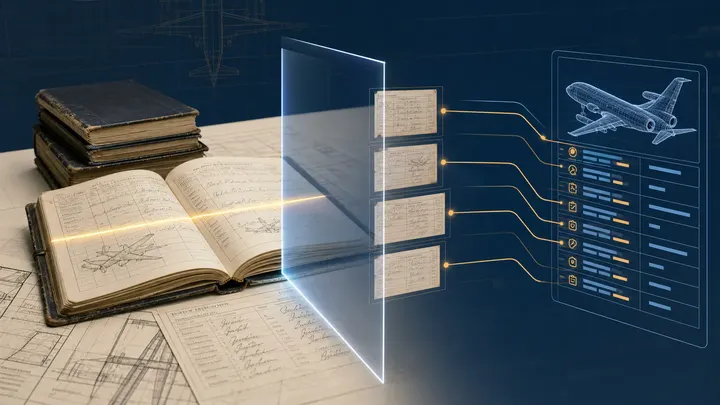
Radar is a software evidence layer. It can make maintenance records searchable, connect related documents, structure selected facts, and support review. It should not be represented as a full outsourced technical-records department unless a separate, explicit service offering and scope exists.
Define the outcome before the page count
Page volume determines workload, but it does not define success. A statement of work should name the intended outcome:
- protect a deteriorating paper archive;
- create a usable digital logbook for daily maintenance research;
- reconcile a maintenance-tracking baseline;
- prepare evidence for a pre-buy, financing, appraisal, or sale;
- support an aircraft lease transition or return;
- investigate missing or contradictory records; or
- establish ongoing intake and quality control.
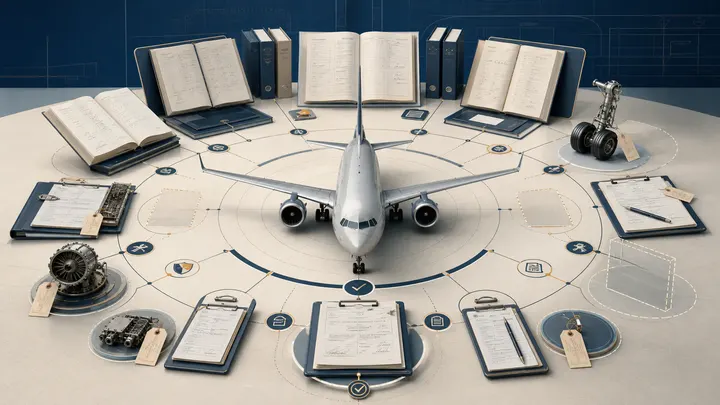
Then identify the material records. For one aircraft that may include airframe, engines, APU, propellers, landing gear, serialized-component records, work orders, task cards, AD and Service Bulletin evidence, FAA forms, repairs, alterations, instructions for continued airworthiness, weight and balance, and maintenance-program status.
A statement-of-work matrix
| Workstream | Scope question | Acceptance evidence |
|---|---|---|
| Custody | Who possesses originals at every handoff? | Chain-of-custody log and returned-item confirmation |
| Completeness | What containers, systems, and date ranges are included? | Reconciled inventory and documented gaps |
| Imaging | What scan quality and file rules apply? | Sample approval and page-level quality results |
| Classification | Which document types and asset identities are required? | Accuracy sample by document family |
| Extraction | Which fields are captured and at what review level? | Field-specific quality report and source links |
| Reconciliation | What conclusions must be supported? | Reviewer-approved result and exception register |
| Sharing | Who can see which records and for how long? | Role matrix, activity history, and revocation test |
| Export | What leaves the system at completion? | Tested original, index, metadata, and issue exports |
Include assumptions about handwriting, languages, microfilm, foldouts, duplex pages, photographs, media, duplicate sets, and offsite archives. These conditions affect both price and quality.
Records inventory and chain of custody
Before scanning, create a control list for every binder, box, loose group, digital folder, and external source. Give each container an identifier and record:
- aircraft or component association;
- visible date range and volume label;
- page or document estimate;
- condition and special handling;
- origin, current custodian, and destination;
- transfer date and receiving confirmation; and
- known missing volumes or related systems.
For irreplaceable originals, ask whether work occurs onsite, how transportation is secured, how access is logged, and how physical damage or loss is handled. Back up existing digital files before renaming or reorganizing them.
Scanning and digitization acceptance
A professional scan project needs objective acceptance criteria:
- no omitted fronts, backs, foldouts, inserts, or attachments;
- readable handwriting, stamps, signatures, and faint carbon copies;
- correct orientation, cropping, and page sequence;
- appropriate color treatment where color carries information;
- no destructive enhancement that obscures the source;
- file and folder naming mapped to the inventory;
- duplicate and rescan handling; and
- agreed delivery and backup formats.
Sample every document family, operator location, scanner, and production period. A low overall defect rate can still hide systematic omissions of blank-looking reverse pages or faint entries. The aircraft logbook digitization guide offers a deeper control plan.
Technical indexing, extraction, and reconciliation
Indexing should support how reviewers search, not merely mirror binder labels. Useful dimensions include:
- aircraft and registration;
- engine, APU, propeller, landing gear, or component identity;
- document type and event;
- work or compliance date;
- part and serial number;
- work order or task reference;
- maintenance provider; and
- linked source pages.
Extraction can accelerate review, but no provider should silently convert ambiguous handwriting or conflicting times into a definitive field. Require visible confidence or review status, retained source images, and correction history.
Technical reconciliation is a separate professional deliverable. Define the qualifications of reviewers, the standards and source hierarchy they use, what constitutes sufficient support, and who accepts unresolved exceptions. The engagement should not blur clerical organization with regulatory authority.
Transaction and transition support
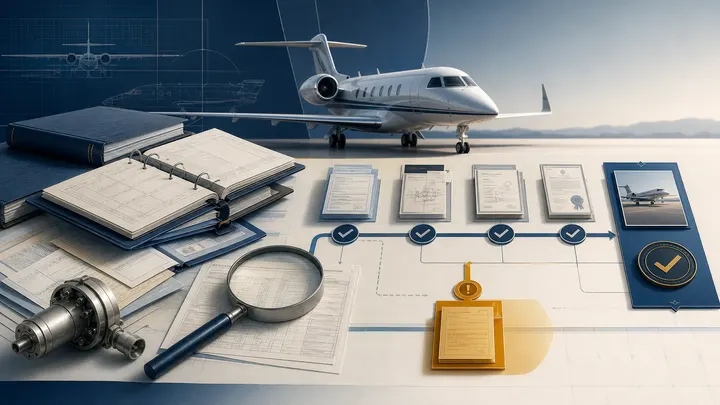
A sale, purchase, financing, appraisal, or lease transition requires a decision-specific package. The technical records portion may include:
- current status reports and source support;
- aircraft, engine, APU, and component history;
- AD and major inspection evidence;
- life-limited-part and time-controlled-component trace;
- repairs, alterations, damage history, and approvals;
- maintenance-program and engine-program records;
- open discrepancies and planned maintenance;
- missing-record and conflict register; and
- a frozen package representing what was reviewed.
This does not replace title, escrow, legal, tax, insurance, physical inspection, or regulatory work. For acquisition workflows, pair it with an independent aircraft pre-buy records review.
Ongoing records administration
A migration decays if new records keep arriving through email, paper, vendor portals, and shared drives. An ongoing service should specify:
- authorized intake channels and deadlines;
- completeness checks for new work packages;
- association to the correct aircraft and component;
- extraction and review responsibilities;
- exception routing and escalation;
- integration with maintenance tracking;
- retention, backup, and access reviews; and
- return or disposition of originals.
Useful service measures include intake age, rejected-package rate, open exceptions by consequence, correction rate, source-link coverage, and time to retrieve evidence.
Security, confidentiality, and portability
Aircraft records can expose ownership, travel, maintenance findings, vendor pricing, personnel data, and transaction information. Ask the provider about:
- personnel access and background practices;
- authentication, encryption, audit logs, and least privilege;
- customer separation and subcontractors;
- secure transfer and physical media;
- incident response and notification;
- backup, recovery, and retention;
- data location where relevant; and
- deletion and certification after the engagement.
The exit requirement is equally important. Customers should be able to obtain original documents in usable structure plus the agreed index, structured fields, relationships, and exceptions. A service that produces only a proprietary portal can create a new records risk.
How to evaluate providers
Run a paid or controlled pilot on representative material. Include a faded handwritten entry, a multi-document work package, a component swap, duplicate pages, an ambiguous identifier, and a genuine conflict.
Score:
- inventory completeness;
- image quality;
- classification and asset association;
- extraction accuracy by critical field;
- source traceability;
- exception visibility;
- review workflow;
- security and access;
- export usability; and
- communication and issue resolution.
Require providers to separate automated results, human-reviewed results, and technical conclusions. Ask for references with similar aircraft, document condition, volume, and outcome, not merely the same industry label.
Buyer questions that prevent scope failure
- Exactly what is included per page, record, aircraft, and month?
- Which steps are automated, clerical, or performed by qualified technical reviewers?
- Who defines and accepts aircraft and component identity?
- How are unreadable, missing, duplicate, and contradictory records reported?
- What quality sample and rejection thresholds apply?
- Who owns rescan and remediation cost?
- Can every extracted fact open to its source?
- What is expressly excluded from technical or regulatory conclusions?
- What data and files do we receive on demand and at termination?
- How is ongoing intake measured after the initial project?
The strongest service defines each responsibility, preserves the evidence, reports uncertainty, and delivers a result another qualified reviewer can inspect. A promise to “handle everything” is a warning sign.
Sources and further reading
Common questions
Frequently asked questions
What do aircraft records management services include?
Depending on the provider and statement of work, services may include records inventory, scanning, indexing, metadata capture, aircraft and component reconciliation, exception reporting, transaction support, and ongoing intake administration.
Is scanning the same as technical records management?
No. Scanning creates digital images. Technical records management may also classify records, connect them to aircraft and components, reconcile statuses, identify exceptions, and maintain an ongoing controlled archive.
Can a records provider determine that an aircraft is compliant?
A qualified provider may evaluate a defined requirement under a written scope, but a platform or clerical service does not make a blanket compliance or return-to-service determination. Responsibility depends on the applicable rules, operation, and authorized people or organizations.
What should the customer receive at the end of a project?
For a scanning or migration engagement, the customer should receive the agreed source-image files, usable index, documented exceptions, quality and acceptance results, and portable export. Other service engagements should define equivalent decision-ready deliverables, with technical conclusions and structured data linked to source records.
Does Radar provide outsourced records administration?
Radar is a software platform for digitizing, connecting, searching, structuring, and supporting verification of aircraft maintenance records. Any implementation or service scope should be confirmed separately and should not be assumed from the platform’s records capabilities.
Keep researching
Related aircraft guides

Run maintenance from connected evidence
Know what is due, and open the record that proves it.
Radar reads every logbook back to birth and builds the due list from the signed entries, with the page behind every line.