

In brief
A lease-return records package should prove the agreed delivery condition with source-linked evidence. Start with the signed lease and amendments, map every records obligation, and preserve explicit dispositions for gaps.
Tools for this decision
Run the numbers while you read.

An aircraft lease return is a contract performance exercise supported by technical evidence. The return package must show that the specific aircraft, engines, components, configuration, and maintenance position meet the signed lease, not a generic idea of “redelivery condition.”
Use this checklist to organize the work. Then replace every generic item with the actual lease clause, amendment, side letter, governing requirement, and written agreement between the parties.
Build the controlling return matrix
Read the entire contract set before collecting documents. Return conditions may be changed by delivery certificates, amendments, waivers, consent letters, insurance settlements, maintenance-contribution agreements, and later correspondence.
| Matrix field | Required entry |
|---|---|
| Requirement ID | Stable control number |
| Controlling text | Exact lease or amendment citation |
| Asset | Aircraft, engine, APU, landing gear, or component |
| Test date | Return date, inspection date, or utilization cut-off |
| Evidence | Required document and source |
| Owner | Party producing and reviewing |
| Status | Open, submitted, questioned, accepted, or reserved |
| Disposition | Cure, alternate evidence, payment, waiver, or rejection |
Keep regulatory and contract columns separate. A record may meet the applicable retention rule and still fail a negotiated return requirement.
Set a realistic return timeline
The IATA aircraft-leasing guidance recommends early coordination and notes that older-aircraft records can require more review time. A practical schedule works backward:
- Long-range planning: freeze the contract matrix, forecast status at return, and identify high-risk trace gaps.
- Pre-induction: agree inspection, records-review, test-flight, MRO, access, format, and communication protocols.
- Return check: control findings, non-routines, parts, engineering, and records production daily.
- Final review: reconcile utilization, status, configuration, open items, and agreed compensation.
- Delivery: freeze the final index, transfer media and access, execute receipts, and preserve retained copies.
Do not leave records compilation until the maintenance check closes. Work packages and trace documents are easiest to correct while the issuing organization is still engaged.
Aircraft identity and delivery baseline
- Manufacturer, model, serial number, registration, and operator match.
- Engine, APU, landing-gear, propeller, and controlled-component identities reconcile.
- Delivery condition and accepted delivery exceptions are indexed.
- Registration and operator changes are chronologically documented.
- Hours, cycles, and other utilization measures reconcile from delivery through return.
- No records from another tail or component remain in the package.
- Return-time assumptions in maintenance-adjustment calculations match final utilization.
Use a cut-off statement that records the final aircraft and component totals, source, timestamp, and sign-off.
Maintenance program and current status
- Approved or accepted maintenance program and revision history are present.
- Current scheduled-maintenance status identifies last accomplishment and next due.
- Out-of-phase tasks, escalations, tolerances, and bridging checks are supported.
- Airworthiness Directive status includes applicability, method, recurring due, and source evidence.
- Service Bulletin status meets the lease definition, not an assumed industry convention.
- Deferred defects and carry-forward items are listed with allowed disposition.
- Recent maintenance releases and detailed work packages are complete.
- Return check findings and non-routines reconcile to the final release.
A tracking-system report is a status view. Material statuses should remain traceable to the maintenance records and other source evidence that support them.
Engines, APU, landing gear, and LLP trace
For each controlled asset:
- Part and serial numbers match physical and records identity.
- Time and cycles since new, overhaul, or event reconcile.
- Shop-visit reports, release certificates, and build records are included.
- Life-limited-part status shows the controlling limit and accumulated life.
- Installation and removal history connects every relevant life segment.
- Program enrollment, payment, transfer, and utilization reporting are current where required.
- Hard-time and on-condition component statuses meet the contract.
- No-borrowed-parts or replacement-parts requirements are resolved.
“Back-to-birth” is a commercial traceability expression, not one universally identical regulatory package. Apply the lease definition and agreed IATA or other industry methodology. Record any break in the chain; do not convert it into an unsupported zero-time assumption.
Repairs, damage, modifications, and configuration
- All damage events and required notices are indexed.
- Repair records link the finding, approved data, accomplishment, inspections, and continuing requirements.
- Major repairs or alterations have the required jurisdiction-specific forms and approvals.
- Supplemental type certificates, engineering orders, drawings, and ICAs are complete.
- Lessor consents and restoration obligations are satisfied.
- Weight and balance, equipment list, wiring, manuals, and supplements reflect final configuration.
- Cabin, avionics, connectivity, livery, and mission equipment match the return definition.
- Repeat inspections or operating limitations are in the maintenance program.
An insurance settlement or lessor consent does not replace the technical substantiation for the repair.
Components, parts, and commercial trace
The lease may require documentation beyond the regulatory floor:
- Release certificates match part and serial numbers.
- Authorized-release status and issuing organization are clear.
- Installation eligibility and interchangeability are confirmed.
- Previous-operator, non-incident, or commercial trace statements are supplied when contractually required.
- Shelf-life and storage controls are current.
- PMA parts, DER-approved repair data, or other alternative-part restrictions are addressed.
- Removed parts and loose equipment are accounted for.
- Theft, sanctions, and export-control documentation is addressed where applicable.
Do not label a commercial trace statement as an airworthiness approval. Different documents answer different questions.
Manuals and operational records
Confirm the required revision and delivery format for:
- Aircraft, engine, APU, and component manuals.
- Flight manual and supplements.
- Maintenance planning data.
- Illustrated parts and wiring information.
- Structural repair and corrosion-control documents.
- Minimum equipment and configuration deviation material where applicable.
- Weight and balance, loading, and equipment lists.
- Technical log and journey records required by the lease.
- Noise, radio, airworthiness, and other certificates in scope.
Licensed technical publications may be access rights rather than transferrable files. Agree how subscriptions and portals will transition.
Build the return data room
Use an index that another team can navigate without the preparer:
| Index field | Purpose |
|---|---|
| Control ID | Stable reference used in comments and acceptance |
| Document title/type | Human-readable description |
| Asset and serial | Prevents cross-tail contamination |
| Event/effective date | Places evidence in chronology |
| Requirement links | Lease clause and applicable status |
| File/version | Exact retrievable source |
| Reviewer status | Submitted, queried, replaced, or accepted |
| Superseded by | Preserves history without duplicate reliance |
Freeze each formal submission. If a file is replaced, preserve the earlier version and why it changed. Set roles so an uploader cannot silently alter an accepted record.
Operate the query and acceptance process
Every records comment should identify the exact requirement, question, source reviewed, requested cure, owner, and due date. Separate:
- Missing: expected evidence was not delivered.
- Conflicting: two sources disagree.
- Defective: evidence exists but is incomplete, illegible, unsigned, or misidentified.
- Nonconforming: evidence proves a status outside the return condition.
- Commercial: the parties agree a payment, reserve, or waiver rather than cure.
Only a person authorized under the return protocol should mark a contractual exception accepted. Technical reviewers should state the evidence and effect, not invent commercial authority.
Final delivery and handover
- Final utilization and all status reports share one cut-off.
- Maintenance release and open-item list agree.
- Data-room index and delivered files reconcile by count and hash or equivalent.
- Required originals, electronic media, keys, and portal access are transferred.
- Permissions work for the receiving party.
- Exceptions and reservations are attached to the return certificate.
- Post-delivery record cures have owners and dates.
- Each party’s retained copy, retention period, and access method are documented.
EASA rules expressly address transfer of continuing-airworthiness records in specified circumstances; U.S. rules such as 14 CFR 91.417 also require transfer of certain retained records when an aircraft is sold. A lease return is not necessarily a sale, so determine the exact rule and contractual transfer obligation for the transaction.
Sources and further reading
Common questions
Frequently asked questions
When should lease-return records work begin?
Begin before the last major maintenance-planning cycle, then intensify under a timeline agreed by the parties. Older aircraft, multiple operator transitions, engine shop visits, modifications, and known records gaps require more lead time.
Is there one universal aircraft lease-return checklist?
No. The signed lease, amendments, side letters, delivery documents, governing law, State of Registry rules, maintenance program, and agreed return protocol control. An industry checklist is a planning aid, not a substitute for those sources.
What happens when a lease-return record is missing?
Record the exact gap, requirement, searches performed, technical effect, proposed alternate evidence, and commercial consequence. The authorized parties must decide whether to cure, accept, compensate, extend, or reject it under the lease.
Are scanned records acceptable at lease return?
It depends on the lease, applicable rules, authority acceptance, and agreed delivery format. Electronic records should preserve legibility, integrity, signatures, auditability, retrievability, and a complete export. Do not destroy required originals merely because scans exist.
Does passing a records checklist mean the aircraft meets return conditions?
No. Records are one workstream. Physical condition, maintenance performance, configuration, title, insurance, payments, delivery location, and other contractual conditions require separate confirmation by the responsible specialists.
Keep researching
Related aircraft guides

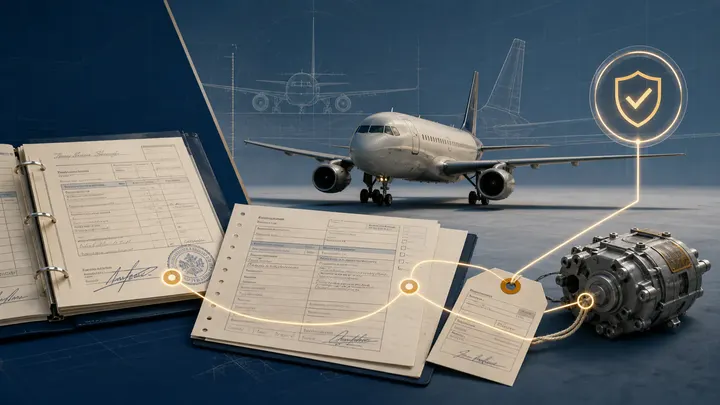


Run maintenance from connected evidence
Know what is due, and open the record that proves it.
Radar reads every logbook back to birth and builds the due list from the signed entries, with the page behind every line.