

In brief
AI can help classify, search, extract, connect, and summarize aircraft maintenance records, but it should not be treated as maintenance authority or a compliance determination. Safe adoption requires bounded tasks, representative testing, source citations, exception workflows, and accountable human review.
Tools for this decision
Run the numbers while you read.

Aircraft maintenance records contain a large amount of repetitive research work: finding a serial number across volumes, separating documents in a work package, comparing recorded times, or locating the entry behind a status line. AI can help with those tasks.
It can also produce confident-looking errors. The safe operating model keeps AI out of the decision seat: AI narrows, proposes, connects, and cites; accountable people verify where the decision warrants it.
Useful AI jobs in aircraft records
| Task | AI can help by | Required control |
|---|---|---|
| Page reading | Converting scans and handwriting into searchable text | Preserve the image and measure by critical field |
| Document grouping | Keeping a work order, task cards, release, and entry together | Show boundaries and allow correction |
| Classification | Identifying form, log entry, work card, or shop report | Retain unknown and low-confidence classes |
| Extraction | Proposing dates, times, serials, work orders, and signatures | Link every field to source and confidence |
| Entity resolution | Connecting variants of an aircraft or component identifier | Prevent unsupported identity merges |
| Search | Finding semantic matches beyond exact wording | Cite matched pages and support filters |
| Conflict detection | Flagging inconsistent times, identities, or dates | Do not silently choose a winner |
| Summarization | Drafting a review narrative from selected records | Limit to cited evidence and label unresolved issues |
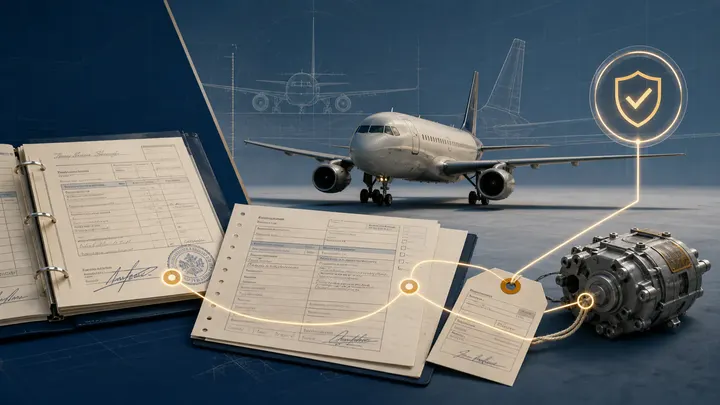
Radar works in this evidence layer: using document processing to help digitize, connect, search, and structure maintenance records while supporting verification against the source.
What AI should not be asked to decide alone
High-consequence conclusions often depend on information outside the visible page:
- whether an AD applies to the aircraft and installed configuration;
- whether the documented method satisfies the governing requirement;
- whether a maintenance entry is complete and made by an appropriately authorized person;
- whether a repair or alteration uses acceptable or approved data;
- whether a life-limited component’s history is continuous;
- whether conflicting times can be reconciled; and
- whether an aircraft is airworthy or can be returned to service.
AI can retrieve the directive, records, and related identifiers. It cannot make missing evidence appear. It also does not possess a mechanic certificate, inspection authorization, repair-station authority, or operator responsibility.
14 CFR 43.9 describes the content and form required for many maintenance records. 14 CFR 91.417 addresses specified recordkeeping responsibilities for owners and operators. Software does not transfer those responsibilities.
The evidence-first architecture
A safe record-intelligence result should contain:
- the proposed answer or field, stated narrowly;
- the source page (a file name alone is not enough);
- the matched region and context;
- aircraft and component identity used by the system;
- related supporting or contradicting records;
- confidence or reason for review;
- the model and processing history sufficient for operational traceability; and
- reviewer decisions and corrections.
If an answer cannot show its source, treat it as a lead for research, not as evidence. Generated prose should never become the only retained record of the underlying event.
Risk tiers for AI-assisted records work
| Tier | Example | Appropriate operating pattern |
|---|---|---|
| Low | Search for a vendor name or document category | User checks relevant returned pages |
| Moderate | Extract work order and date for an index | Confidence threshold plus sampled review |
| High | Reconstruct a component installation history | Qualified review of source chain and conflicts |
| Critical | Conclude regulatory compliance or remaining life | AI may gather evidence; accountable technical determination outside autonomous workflow |
Risk is a combination of the consequence of error and the likelihood that the task will fail. Handwriting, missing pages, ambiguous identifiers, and unfamiliar document formats raise likelihood. Life limits, regulatory status, and return-to-service decisions raise consequence.
NIST’s cross-sector AI Risk Management Framework describes trustworthy characteristics including validity, reliability, accountability, transparency, explainability, privacy, and security. It also notes that error measures should consider context and that human intervention may be appropriate when systems cannot detect or correct errors. It is a cross-sector framework rather than an aviation regulation, and it gives records teams a useful governance structure.
Test the workflow, not the demo
Build an evaluation set from real records and freeze the expected results before tuning. Include:
- clean typed entries and difficult handwriting;
- faded copies, stamps, tables, and checkboxes;
- multi-page work packages with known boundaries;
- similar serial numbers and identifier variants;
- engine or component installation and removal records;
- a missing attachment;
- two sources that genuinely conflict; and
- examples the system should leave unresolved.
Measure each pipeline step:
| Measure | Question |
|---|---|
| Page coverage | Did the system process every expected source page? |
| Grouping accuracy | Did it keep one maintenance document together? |
| Classification accuracy | Did it identify the document type without forcing an answer? |
| Critical-field precision | When it proposed a field, how often was it right? |
| Critical-field recall | How much of the reviewed evidence did it find? |
| Source support | Did each result cite the correct page? |
| Conflict recall | Did it surface known disagreements? |
| Review efficiency | Did qualified reviewers reach supported conclusions faster? |
Avoid a single “AI accuracy” number. A system can read 99 percent of ordinary words and still miss the digit that changes a component identity.
Human review is a designed workflow
“Human in the loop” is not a control unless the loop is usable. A reviewer needs:
- the source image and proposed extraction together;
- enough surrounding context to understand the record;
- linked earlier and later events;
- clear low-confidence and conflict reasons;
- accept, correct, reject, and escalate actions;
- retained history of the automated and reviewed values; and
- task routing based on reviewer competence.
The organization should specify which results require review, who may accept them, what supporting evidence is sufficient, and how corrections propagate to downstream systems. Review should concentrate on consequences and exceptions rather than treating every field as equal.
Generative answers and maintenance-record search
Natural-language questions can be valuable: “Find every record mentioning this engine serial,” or “Show the source behind this recorded inspection.” The safest answer pattern is retrieval-first:
- identify relevant records;
- display citations to exact pages;
- summarize only the retrieved evidence;
- separate supported facts from inference;
- state when evidence is incomplete or conflicting; and
- let the user open the source immediately.
Do not allow a conversational interface to hide the search scope. Users should know which aircraft, record set, date range, and document types were available. “No result found” is not proof that no record exists.
Security, privacy, and data governance
Before records enter an AI workflow, establish:
- customer-data ownership;
- permitted processing purposes;
- whether customer data is used to train models;
- model and infrastructure providers;
- data location and retention where relevant;
- access roles and audit logging;
- encryption and secure transfer;
- deletion, backup, and recovery;
- incident response and notification; and
- controls for exporting records or generated results.
Aircraft records may include personal identifiers, signatures, maintenance findings, commercial terms, location information, and proprietary technical data. Limit the AI system to the data and users required for the task.
NIST’s Generative AI Profile highlights risks including confabulation and downstream effects from third-party components. Procurement should therefore cover model changes, evaluation after changes, and rollback or suspension.
Implementation roadmap
Choose a bounded use case
Begin with a measurable workflow such as records search, document classification, or transaction-package indexing. “Automate compliance” is too broad to start with.
Establish the evidence set
Inventory records, protect originals, define identity, and create reviewed expected results for representative material.
Pilot with explicit thresholds
Set minimum source support, critical-field quality, exception recall, security, and user-time targets. Include failure cases.
Integrate cautiously
Keep proposed and accepted values distinct. Do not automatically write AI output into a maintenance tracker or authoritative status without validation and ownership.
Monitor change
Track new document families, corrections, false negatives, conflicts, review time, access, and model or vendor changes. Re-test after material changes.
Expand by evidence
Add workflows only after the existing one shows a measurable benefit without unacceptable tail risk.
Questions for an AI records vendor
- Which exact tasks use OCR, classifiers, language models, rules, or people?
- Can every proposed fact open to the exact source page?
- How are unknown, low-confidence, and conflicting results represented?
- What performance has been measured on handwriting and our document families?
- Can we test a frozen sample and retain the results?
- What customer data reaches third parties, and is any used for training?
- How are model changes communicated and re-evaluated?
- What prevents a generated statement from becoming an accepted maintenance fact?
- Can we export originals, structured data, citations, review status, and history?
- What responsibilities remain explicitly with our records and maintenance teams?
The best AI shortens the path to the evidence and makes the remaining judgment clearer. Evidence hidden behind an answer is the failure mode to avoid.
Sources and further reading
Common questions
Frequently asked questions
How can AI be used with aircraft maintenance records?
AI can help improve search, classify documents, group related pages, extract candidate fields, connect records, identify conflicts, and draft source-linked summaries for human review.
Can AI determine whether an aircraft complies with an Airworthiness Directive?
AI may help find and organize relevant evidence, but applicability and compliance conclusions require the governing directive, aircraft configuration, approved methods, complete records, and accountable qualified review.
Can AI replace a maintenance records analyst?
It can reduce repetitive search and data-entry work, but ambiguous records, configuration history, technical interpretation, and consequential decisions still require appropriate people and procedures.
What is the most important control for maintenance-record AI?
A consequential result should remain traceable to the exact source record, with uncertainty, conflicts, and corrections visible to a reviewer.
What does Radar claim its AI can do?
Radar digitizes, connects, searches, structures, and supports verification of aircraft maintenance records. It does not claim perfect extraction, automatic airworthiness or compliance determination, or authority to approve maintenance.
Keep researching
Related aircraft guides



Run maintenance from connected evidence
Know what is due, and open the record that proves it.
Radar reads every logbook back to birth and builds the due list from the signed entries, with the page behind every line.