
DEEP DIVE · THE RADAR LOGBOOK SERIES
Anatomy of a logbook entry.
Every maintenance entry answers the same seven questions. Here is one real airframe entry from a Challenger 350, walked line by line, with the rule behind each part, three common gaps, and a checklist you can hold your own entries against.



Sound on for the soundtrack; captions are on by default. Keys: Space plays and pauses, arrows skip 5 seconds, 1 to 5 jump to a chapter. Download the MP4.
THE SHORT VERSION
Seven questions, one page.
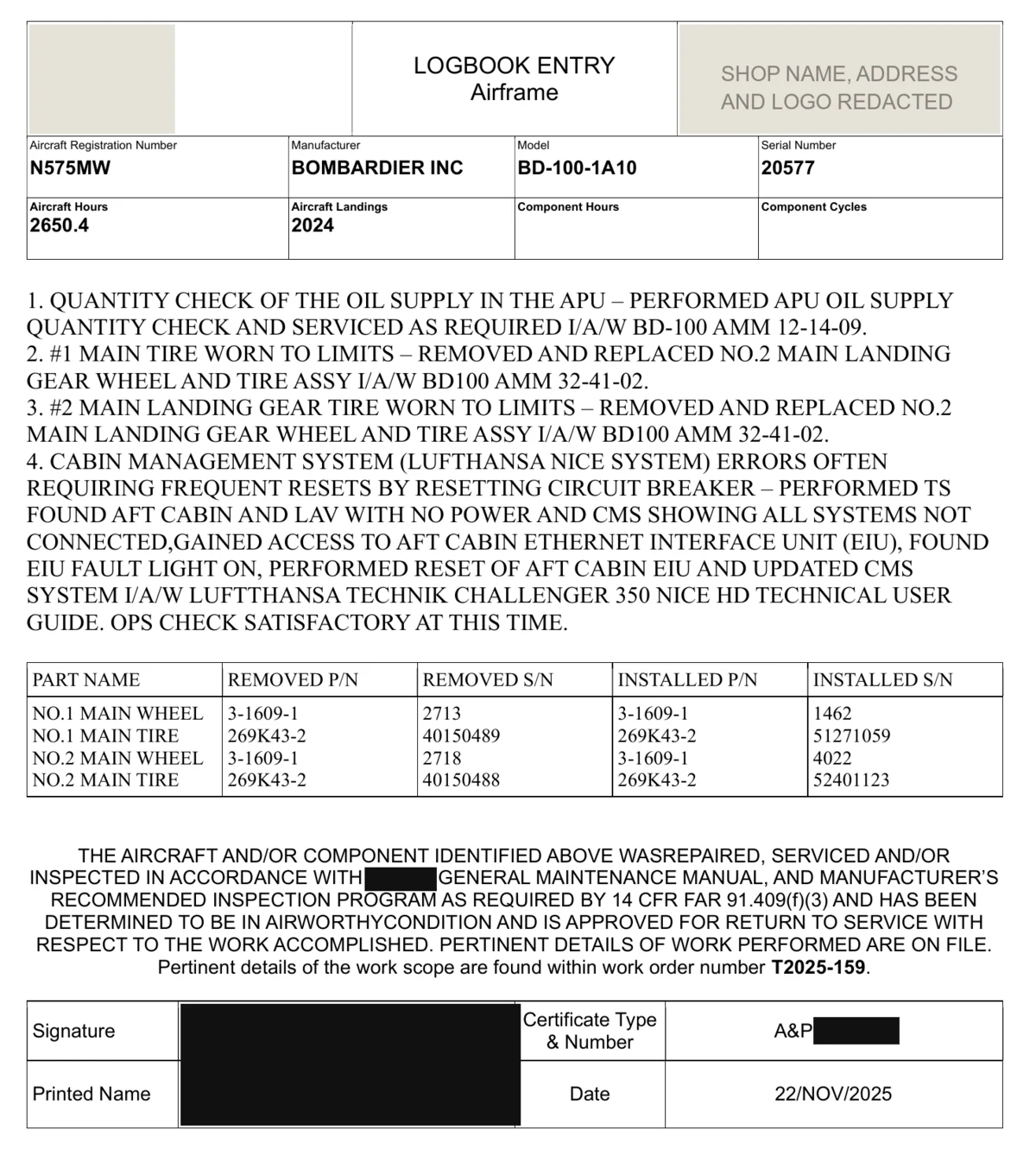
The real entry from the film, 22 Nov 2025. The shop, the technician’s name and signature, and the certificate number are redacted.
 1234567
 - 1DateWhen was the work finished?
43.9(a)(2) - 2Aircraft and timesWhich aircraft, at what time?
43.11(a)(2) · 91.417(a)(2) - 3Work and data usedWhat was done, to what data?
43.9(a)(1) · 43.13(a) - 4Parts off and onWhich parts came off and on?
P/N and S/N - 5Signed byWho approved it?
43.9(a)(4) - 6Return to serviceIs it back in service?
43.9(a)(4) · 91.407 - 7Work orderWhere is the full file?
Cross-reference
THE CHECKLIST
What a complete entry contains.
Hold one of your own entries against this list and tick what it has. The right column is the rule behind each line, and the example is the real entry from the film.
PART 1 OF 7
The date
Part 43 asks for the date the work was completed. It fixes the entry in the aircraft’s history, and every calendar interval and due date that follows counts from it.
On this entryTyped beside the signature: 22/NOV/2025.
PART 2 OF 7
The aircraft and its times
The header ties the entry to one airframe: registration, maker, model and serial number. The serial is the part that never changes; registrations can.
Total time and landings place the work in the aircraft’s life. Part 43 requires total time on inspection entries (43.11), and 91.417 requires the owner to keep the airframe’s total time. Most shops record both on every entry, because AD intervals, inspection intervals and part limits are counted in hours, landings or cycles.
On this entryN575MW, Bombardier BD-100-1A10, serial 20577; 2,650.4 hours, 2,024 landings. The aircraft was re-registered N395PD in 2026.
PART 3 OF 7
The work, and the data it followed
43.9(a)(1) asks for a description of the work, or a reference to data acceptable to the FAA. Good entries do both: what was found, what was done and the manual chapter it was done to.
Under 43.13(a), maintenance is done to the manufacturer’s manual or instructions for continued airworthiness, or other methods acceptable to the FAA. Naming the chapter lets the next mechanic, or a buyer’s inspector, check the work against the same data.
On this entryFour items, each tied to its data: an APU oil quantity check to BD-100 AMM 12-14-09, both main wheel and tire assemblies replaced to AMM 32-41-02, and a cabin system fault traced and reset to the Lufthansa Technik user guide.
PART 4 OF 7
Parts off and on
A part number says what a part is; a serial number says which physical part it is. Recording both, for every part removed and installed, is what lets a part be traced to its release paperwork (the FAA Form 8130-3 or equivalent) and, for life-limited parts, back to birth.
Here the part numbers stay the same and the serials change: the same design, different wheels and tires.
On this entryNo. 1 main wheel 3-1609-1: S/N 2713 off, 1462 on; No. 1 main tire 269K43-2: S/N 40150489 off, 51271059 on; No. 2 main wheel 3-1609-1: S/N 2718 off, 4022 on; No. 2 main tire 269K43-2: S/N 40150488 off, 52401123 on.
PART 5 OF 7
Who signed
The person approving the work signs, and gives the kind of certificate they hold and its number (43.9(a)(4)). If someone else did the work, their name goes on the entry too (43.9(a)(3)). A repair station entry carries the station’s certificate and the authorized person’s signature.
On this entrySigned by an A&P mechanic, with printed name and certificate number. All three are redacted on this page.
PART 6 OF 7
The return to service
The signature on a maintenance entry is the approval for return to service, and only for the work performed (43.9(a)(4)). Under 91.407, an aircraft that has had maintenance may not be operated until it has been approved for return to service and the entry has been made.
Inspection entries follow 43.11 instead: the type and extent of the inspection, the date and total time, and either a statement that the aircraft is airworthy or that a list of discrepancies was given to the owner. Inspections under a program, like this aircraft’s manufacturer’s program chosen under 91.409(f)(3), name the program and the part of it done.
On this entry“…has been determined to be in airworthy condition and is approved for return to service with respect to the work accomplished,” under the manufacturer’s recommended inspection program, 14 CFR 91.409(f)(3).
PART 7 OF 7
The work order
Part 43 doesn’t require a work order number on the entry, but most shops add one. The entry is the summary; the work order holds the task cards, the parts’ release tags, measurements and test results. When a question comes up at a pre-buy, the work order is where the answer is.
On this entry“Pertinent details of the work scope are found within work order number T2025-159.”
WHAT GOES WRONG
Three common gaps, and how a reviewer flags them.
These are illustrations, made up for the film, not records from this aircraft. Each is the kind of entry a records reviewer marks and sends back to the shop.
Illustration
No aircraft times
An entry with a date and a description but no hours or landings can’t be placed in the aircraft’s life. Recurring ADs and part limits can’t be counted from it, and a gap in the times raises questions about the entries around it.
What the reviewer asks forAsk the shop for the times from the work order, and add them by a dated, signed correction rather than by writing over the entry.
Illustration
“Replaced part”
A description that doesn’t name the part, its serial numbers or the data used tells a reviewer almost nothing. 43.9(a)(1) asks for a description of the work; this one can’t be tied to a release tag or a manual.
What the reviewer asks forAsk for the part name, part and serial numbers, and the manual reference, usually from the work order and the part’s 8130-3.
Illustration
No signed return to service
An entry with no signature, certificate or approval statement doesn’t approve anything. Under 91.407, the aircraft may not be operated after that work until it is approved and recorded.
What the reviewer asks forAsk the shop for the signed entry. If the aircraft has flown since, that becomes a question for the seller and the shop.
GLOSSARY
The words on the page.
- Maintenance record entry
- The entry required by 14 CFR 43.9 for maintenance, preventive maintenance, rebuilding or alteration.
- Inspection entry
- The entry required by 43.11 for an annual, 100-hour or program inspection.
- Approval for return to service
- The authorized person’s signed approval that the aircraft may be operated again after the work.
- Total time in service
- Hours from takeoff to landing over the life of the airframe, engine or part.
- Landings and cycles
- Counts of flights or pressure cycles. Some parts and ADs are limited by these rather than hours.
- Acceptable data
- Methods and data the FAA accepts for maintenance, usually the manufacturer’s manual (43.13(a)).
- AMM
- Aircraft maintenance manual. Entries cite its chapter, for example 32-41-02 for main gear wheels.
- A&P
- An FAA mechanic certificate with airframe and powerplant ratings.
- Work order
- The shop’s job file: task cards, parts, tags and sign-offs for one visit.
- Form 337
- The FAA form for major repairs and major alterations, filed in addition to the entry.
ABOUT THIS EXAMPLE
The entry in the film and on this page is a real airframe logbook entry of 22 Nov 2025 for Challenger 350 serial 20577, then registered N575MW and now N395PD. The shop’s name, logo and contact details, the technician’s signature and printed name, the certificate number and the operator’s name in the return to service statement are redacted. The three entries under “what goes wrong” are illustrations made up for the film. The photographs of the hangar, paperwork and records are illustrations, not this aircraft.
KEEP READING
SOURCES
GET A DEMO
Find the incomplete entries before a buyer does.
Send us one aircraft’s logbooks. Radar reads every entry, checks it for the date, times, description, parts, signature and return to service, and shows you each gap on the page it came from.
This page explains the rules in general terms. Your inspection program, operating rules and contracts can add requirements.