
LEARN: AIRCRAFT LOGBOOKS
Part 1 of the Radar logbook series
How aircraft logbooks work.
Every jet has a second identity: its paperwork. Why records exist, the four logbooks, what one entry must say, the time numbers and inspections, on the real records of Challenger 350 N395PD. Then the same lesson written out below, with a glossary.





Sound on for the soundtrack; captions are on by default. Keys: Space plays and pauses, arrows skip 5 seconds, 0 to 7 jump to a chapter. Download the MP4.
THE SHORT VERSION
Twelve terms, one jet.
Each with its real example from N395PD’s records.
- AWAirworthy
- The aircraft conforms to its type design and is in condition for safe operation. It may fly only while both are true.
- On N395PDAirworthiness date 23 Aug 2015
- LogLogbook
- The bound or digital record of every inspection, repair, alteration and part change for one unit: the airframe, an engine, a propeller or an APU.
- On N395PDFour books: airframe, two engines, APU
- EntryLogbook entry
- The written record of one job. 14 CFR 43.9 sets what it must say; 43.11 adds more for inspections.
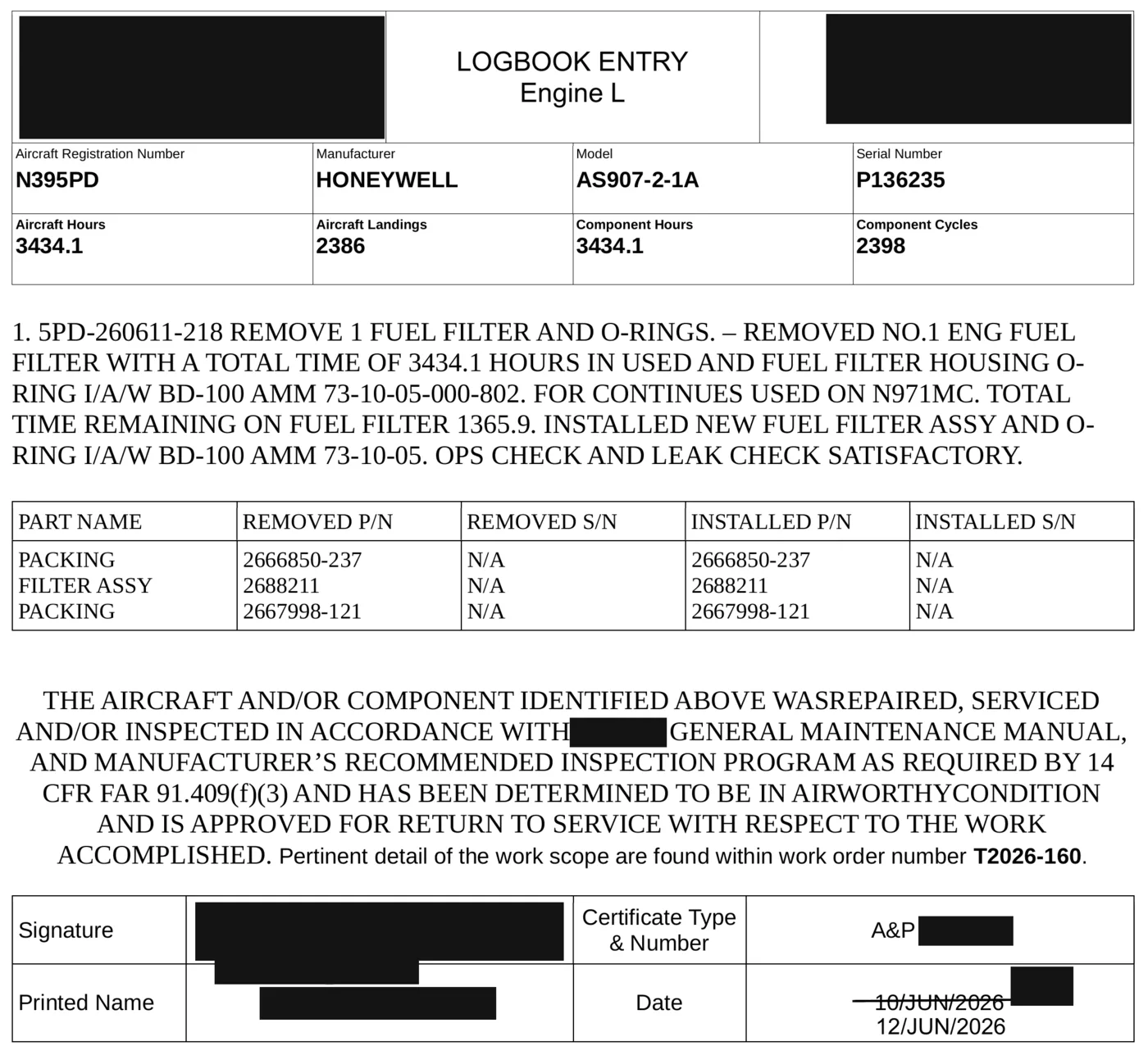
- On N395PDEngine L, fuel filter, 12 Jun 2026
- RTSReturn to service
- The signed approval that lets the aircraft or unit fly again after the work in that entry.
- On N395PDSigned by an A&P mechanic, certificate number on the entry
- TTTotal time
- Total time in service of the airframe, in hours. 91.417 requires it for the airframe, each engine and each propeller.
- On N395PD3,434.1 hrs on 12 Jun 2026
- TSNTime since new
- Hours on a unit or part since it was built. Life limits and overhaul intervals are often counted from here.
- On N395PDEngine P136235: 3,434.1 hrs
- TSOTime since overhaul
- Hours since a unit or part was last overhauled. It restarts at zero at each overhaul, while its time since new keeps counting.
- On N395PDAn overhauled LPT stub shaft arrived with 4,648.98 hrs since new
- CSNCycles since new
- For engines, cycles counted under the maker’s definition, roughly one per flight. Many life-limited parts are counted in cycles, not hours.
- On N395PDEngine P136235: 2,398 cycles
- LDGLandings
- The airframe’s own count of flights. Landing gear and some structure have limits in landings.
- On N395PD2,386 landings on 12 Jun 2026
- ANNAnnual inspection
- A full inspection every 12 calendar months, the default for most small aircraft. A 100-hour inspection is added when the aircraft is flown for hire.
- On N395PDNot used on this jet: it follows an inspection program
- PROGInspection program
- A schedule of inspection tasks due by hours, cycles and calendar time, often the manufacturer’s. Required for turbojet and other larger aircraft.
- On N395PD12 and 24 month, 600 hour tasks, 15 Jul 2026
- ADAirworthiness Directive
- An FAA rule under 14 CFR Part 39 that fixes an unsafe condition. Mandatory. The records show each AD’s status and method of compliance.
- On N395PDAD 74-08-09 R3 (k)
THE FOUR BOOKS
Each book keeps its own clock.
N395PD’s logbooks and their times on 23 Jan 2023, from the aircraft’s component times report. A jet has no propeller logs; turboprops and piston aircraft keep one per propeller.
Airframe logChallenger 350 · S/N 20577
2,061.3 hrs1,678 landings
Engine log, No. 1AS907-2-1A · S/N P136235
2,061.3 hrs since new1,689 cycles
Engine log, No. 2AS907-2-1A · S/N P136234
2,061.3 hrs since new1,689 cycles
APU logGTCP36-150(BD) · S/N P-662
2,173.75 hrsits own clock
Propeller logOne per propeller
Not on a jetturboprops and pistons
WHY RECORDS EXIST
An aircraft may fly only while it is airworthy. The records prove it.
Airworthy has a two part meaning in FAA rules: the aircraft conforms to its type design, and it is in condition for safe operation. Both depend on what has been done to it over its life, and the logbooks are where that is written down.
The owner or operator is responsible for keeping them. 14 CFR 91.417 lists what must be kept and for how long:
THE FOUR BOOKS
One logbook for each major unit.
An aircraft’s records are split by unit. The airframe log covers the structure, systems and avionics, plus inspections and ADs on the airframe. Each engine has its own log, each propeller has its own log, and an auxiliary power unit (APU) usually has one too.
N395PD is a Challenger 350, serial 20577. It has an airframe log, two engine logs (Honeywell AS907-2-1A, serials P136235 and P136234) and an APU log (GTCP36-150(BD), serial P-662). Jets have no propellers, so no propeller logs.
Engines, propellers and APUs come off for overhaul, get swapped and get sold. Their logbooks move with them. An engine installed on a different aircraft brings its own hours, cycles, inspections and ADs, so its book has to stay complete on its own. The airframe log records the removal and the installation; the engine log carries the engine’s history.
ONE ENTRY
What a logbook entry must say.
The film shows a real entry from N395PD’s left engine log, dated 12 Jun 2026: the No. 1 engine fuel filter and its O-rings were replaced per the Bombardier maintenance manual, then ops and leak checked. Under 14 CFR 43.9 a maintenance entry holds:
THE TIME NUMBERS
Every entry carries the clocks forward.
Each logbook keeps a running count. The airframe counts total time and landings. Each engine counts its time since new and its cycles. An APU counts its own hours. Parts that are overhauled on a schedule also count time since overhaul, which restarts at zero at each overhaul.
These counts are how anything with a limit is tracked: inspections due every so many hours, parts retired after so many cycles, overhauls at a set interval. They should only go up from one entry to the next. A count that goes backward, or a gap between entries, is a question for whoever is reading the records.
| Date | Source | TT (hrs) | Landings | Engine TSN (hrs) | Engine cycles |
|---|---|---|---|---|---|
| 23 Jan 2023 | Component times report | 2,061.3 | 1,678 | 2,061.3 | 1,689 |
| 7 Dec 2023 | Flight log 001 | 2,169.1 | 1,777 | 2,169.1 | 1,789 |
| 28 May 2025 | Flight log 41 | 2,363.1 | 1,888 | 2,363.1 | 1,900 |
| 12 Jun 2026 | Engine L entry | 3,434.1 | 2,386 | 3,434.1 | 2,398 |
INSPECTIONS
On a schedule, then signed off.
Most small aircraft get an annual inspection every 12 calendar months under 14 CFR 91.409(a). If the aircraft carries people for hire or is used for flight instruction for hire, it also needs a 100-hour inspection (91.409(b)).
Large airplanes, turbojet multiengine airplanes, turboprop multiengine airplanes and turbine helicopters follow an inspection program instead (91.409(e)). The owner picks one of the programs in 91.409(f): a continuous airworthiness program, an approved aircraft inspection program, the manufacturer’s current recommended program, or one the FAA approves.
N395PD follows the manufacturer’s program. Its tasks come due by hours, cycles and months. On 15 Jul 2026, at 3,446.5 hours and 2,393 landings, the 12 and 24 month tasks, the 600 hour tasks and the APU 800 and 2,400 hour tasks were signed off, with a statement that the aircraft was inspected under the manufacturer’s recommended program per 91.409(f)(3), found airworthy and approved for return to service.
| Annual and 100-hour | Inspection program | |
|---|---|---|
| Who | Most small aircraft under Part 91 | Large airplanes, turbojet and turboprop multiengine airplanes, turbine helicopters |
| When | Every 12 calendar months; plus every 100 hours if flown for hire | Task by task, due by hours, cycles or months |
| Rule | 14 CFR 91.409(a) and (b) | 14 CFR 91.409(e) and (f) |
| On N395PD | Not used | Manufacturer’s program: 12 and 24 month, 600 hour, APU 800 and 2,400 hour tasks signed off 15 Jul 2026 |
ADS, SBS AND TAGS
The paper behind the entries.
Entries also record Airworthiness Directives (FAA rules, mandatory), service bulletins (the maker’s notices) and the FAA Form 8130-3 release tags that come with parts. On N395PD: AD 74-08-09 R3 (k), Honeywell SB AS907-72-9094, and an 8130-3 for carbon seal S/N 26-169020-00568.
THE LIFE STORY
Years of entries become one story.
Every date and number below is from the aircraft’s own records. Hours are airframe total time. Buyers, pre-buy inspectors and lenders read this story to decide what the aircraft is worth and whether it is what the seller says.
- ·Airworthiness date
- 2,061.3 hrsTimes report: 1,678 landings
- 2,169.1 hrsFlight log 001, as N575MW
- 2,363.1 hrsGround spoiler fault: thrust quadrant replaced
- 3,015.4 hrs600 hour package, AD 74-08-09 R3
- ·Entries now read N395PD
- 3,434.1 hrsNo. 1 engine fuel filter
- 3,446.5 hrsEngine shop visit, SB AS907-72-9094
- 3,446.5 hrs12 and 24 month inspections
ABOUT THIS EXAMPLE
Every value in the film and on this page comes from the records of one airframe, Challenger 350 serial 20577, registered N395PD (its entries read N575MW until April 2026): the component times report of 23 Jan 2023, airframe flight logs of 7 December 2023 and 28 May 2025, the left engine log entry of 12 Jun 2026, the 600 hour package of 10 February 2026, work order 39023 of 14 July 2026 and the inspection package of 15 Jul 2026. Shop and operator names, people’s names, signatures and certificate numbers are redacted. In the film, the engine log entry and the flight log are the real scans; the inspection sign-off is redrawn from the real entry; the books, cards and charts are drawn from the real values; the photographs of the hangar, engine and paperwork are illustrations, not this aircraft.
THE SERIES
KEEP READING
SOURCES
GET A DEMO
Turn your logbooks into one record.
Send us one aircraft’s logbooks. Radar reads every page of the airframe, engine, propeller and APU logs back to birth, and every entry opens with its times, its sign-off and the page it came from.
This page explains the rules in general terms. Your operating rules, inspection program and contracts can add requirements.