
PART 3 OF 3 · THE RADAR LOGBOOK SERIES
How buyers, inspectors and lenders read your logbooks.
Two identical jets can sell, finance and insure very differently. The difference is in the binders. Here is who reads them, the five questions they ask, and what good answers look like, on the real records of Challenger 350 N395PD.







Sound on for the soundtrack; captions are on by default. Keys: Space plays and pauses, arrows skip 5 seconds, 1 to 8 jump to a chapter. Download the MP4.
WHO READS THEM
Four readers, one set of binders.
Each one reads for a different reason. Records can move the price, the financing and the insurance significantly, because each of these readers prices what the records cannot show.
The pre-buy inspector
Works for the buyer. Reads the records against the aircraft: data plates, inspection status, ADs, damage and repairs. Findings go into a report the deal is negotiated from.
The buyer’s broker
Turns what the inspector finds into price and terms. A gap or a missing tag becomes a holdback, a fix the seller pays for, or a lower offer.
The lender and the insurer
Rely on the records to support the aircraft’s value and condition before they finance or cover it. Weak records can mean more conditions, more questions, or a lower valuation.
The FAA, for Part 135
When an aircraft is added to a Part 135 operator’s certificate, FAA inspectors review its records as part of the conformity inspection. The operator’s maintenance program has to pick the aircraft up from where its records say it is.
THE FIVE QUESTIONS
A records scorecard.
Every records review comes back to five questions. Here they are with a real answer from N395PD for each.
| Scorecard | The question | On N395PD |
|---|---|---|
| ✓Complete | Are all the books here, with no gaps in time? | 2,906.1 to 3,015.4 hrs, Jan to Feb 2026, in order |
| ✓Traceable | Does every serialized part have its tag and its history? | Shaft S/N 12-162684-00105: 8130-3 with 4,648.98 hrs, 2,563 cycles |
| ✓AD current | Is every AD on the list, with method and next due? | AD 74-08-09 R3 (k): next due by 4,015.4 hrs |
| ✓Damage documented | Is every major repair, alteration and damage event on paper? | Form 337 and approved data for each, STC paperwork on file |
| ✓Consistent | Do the times agree across books? | Airframe and engine 1: 3,015.4 hrs on 10 Feb 2026 |
1 · COMPLETE
Every book, and no gaps in time.
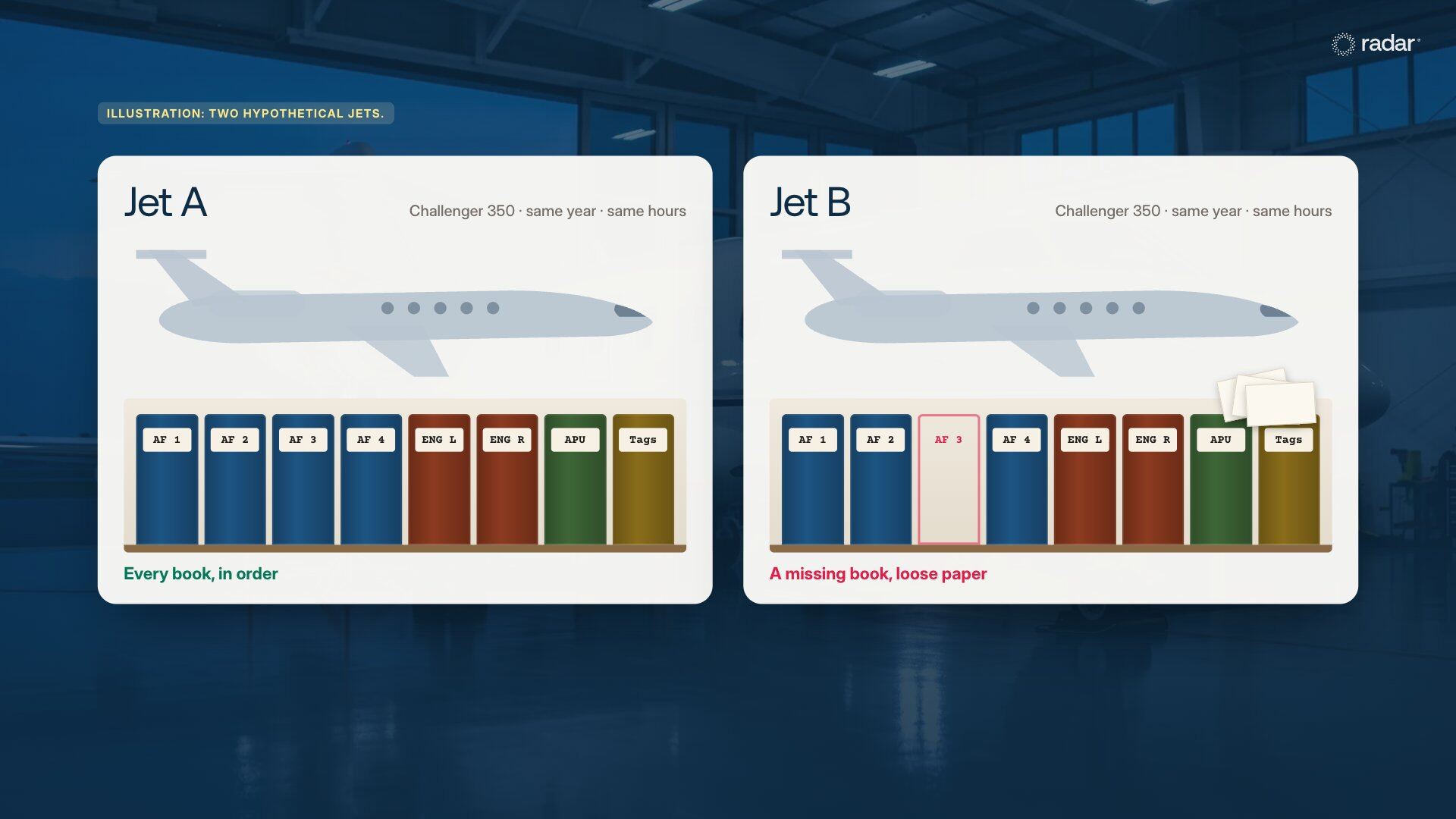
The first thing a reviewer does is count the books. Airframe logs from new, each engine’s logs, the APU and propeller logs if fitted, and the supporting work order packages. A missing volume is the first question.
Then they read the entries in order. Each one picks up where the last ended, and total time and landings only go forward. Five of N395PD’s airframe entries from early 2026 read like this:
WHAT A GAP LOOKS LIKE
Hours with no record are a question for the seller.
An example, not N395PD: an entry at 1,204.6 hours on 12 Mar, and the next at 1,391.2 hours on 30 Sep. That is 186.6 hours and 6 months with no maintenance recorded. The aircraft may have flown cleanly the whole time, but the records cannot show it, so the buyer’s side asks: where was it, who maintained it, and were inspections done on time?
The usual fixes are finding the missing pages (from the operator, the shop or the previous owner), reconstructing the period from flight logs and shop records, or accepting the gap and pricing it in.
2 · TRACEABLE
Every serialized part, back to birth.
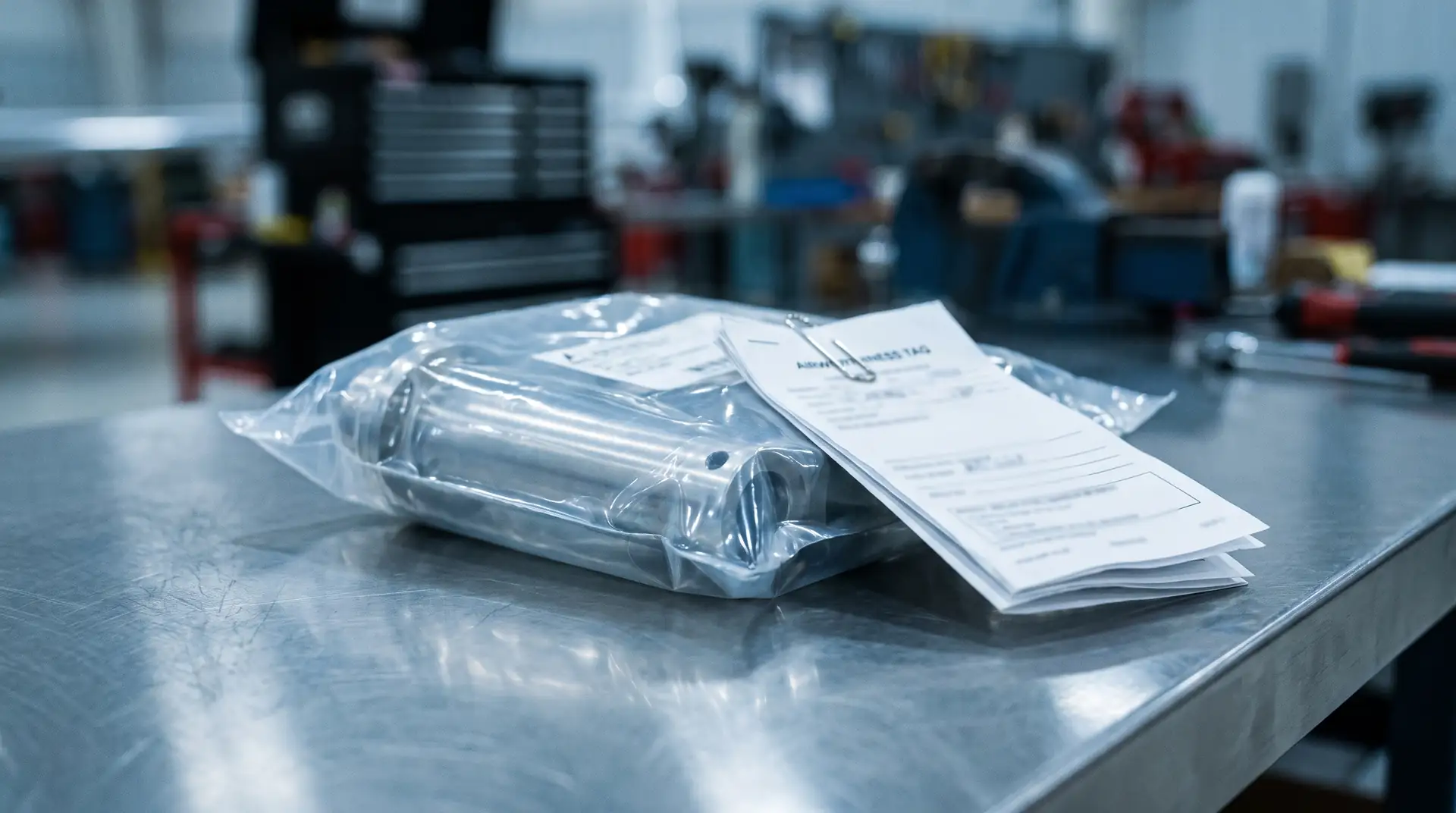
Every serialized part installed should have a release document, and every life-limited part a history back to new. On work order 39023 (14 Jul 2026), N395PD’s left engine received two parts:
3 · AD STATUS
Every applicable AD, how it was met, and when it is next due.
14 CFR 91.417(a)(2)(v) requires the current status of every applicable AD: the AD number and revision, the method of compliance and, for recurring ADs, the time and date the next action is due. A reviewer checks the list against the FAA’s ADs for the airframe, engines, APU and installed appliances, then checks the entries behind each line.
4 · DAMAGE AND MAJOR REPAIRS
Major work leaves its own paper.
A major repair or major alteration is recorded on FAA Form 337, with the approved data used, under 14 CFR 43.9(d) and Part 43 Appendix B. The logbook entry records the work and points to the form. 91.417(a)(2)(vi) keeps copies of the 337s for major alterations with the aircraft for good.
An STC modification is usually a major alteration, so it has a 337 that names the STC. Keep the STC itself, its installation data and its instructions for continued airworthiness with the records, and make sure the maintenance program picks those instructions up.
Buyers ask about damage history directly. The answer they want is a list of every event, each with its repair records: what was damaged, the data used for the repair, who did it, and the return to service. A repair that is visible on the aircraft and missing from the records is one of the hardest questions to answer late in a deal.
5 · CONSISTENT
The books agree with each other.
Times recorded in different books on the same day should agree. On 10 Feb 2026, N395PD’s 600 hour package shows the airframe at 3,015.4 hours and 2,174 landings, and engine 1 (S/N P136235) at 3,015.4 hours and 2,186 cycles. On 14 Jul 2026 the engine entry for work order 39023 shows 3,446.5 hours on both, with 2,393 landings and 2,405 engine cycles. Engine cycles sit 12 above landings on both dates: a steady relationship a reviewer can follow.
An example, not N395PD: the airframe book reads 1,512.3 hours and the engine book 1,521.3 on the same day. Two digits are swapped, and until someone finds which book is right, every time-based limit on that engine is in doubt.
PRE-BUY RECORDS CHECKLIST
Check these before the buyer’s inspector does.
Sixteen checks under the five questions. Each one is something a records review will ask for.
Complete
- ✓Every airframe, engine, APU and propeller logbook from new is present, with no missing volumes.
- ✓Entries run in date order, and total time and landings (or cycles) only go forward.
- ✓Any period with no entries is explained, with flight logs or shop records to support it.
- ✓Work order packages are kept with the logbooks for the work the entries refer to.
Traceable
- ✓Every installed serialized part has a release document: an 8130-3, an EASA Form 1 or an equivalent record.
- ✓Part number and serial number on each tag match the part and the entry that installed it.
- ✓Every life-limited part has a history back to new and a current remaining life against its limit.
AD current
- ✓The AD status list covers the airframe, each engine, the APU, propellers and installed appliances.
- ✓Each AD shows its revision, method of compliance and, if it recurs, the next due time or date.
- ✓Each line on the list traces to a signed entry that records the compliance.
Damage documented
- ✓Every major repair and alteration has its FAA Form 337, with the approved data named.
- ✓Every STC installed has its 337, the STC and its instructions for continued airworthiness on file.
- ✓Every damage event is disclosed and closed out with its repair records and return to service.
Consistent
- ✓Airframe and engine totals agree on dates where both books have entries.
- ✓Serial numbers agree across logbooks, tags, the AD list and the aircraft’s data plates.
- ✓Inspection status matches the inspection program the aircraft is on (14 CFR 91.409).
GLOSSARY
The words a records review uses.
- Total time (TT, TAT)
- Hours in service of the airframe since new. Each engine, propeller and APU keeps its own total too. 14 CFR 91.417(a)(2)(i) requires them in the records.
- Landings and cycles
- The airframe counts landings. Engines count cycles, which need not match landings exactly; what matters is that each count only goes forward and the relationship stays steady.
- Life-limited part
- A part with a mandatory replacement limit in hours, cycles or calendar time, set by the type certificate or the Airworthiness Limitations section of the manufacturer’s instructions (14 CFR 91.403(c)).
- Back to birth
- A history that follows a part from the day it was made to today, through every installation, overhaul and shop visit. It is how a life-limited part proves how much life it has left.
- FAA Form 8130-3
- The Authorized Release Certificate that travels with a part: a maker’s release of a new part, or a repair station’s release after its work. It releases the part, not the aircraft.
- Method of compliance
- How an AD was met: the inspection, modification, part replacement or service bulletin the AD allows. 91.417(a)(2)(v) requires it in the AD status, with the next due time for recurring ADs.
- FAA Form 337
- The Major Repair and Alteration form. A major repair or alteration is recorded on it, with the approved data used, under 14 CFR 43.9(d) and Part 43 Appendix B.
- STC
- A supplemental type certificate: FAA approval for a design change to a type-certificated product. Installing one is usually a major alteration, recorded on a 337 that names the STC.
- Conformity inspection
- For a Part 135 operator, the FAA’s check that an aircraft and its records conform before it is added to the operator’s certificate.
ABOUT THIS EXAMPLE
Real values in the film and on this page come from one airframe, Challenger 350 serial 20577, registered N395PD (records before April 2026 name its earlier registration, N575MW): five airframe entries from January and February 2026, the 600 hour package of 10 February 2026, work order 39023 and its 8130-3 tags (14 Jul 2026), and the airframe entry of January 2025. The two jets, the gap in time and the mismatched totals are hypothetical examples and are labeled that way. The Form 337 is a blank form redrawn for illustration. Names, signatures, certificate numbers and shops are left out or redacted. The photographs of the hangar, parts and paperwork are illustrations, not this aircraft.
THE SERIES
SOURCES
GET A DEMO
See your records the way a buyer will.
Send us one aircraft’s logbooks. Radar reads every page and builds the scorecard: every entry in order, every serial tied to its tag, every AD with its method and next due, every 337, and the times checked across every book.
This page explains the rules in general terms. Your inspection program, operating rules, lender and insurer can add requirements.