
DEEP DIVE · AIRCRAFT RECORDS
Life-limited parts, back to birth.
What a life-limited part is, how its records prove every cycle since new, and what a single missing record does. Built on the real history of a turbine shaft installed on Challenger 350 N395PD in July 2026, then written out below.




Sound on for the soundtrack; captions are on by default. Keys: Space plays and pauses, arrows skip 5 seconds, 1 to 6 jump to a chapter. Download the MP4.
THE SHORT VERSION
Nine terms, one shaft.
Each with its real example from shaft S/N 060319003207.
- LLPLife-limited part
- A part with a mandatory replacement limit in the type design, the Instructions for Continued Airworthiness or the maintenance manual (14 CFR 43.10). Once it reaches the limit, it comes out of service.
- On N395PDLPT stub shaft, P/N 3035691-1
- ALSAirworthiness limitations
- The section of the type certificate holder’s instructions that sets mandatory replacement times. For an engine, Part 33 requires one. 14 CFR 91.403(c) makes it binding on the operator.
- On N395PDThe shaft’s part log points to the engine maker’s list of life limits
- CycleCycle
- The unit most rotating engine parts are limited in. For most turbine engines one cycle is one flight, start to shutdown; the manufacturer defines exactly what counts.
- On N395PD3,194 cycles on engine P118381
- CSNCycles since new
- Every cycle the part has run since it was made, on every engine it has been in. TSN is the same for hours. Neither restarts at an overhaul.
- On N395PDCSN 3194 and TSN 4789.1 on the shaft’s 8130-3
- StatusLife status
- The accumulated cycles, hours or other limit of a life-limited part (14 CFR 43.10). The owner must keep its current status for every life-limited part (91.417(a)(2)(ii)).
- On N395PD3,194 cycles at installation on N395PD
- B2BBack to birth
- A history that runs from the part’s manufacture to today, with every installation, removal and shop visit, so the current count can be checked rather than taken on trust.
- On N395PDNew 24 Aug 2006 to installed 14 Jul 2026
- LogPart log or record card
- A card that travels with a serialized part. Each row records an installation or removal: the date, the engine, and the hours and cycles at the time.
- On N395PDHoneywell Life Limited Part Log, S/N 060319003207
- 8130-3FAA Form 8130-3
- The release tag for a part after a shop visit. It releases the part, not the aircraft. For a used life-limited part, block 12 often repeats its total hours and cycles.
- On N395PDOVERHAULED, 2 Jun 2026, TSN 4789.1, CSN 3194
- GapA broken link
- A stretch of the part’s life with no record. The cycles it ran there can’t be proven, so its life status can’t either.
- On N395PDHypothetical in the film; this shaft’s chain is complete
LIFE-LIMITED PARTS
A hard limit, counted from new.
Some parts are never allowed to wear out in service, because a failure would not be contained. Engine fan and turbine disks, shafts and some spools are the classic examples. For these, the type certificate holder sets a mandatory replacement time in its airworthiness limitations, usually in cycles for rotating engine parts and sometimes in hours or calendar time.
14 CFR 91.403(c) says an aircraft can’t be operated unless those limits are complied with. 14 CFR 91.417(a)(2)(ii) requires the owner to keep the current status of every life-limited part, and 91.417(b) sends that status with the aircraft when it is sold.
The limit belongs to the part, not to the engine it sits in. Move a disk or a shaft to another engine and its count carries on from where it stopped. An overhaul does not reset it.
BACK TO BIRTH
What back to birth means.
A back-to-birth history shows the part from the day it was made to today: each engine it was installed in, when it went on and came off, the hours and cycles each time, and each shop visit in between. Add the pieces up and you get the cycles since new, and anyone can check the arithmetic.
The FAA rule asks for current status. It does not use the words back to birth, and the FAA has said the records rule alone does not require every historical record. Buyers, lessors, lenders and engine programs very often do ask for the full chain, because a current status with nothing behind it is only an assertion.
ONE REAL CHAIN
Shaft 060319003207, from 2006 to N395PD.
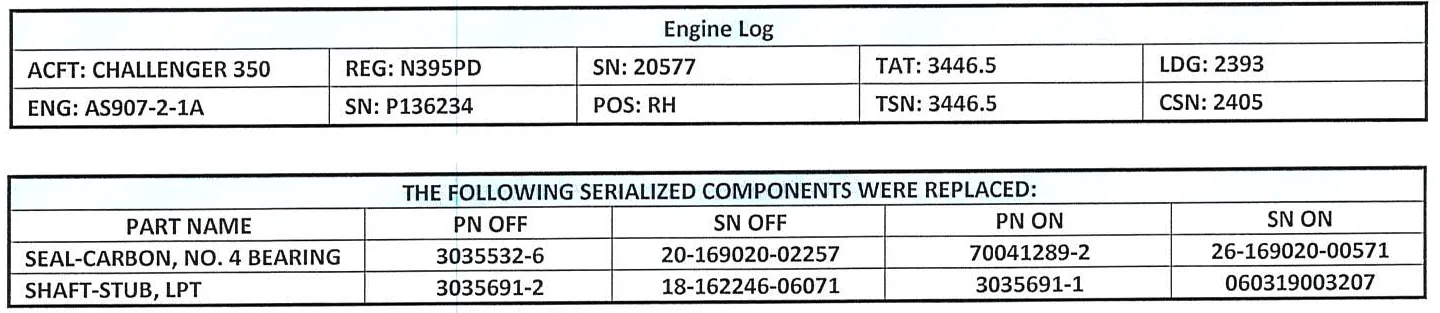
In July 2026, N395PD, a Challenger 350, had both low pressure turbine stub shafts replaced at an engine shop under work order 39023. Neither replacement was new. Both came with their history, and the right engine’s shaft came with a part log that starts on the day it was made.
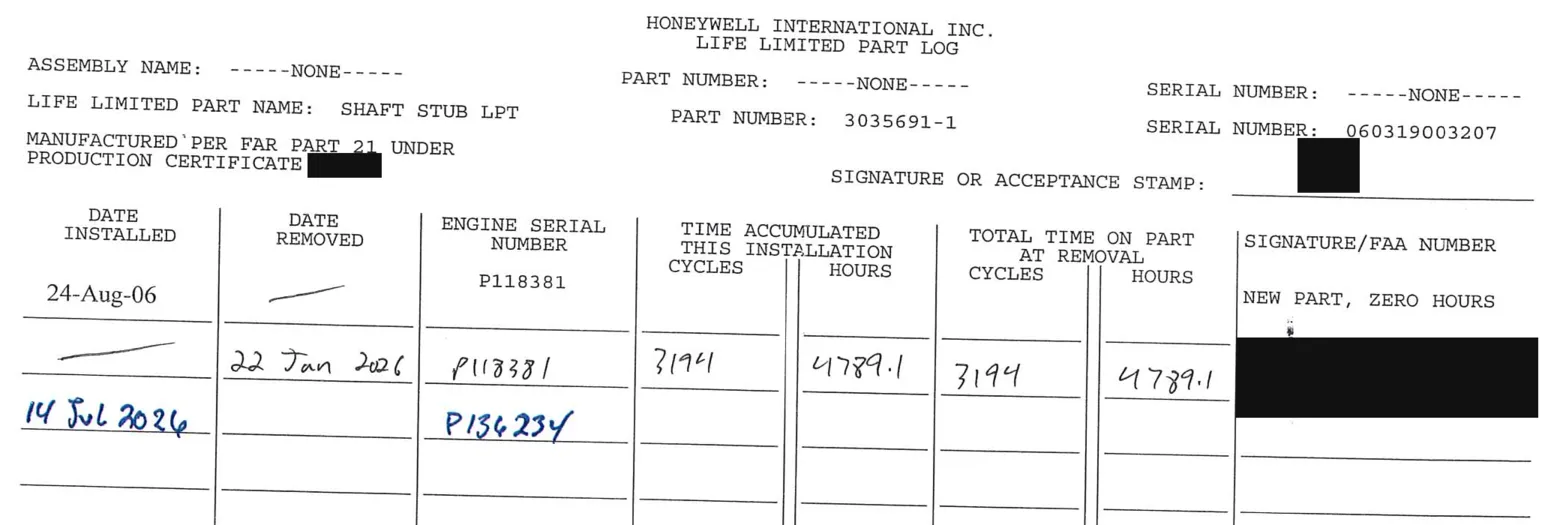
- 24 Aug 2006: new part, zero hours, installed on engine P118381 (Honeywell Life Limited Part Log).
- 22 Jan 2026: removed from engine P118381 with 3,194 cycles and 4,789.1 hours, all on that engine (same log).
- 2 Jun 2026: overhauled by Honeywell’s repair station to LMM 72-05-12 Rev 44, released on an FAA Form 8130-3 whose block 12 reads TSN 4789.1, CSN 3194 (also its Life Limited Maintenance Record).
- 14 Jul 2026: installed on N395PD’s right engine, P136234, replacing P/N 3035691-2 S/N 18-162246-06071 (engine log entry, work order 39023).
- Its twin on the left engine, S/N 12-162684-00105, was removed from engine P-118890 on 16 Feb 2022 with 4,648.98 hours and 2,563 cycles on the part, overhauled on 10 Mar 2026, and installed on engine P136235 on 14 Jul 2026.
- New · installed 24 Aug 2006 Engine P118381. New part, zero hours. Cycles since new0 Part log, row 1
- Removed 22 Jan 2026 Engine P118381. 4,789.1 hours on that engine. Cycles since new3,194 Part log, row 2
- Shop visit 2 Jun 2026 Overhauled by Honeywell’s repair station. FAA Form 8130-3, block 12: TSN 4789.1, CSN 3194. Cycles since new3,194 8130-3
- Installed 14 Jul 2026 N395PD right engine P136234, work order 39023. Cycles since new3,194 + every cycle since Engine log and part log, row 3
THE DOCUMENTS
What documents make the chain.
No single document proves a part’s whole life. The chain is built from several, and each one has to agree with the next on part number, serial number, dates and times.
- Birth: the maker’s record that the part was produced new under its production approval, often the first line of the part log, or a new-part 8130-3.
- Each installation and removal: the engine or aircraft log entry, with the engine serial number and the hours and cycles at that moment.
- The part’s own log or record card, which travels with it and repeats those installs and removals.
- Each shop visit: the work order or shop findings and the 8130-3 (or EASA Form 1) that released the part, usually with its totals in block 12.
- Today: the current life status, in the owner’s records, adding every cycle since the last installation.
A BROKEN LINK
When one record is missing.
Picture the same shaft with its removal record from the first engine missing. The part log jumps from installed in 2006 to overhauled in 2026, and nothing says how many cycles it ran in between. Every number after the gap depends on the missing one.
A part whose life status can’t be established can’t be shown to be within its limit. In practice the history gets researched: the operator’s utilization, the engine’s own records, the shop’s files, the manufacturer. If the gap can’t be closed with records someone will accept, the part may have to be scrapped. 14 CFR 43.10 also requires a removed life-limited part to be controlled, by a records system, a tag, marking, segregation or mutilation, so its status can’t be lost or misused later.
This shaft’s real chain is complete. The gap in the film is an illustration.
REMAINING LIFE
The limit, minus cycles since new.
Remaining life is simple arithmetic once the chain is solid: the limit minus cycles since new. With an example limit of 10,000 cycles, a shaft at 3,194 cycles since new has 6,806 cycles left.
The example limit is only for illustration. This shaft’s real limit is set in Honeywell’s airworthiness limitations for the engine, not in the records shown here, and limits can change with revisions and with the engine model. Always read the current limit from the manufacturer’s data for that exact part number.
If one part of an assembly has a shorter limit than the rest, or a limit in both cycles and hours, whichever comes first governs.
CHECKLIST
Checking a life-limited part’s records.
What a buyer’s inspector, a lessor or an engine program looks for. Run it before they do.
PART HISTORY IN RADAR
One serial number, every package that names it.
Radar reads every page of the logbooks and work order packages and groups them into packages. In the Packages tab, open any part and Radar lists every package on the aircraft that names that serial number, oldest first. Each opens on its pages: the part log, the 8130-3, the entry that installed it.
On N395PD, work order 39023 installed two used shafts. Both came from other engines: S/N 060319003207 from engine P118381, and S/N 12-162684-00105 from engine P-118890. Their part logs, record cards and tags are pages in that package, so their history is one click from the part.
ABOUT THIS EXAMPLE
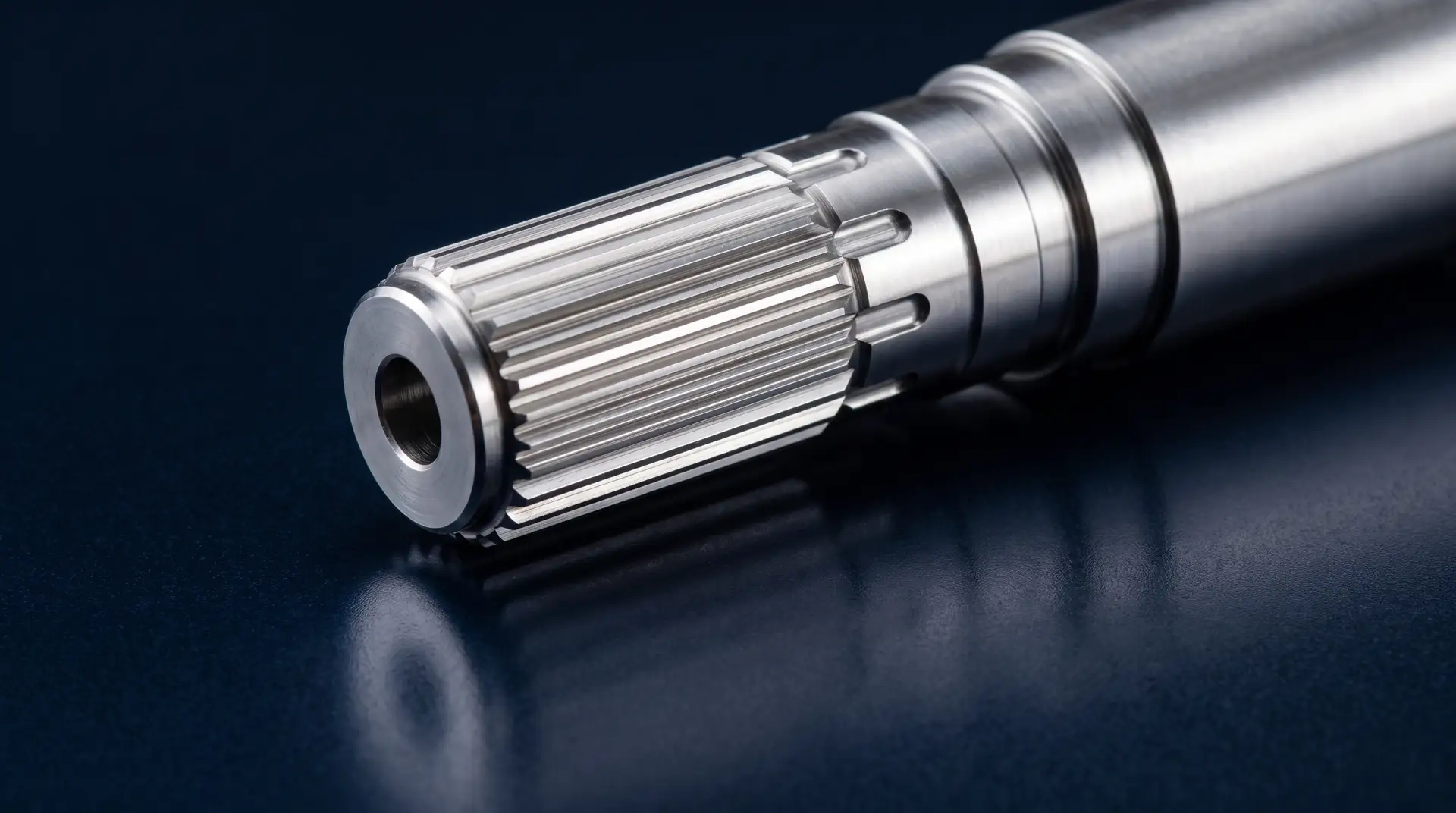
Every real value in the film and on this page comes from one work order package for one airframe, Challenger 350 serial 20577, registered N395PD: work order 39023, July 2026. The part log and the engine log entry are the real scans, cropped and redacted; the 8130-3 is redrawn from the real form. Signatures, names, the inspector’s stamp, certificate and approval numbers, the production certificate number, the engine shop, and 8130-3 tracking and work order numbers are redacted. The missing record in chapter 4 is hypothetical, and the 10,000 cycle limit in chapter 5 is an example: the shaft’s real limit is not in these records. The photographs of the hangar, the shaft and the engine are illustrations, not this aircraft.
KEEP READING
SOURCES
GET A DEMO
Every serial, back to birth.
Send us one aircraft’s logbooks and work order packages. Radar reads every page, and each serialized part opens with every package that names it, oldest first, each on the page it came from.
This page explains the rules in general terms. Life limits, your operating rules, your program and your contracts decide what applies to a given part.