Every time a mechanic touches an aircraft, someone has to approve it for return to service before it flies again (14 CFR 91.407). The regulations say who may sign and what the entry must contain. They say much less about the work around the signature: deciding what to send to the shop, agreeing what the shop is allowed to do, and filing what comes back.
This post walks through that workflow the way a Part 135 director of maintenance (DOM) described it to us. It has seven steps. Part 91 operators run a shorter version of the same thing, and we note where the two differ.
1. Start from the due list
The due list is every item coming due on the aircraft, by date, hours and cycles. It draws from three sources:
- The maintenance program. For a multiengine jet under Part 91 that is the inspection program the operator selected under 14 CFR 91.409(e), most often the manufacturer’s. A Part 135 certificate holder follows its approved program. Replacement times in the airworthiness limitations section are mandatory under 91.403(c).
- Airworthiness Directives. Legally enforceable under Part 39. A recurring AD carries its own interval, with no tolerance borrowed from the inspection program. Recurring ADs covers the next-due math.
- Service bulletins. Advisory for a Part 91 operator unless an AD requires them, but many operators track them anyway, and a lease or an engine program can make them binding.
Each item shows its limit on every clock that applies: 600 hours or 12 months, whichever comes first. Sort the list by what comes due soonest and you have the first draft of the next shop visit.
2. Pick a group of tasks for one visit
An aircraft in a hangar earns nothing, so the DOM groups work. If the phase inspection is due in 40 hours and a recurring AD on the same panel is due in 60, both go in the same visit. Squawks the crew wrote up in the aircraft maintenance log (135.65) that were deferred under the MEL often join them.
The group is a choice about timing and downtime. Pulling an item forward costs the hours or months left on it. Leaving it out can mean a second visit three weeks later.
3. Turn the group into a work order authorization
The group becomes a work order authorization: the list of tasks the operator is asking one vendor to do, with the estimate attached. It moves in either direction:
- The DOM sends it to the vendor. The operator built the list from its own due list and asks the shop to quote it.
- The vendor proposes it to the DOM. Shops that track the aircraft themselves often send a proposed work package ahead of an inspection. The DOM edits it and signs.
Either way, the authorization ends up signed by both sides before the work starts. Many operators ask two or three shops for a quote on the same list before they sign one.
4. Treat the authorization as binding
Once signed, the authorization is the scope of the job. The vendor does the authorized tasks and nothing else without asking.
Anything new comes back as a new estimate for approval: a finding during the inspection, damage found with a panel open, a part that fails its check. The DOM, or the owner on a managed aircraft, approves or declines each item. A large inspection can go through several rounds of this over a few weeks. Each approved estimate becomes part of the authorization, and each declined finding needs a decision of its own: deferred under the MEL, scheduled for later, or shown not to affect airworthiness.
This is where most of the money and most of the arguments live. Keep every estimate and every approval, with who approved it and when.
5. The vendor does the work
The shop opens a work order for the visit and breaks it into tasks, often called task cards. Technicians sign each task as they finish it. Required inspection items (RIIs) are bought back by an inspector who did not do the work (135.429(c)). Parts arrive with their release paperwork, usually an FAA Form 8130-3 (AC 20-62E).
Every work order has tasks, but a task does not need a work order. Part 91 operators often have work done one task at a time: a mechanic replaces a starter generator on the ramp and writes one logbook entry. That entry is the return to service. It carries the description of the work, the date, and the name, signature, certificate number and kind of certificate of the person approving it (14 CFR 43.9), or the inspection record under 43.11 when the task is an inspection. The person signing must be authorized under 43.7.
6. Return to service
Closing a work order is a return to service. On a Part 91 aircraft, the shop’s logbook entries do that, one per task or one for the whole visit.
A Part 135 certificate holder whose aircraft are maintained under the program in 135.411(a)(2) (ten or more passenger seats, or by election under 135.411(b)) needs more. Under 135.443, the aircraft may not fly after maintenance until there is an airworthiness release or a log entry, prepared under the operator’s manual. It certifies that:
- The work was done in accordance with the operator’s manual.
- Every required inspection item was inspected by an authorized person, who found the work satisfactory.
- No known condition exists that would make the aircraft unairworthy.
- As far as the work performed goes, the aircraft is in condition for safe operation.
It is signed by an authorized certificated mechanic or repairman, with a certificate number.
In practice the vendor writes and signs that statement for each work order. A few patterns come up often:
- One release can cover several work orders. A shop that ran the inspection and two squawk repairs on separate work orders at the same visit can sign one release that lists all three.
- Two vendors at once means two releases. If an avionics shop and an airframe shop work on the aircraft in the same week, each signs for its own work.
- A subvendor rolls up under the main shop. When the airframe shop sends a starter generator or an engine to a specialist, the specialist returns the part with its own 8130-3. The airframe shop installs it, verifies the work, and signs the release (14 CFR 145.217 covers contract maintenance). The operator sees one event and one release.
7. File the package
The release is one page. The package behind it is what the next inspector, buyer or lender will ask for. File it as one folder per event:
- The estimates, every round of them.
- The signed work order authorization and each approval.
- The 8130-3 tags for every part installed.
- The logbook entries, signed.
- Test reports: NDT, oil analysis, ops checks, weight and balance if it changed.
- The vendor’s status report for the aircraft.
- The updated due list, showing the items this visit closed and their next due.
- The signed airworthiness release.
A repair station only has to keep its copy of the work for two years and must give the owner a copy of the maintenance release (145.219). After that, the operator’s folder may be the only copy. How to read aircraft logbooks explains why the work order belongs with the logbooks.
How Radar handles each step
Radar is built around this workflow. Here is what it does today, step by step, and what is still being built.
- The due list. Radar builds the due list from the logbooks, with the signed entry and page behind each item’s last compliance. From the due list, Add to plan puts the items you pick into a work plan for one visit.
- The work order authorization and estimates. Planned. Today the work plan holds the tasks and the shop. Sending the authorization to the vendor, or taking one proposed by the vendor, and approving each new estimate against it are being built now.
- 8130-3 tags. Radar lists every installed part with no 8130-3 or other release tag on file and asks the shop for all of them in one email. The replies are filed behind the right entries.
- RII buy-back. A required inspection item stays open until an inspector who did not do the work buys it back, and the inspector signs an inspection statement.
- The release gate. Radar’s Chief Inspector runs a rule set on every work order: the 43.9 entry contents, RII buy-back, squawks closed or deferred under the MEL, 8130-3s on file, AD compliance recorded, and the 135.443 release. You can add your own checklist on top. The release stays locked until every blocking rule is met, and each blocker is named with the person who owns it.
- The signed release. The authorized signer signs the 135.443 release once the gate is clear. Radar seals the record and the RTS package downloads as one PDF, with every rule, who marked it and when, and the 8130-3 tag numbers.
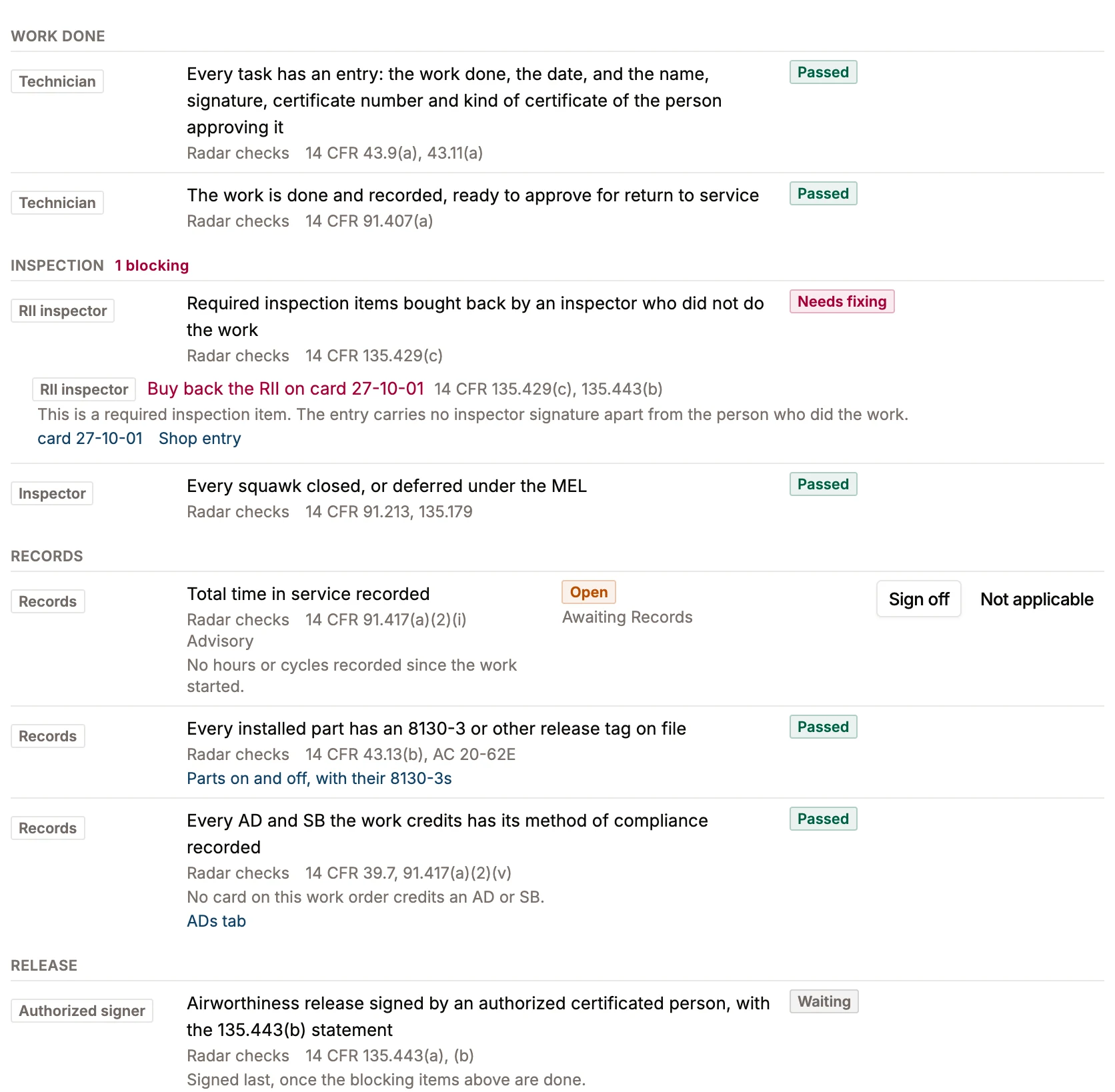
The return to service page shows each step on a Challenger 300, N971MC.