
DEEP DIVE · PART 135
Adding an aircraft to your D085.
What OpSpec D085 is, what goes in the conformity package, and why you keep exactly what you sent. Built from the real records of Challenger 350 S/N 20577, then written out below with a checklist.


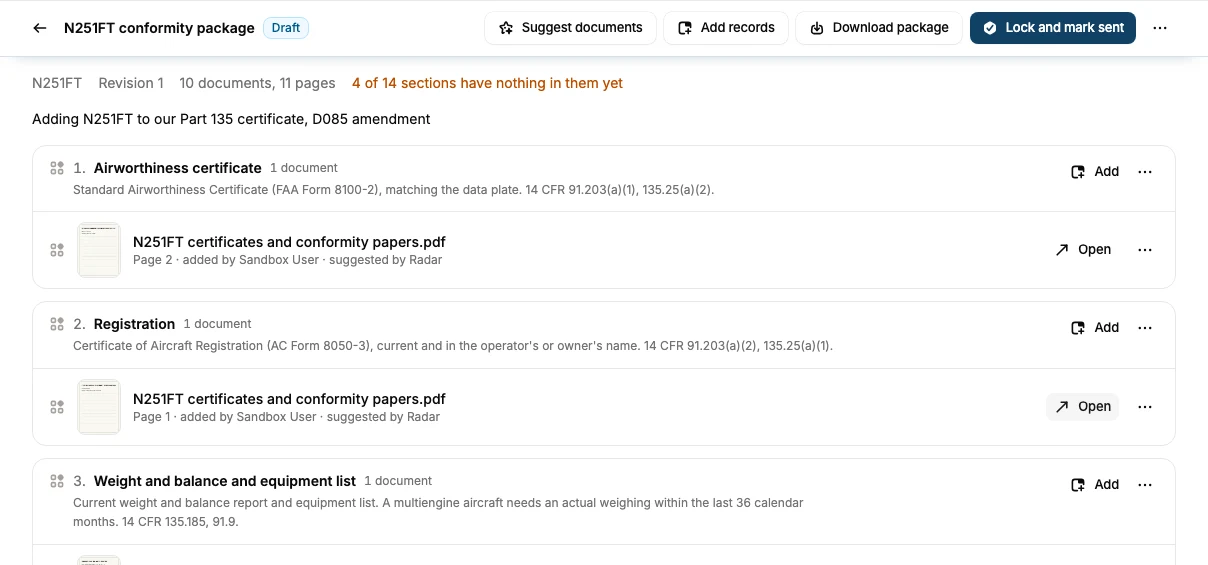
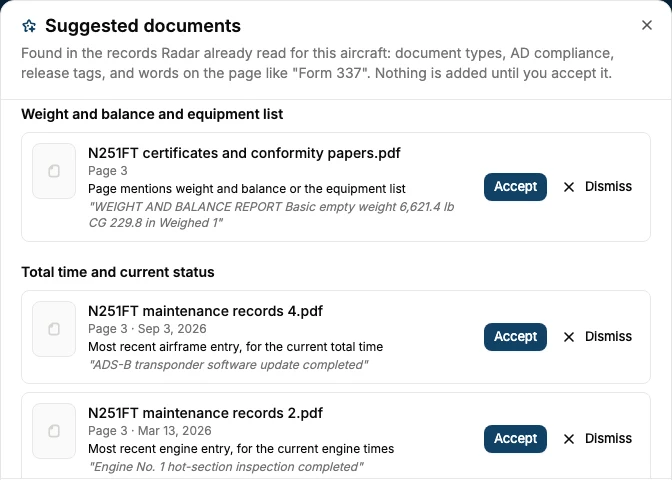
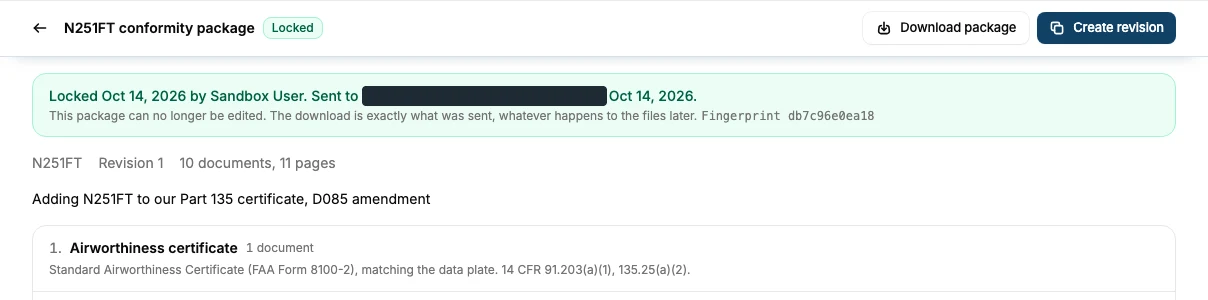

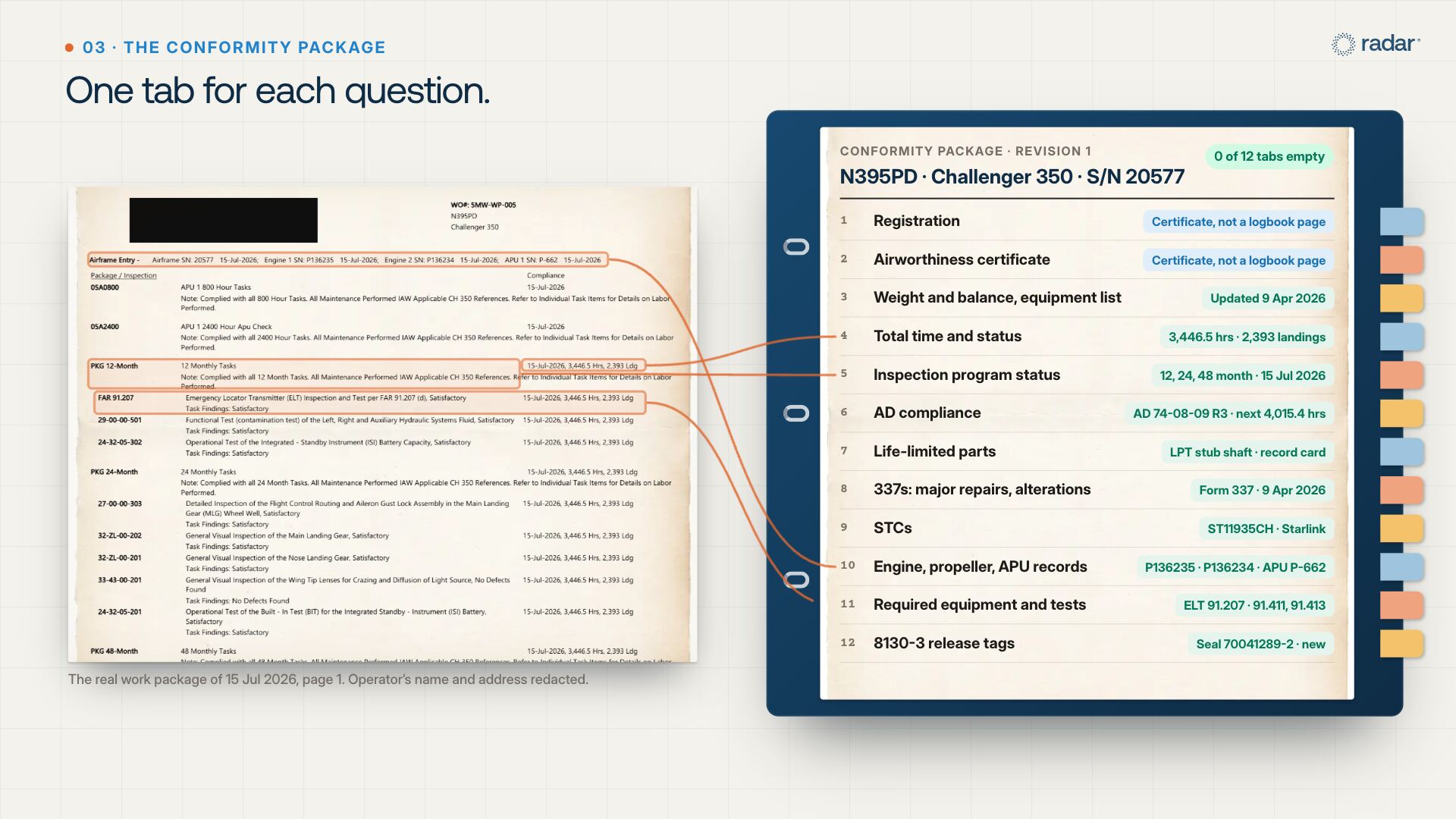
Sound on for the soundtrack; captions are on by default. Keys: Space plays and pauses, arrows skip 5 seconds, 1 to 6 jump to a chapter. Download the MP4.
THE SHORT VERSION
Eight terms you will hear.
- OpSpecsOperations specifications
- The FAA-issued pages that say what a certificate holder is authorized to do, where and with what. They are issued and amended by the FAA (14 CFR 119.51).
- D085Aircraft listing
- The OpSpec paragraph that lists each aircraft a Part 135 certificate may operate, by make, model and series, serial number and registration.
- CHDOCertificate-holding district office
- The FAA office that holds your certificate. Your principal inspectors work there, and OpSpec changes go through it.
- PIPrincipal inspector
- Your assigned FAA inspector for operations, maintenance or avionics. The one reviewing an added aircraft depends on the office and the aircraft.
- PackageConformity package
- An industry name, not an FAA form: the records you assemble to show the aircraft meets the rules and your programs before it goes on the certificate.
- 337FAA Form 337
- The record of a major repair or alteration, under 14 CFR Part 43 Appendix B. Current major alterations are part of the records an operator keeps.
- STCSupplemental type certificate
- FAA approval for a change to a type design, under 14 CFR Part 21 Subpart E. Installing one often brings a flight manual supplement and a new weight and balance.
- CAMPContinuous airworthiness maintenance program
- Required by 14 CFR 135.411(a)(2) for aircraft type certificated with ten or more passenger seats. Nine or fewer seats follow Parts 91 and 43 plus the 135 rules listed in 135.411(a)(1).
WHAT D085 IS
The list of aircraft your certificate may fly.
A Part 135 certificate comes with operations specifications, the FAA-issued pages that spell out what the certificate holder may do. Paragraph D085 is the aircraft listing: each aircraft authorized for use, by make, model and series, serial number and registration.
An aircraft that is not on D085 is not on the certificate. Adding one, removing one, or changing a registration amends the OpSpecs, and the FAA issues the amendment through your certificate-holding district office (14 CFR 119.51).
What the office asks for, how it wants it and how long it takes vary by office and by aircraft. Many will also want to see the aircraft itself. Ask your principal inspector early, and plan the records before the aircraft arrives.
WHAT THE RECORDS PROVE
Registered, certificated, airworthy, and on your program.
Under 14 CFR 135.25 an aircraft operated under Part 135 must be registered as a U.S. civil aircraft, carry an appropriate and current airworthiness certificate, and be in an airworthy condition that meets the applicable requirements, including identification and equipment.
Which maintenance rules then apply depends on seats. Under 135.411, aircraft type certificated for nine or fewer passenger seats are maintained under Parts 91 and 43 plus the Part 135 rules that section lists; ten or more seats means a continuous airworthiness maintenance program (CAMP). Either way, the aircraft has to come onto your program from its records: what was done, when, at what times, and what is due next.
WHAT A CONFORMITY PACKAGE CONTAINS
Twelve tabs, each answering one question.
A common way to organize the package, in the order an inspector tends to work through it. Your office may want more, less or a different order. The last column is the real record from N395PD that fills each tab.
| Tab | What goes in it | Rule | Where it comes from | On N395PD |
|---|---|---|---|---|
| 1Registration | Certificate of Aircraft Registration (AC Form 8050-3), current, in the owner’s name. | 91.203(a)(2), 135.25(a)(1) | The aircraft’s certificates | N395PD; the records before April 2026 name N575MW |
| 2Airworthiness certificate | Standard Airworthiness Certificate (FAA Form 8100-2), matching the data plate. | 91.203(a)(1), 135.25(a)(1) | The aircraft’s certificates | Not in the logbooks: add the certificate itself |
| 3Weight and balance, equipment list | The current report and equipment list. A multiengine aircraft needs an actual weighing within the preceding 36 calendar months, with some exceptions. | 135.185, 91.9 | Weighing report, plus every alteration since | Updated 9 Apr 2026 per NT0089-WAB0-0100 Rev IR |
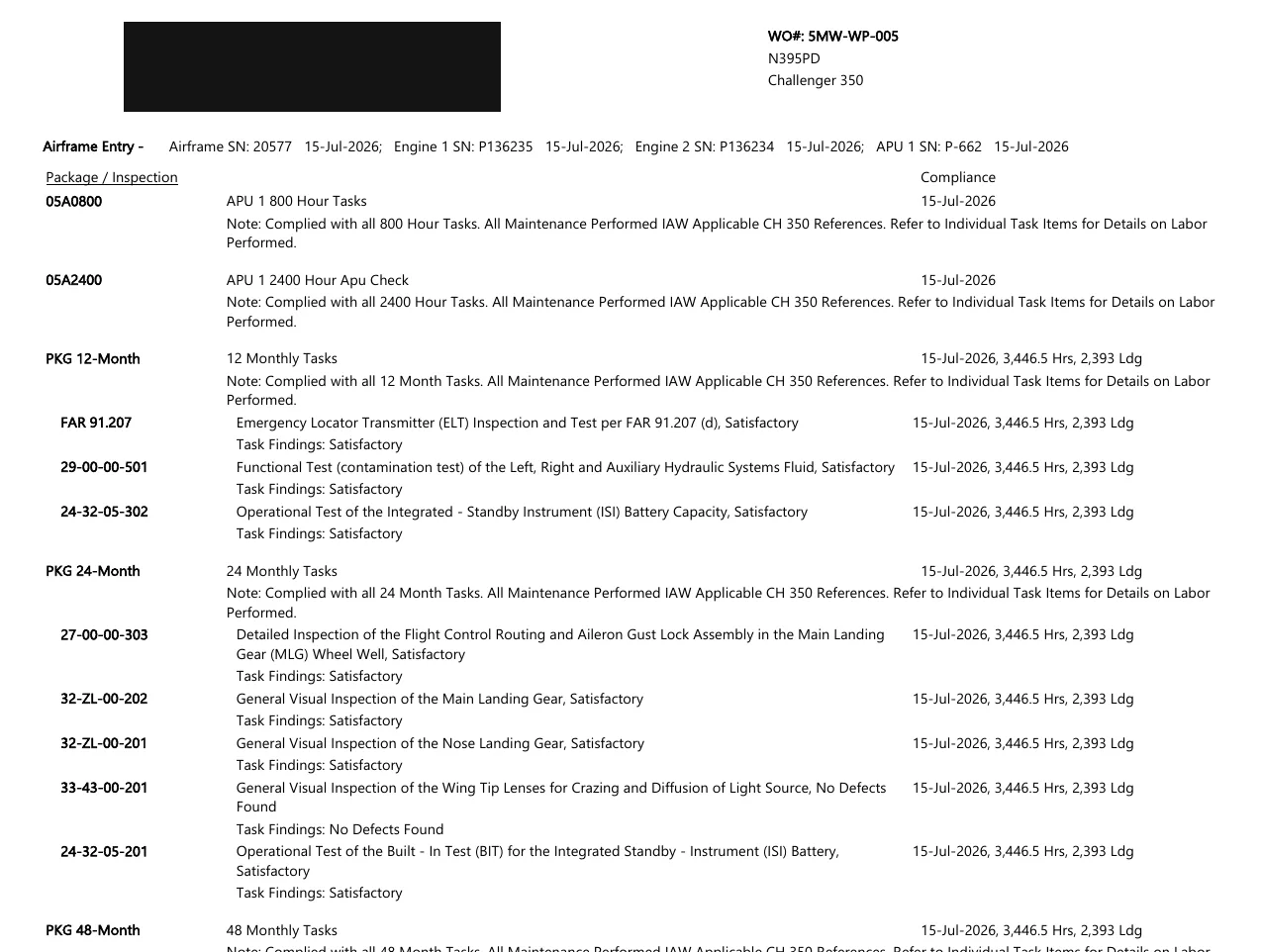
| 4Total time and status | Total time in service of the airframe, each engine and each propeller, with current hours and cycles. | 135.439(a)(2)(i), 91.417(a)(2)(i) | The latest logbook entries | 3,446.5 hrs, 2,393 landings, 15 Jul 2026 |
| 5Inspection program status | The program the aircraft is on and the last completed inspection of each type, with time since. | 135.411, 135.419, 135.439(a)(2)(iv) | Inspection packages and sign-offs | 12, 24 and 48 month packages, 15 Jul 2026 |
| 6AD compliance | Status of every applicable AD: method of compliance, date and, for recurring ADs, when next due. | Part 39, 135.439(a)(2)(v), 91.417(a)(2)(v) | AD entries in every logbook | AD 74-08-09 R3 (k), next due by 4,015.4 hrs |
| 7Life-limited parts | Current status of life-limited parts and time since overhaul of items overhauled on a time basis, with the records that trace them. | 135.439(a)(2)(ii), (iii) | Component cards, 8130-3s and entries | LPT stub shaft S/N 12-162684-00105, 4,648.98 hrs at overhaul |
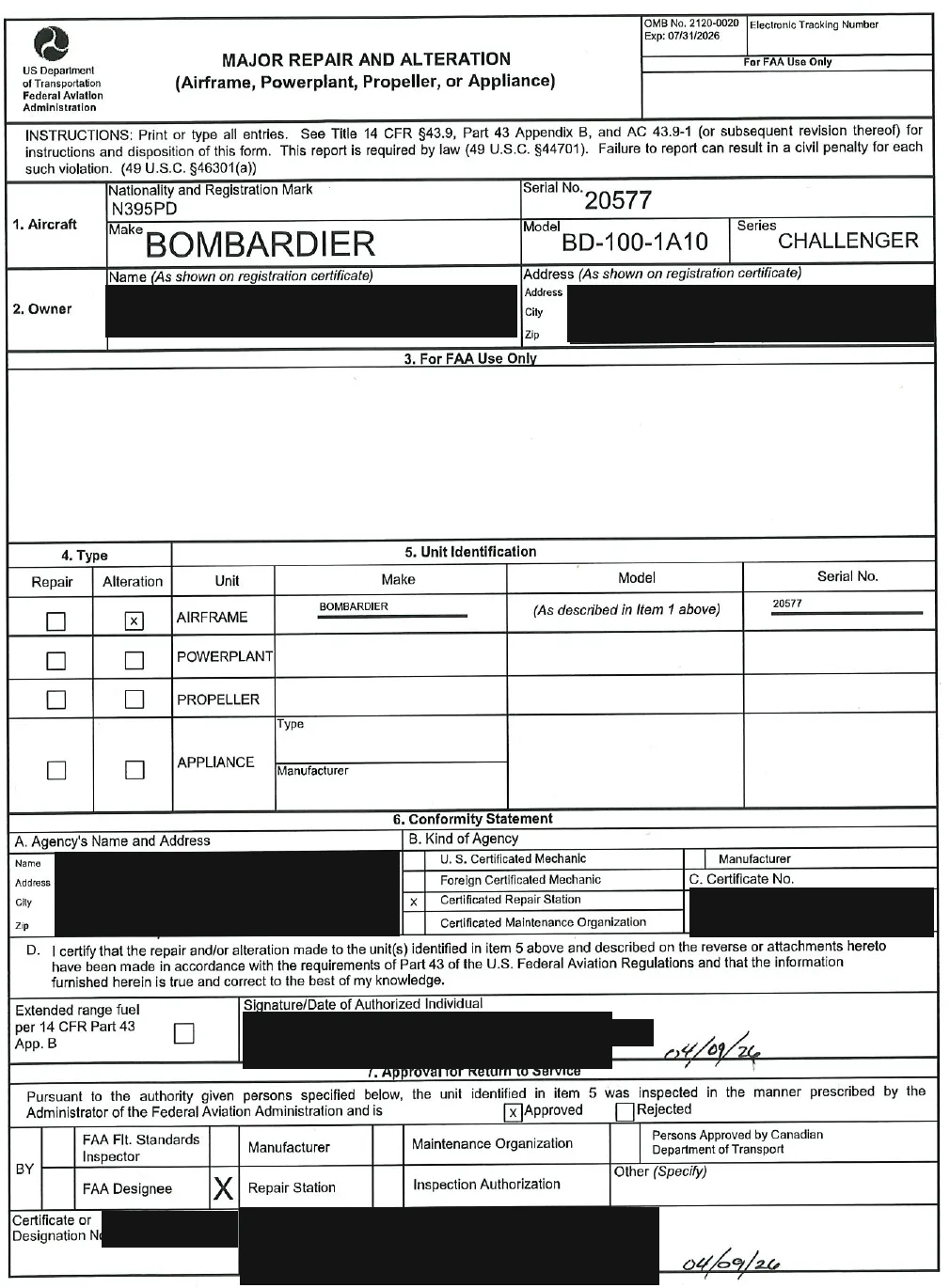
| 8Major repairs and alterations | Form 337s and a list of current major repairs and alterations. | Part 43 App. B, 135.439(a)(2)(vi) | Form 337s filed in the logbooks | Form 337, 9 Apr 2026, airframe alteration |
| 9STCs | Each STC installed, with any flight manual supplement it calls for. | Part 21 Subpart E | The 337 or entry for each install | ST11935CH, SpaceX Starlink Aviation System |
| 10Engine, propeller and APU records | Each engine, propeller and APU by serial number: times since new and since overhaul, hot sections and overhauls. | 135.439, 91.417 | Engine, propeller and APU logbooks | Engines P136235 and P136234; APU GTCP36-150(BD) S/N P-662; no propellers |
| 11Required equipment and tests | Altimeter and static system and transponder tests within 24 calendar months, the ELT inspection within 12, and Part 135 equipment such as CVR, FDR, TAWS and TCAS where required. | 91.411, 91.413, 91.207(d), 135.151 to 135.180 | Test reports and entries | 91.411 and 91.413 tests 22 Jun 2026; ELT 15 Jul 2026 |
| 128130-3 release tags | FAA Form 8130-3 or EASA Form 1 for installed rotables and life-limited parts. | Part 43, AC 20-62E | Work order packages | Seal 70041289-2, S/N 26-169020-00568, new |
ONE PAGE, THREE TABS
Most tabs are filled from the logbooks.
The registration and airworthiness certificates are documents in their own right. Almost everything else is in the logbooks and the work order packages filed with them. On N395PD, one alteration shows how a single record feeds several tabs.
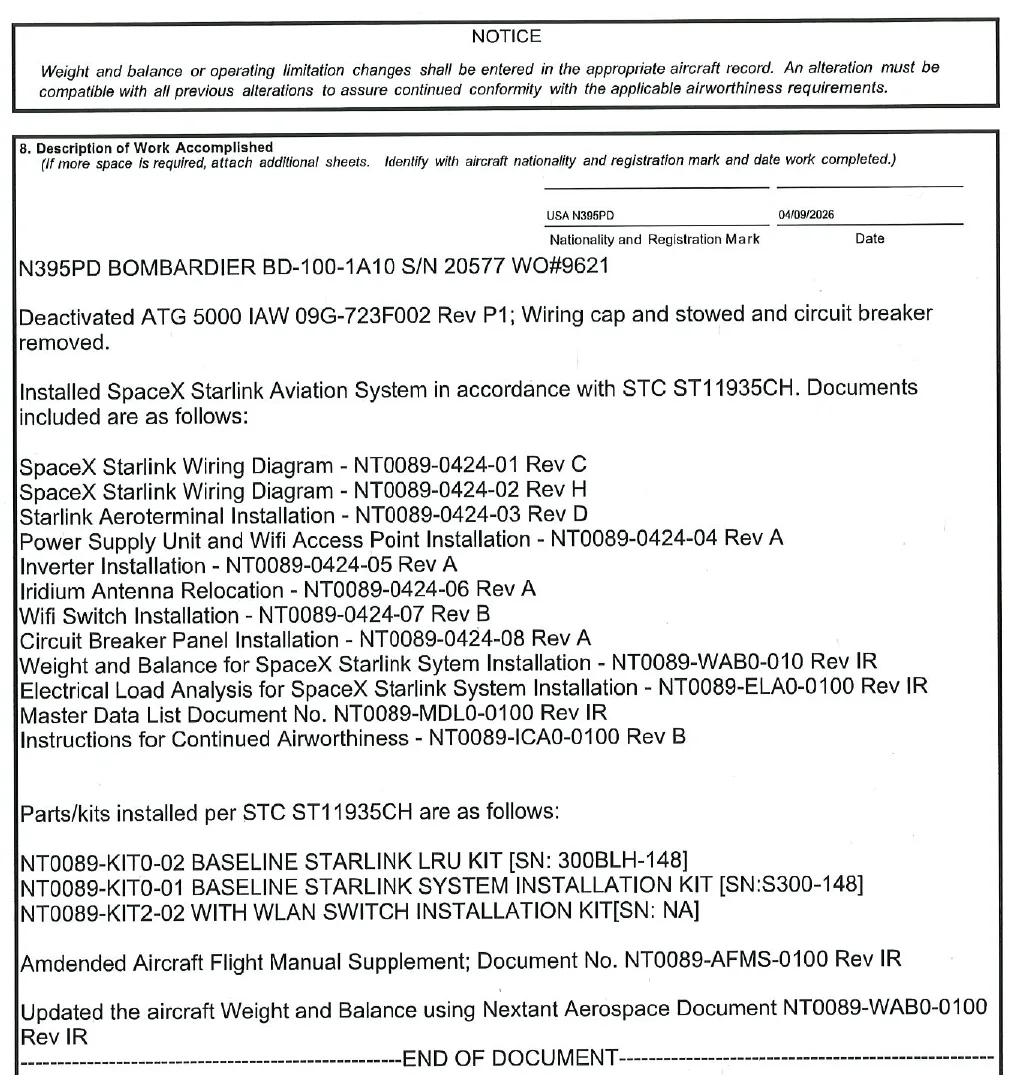
On 9 Apr 2026 a repair station installed a SpaceX Starlink Aviation System under STC ST11935CH and recorded it on FAA Form 337. The back of the form lists the STC data, a flight manual supplement (NT0089-AFMS-0100 Rev IR) and an updated weight and balance (NT0089-WAB0-0100 Rev IR). That one form belongs behind the major alterations tab, is the evidence for the STC tab, and explains why the weight and balance changed.
The work package of 15 Jul 2026 does the same for four more tabs: 12, 24 and 48 month inspection packages, the aircraft at 3,446.5 hours and 2,393 landings, the engine and APU serial numbers, and the ELT test under 91.207(d).
LOCKED WHEN SENT
Keep exactly what the FAA reviewed.
Records keep moving after you send a package. A logbook gets rescanned, a page is reclassified, an entry is corrected, a newer weighing replaces the old one. Months or years later, someone may ask what the district office actually saw when the aircraft went on the certificate.
So freeze the package when it goes out: who it was sent to, the date, every page as it was, and a fingerprint over all of it. If something has to change, start a new revision rather than editing the one that was sent.
AIRCRAFT OVER TIME
Certificates change. So do tail numbers.
Over the life of a certificate, aircraft come on and off D085, some more than once. Each addition had its own package and its own review. Keeping a history of what was on the certificate, and when, makes an audit, a sale or a lender’s question a lookup instead of a search.
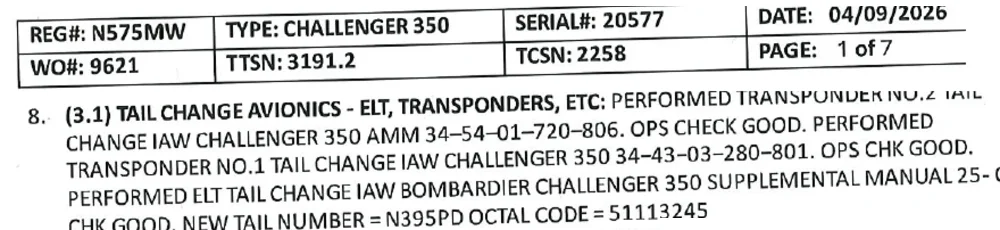
Registrations change too. Challenger 350 S/N 20577 was N575MW until 9 Apr 2026: its work order that day records the aircraft at 3,191.2 hours and 2,258 cycles under N575MW, and the transponders and ELT recoded for N395PD. Its records carry both registrations, and a package for it has to tie them together.
PREP CHECKLIST
Before you send the package.
Work through it before the aircraft arrives. Every gap you find now is a question the inspector does not have to ask.
ABOUT THIS EXAMPLE
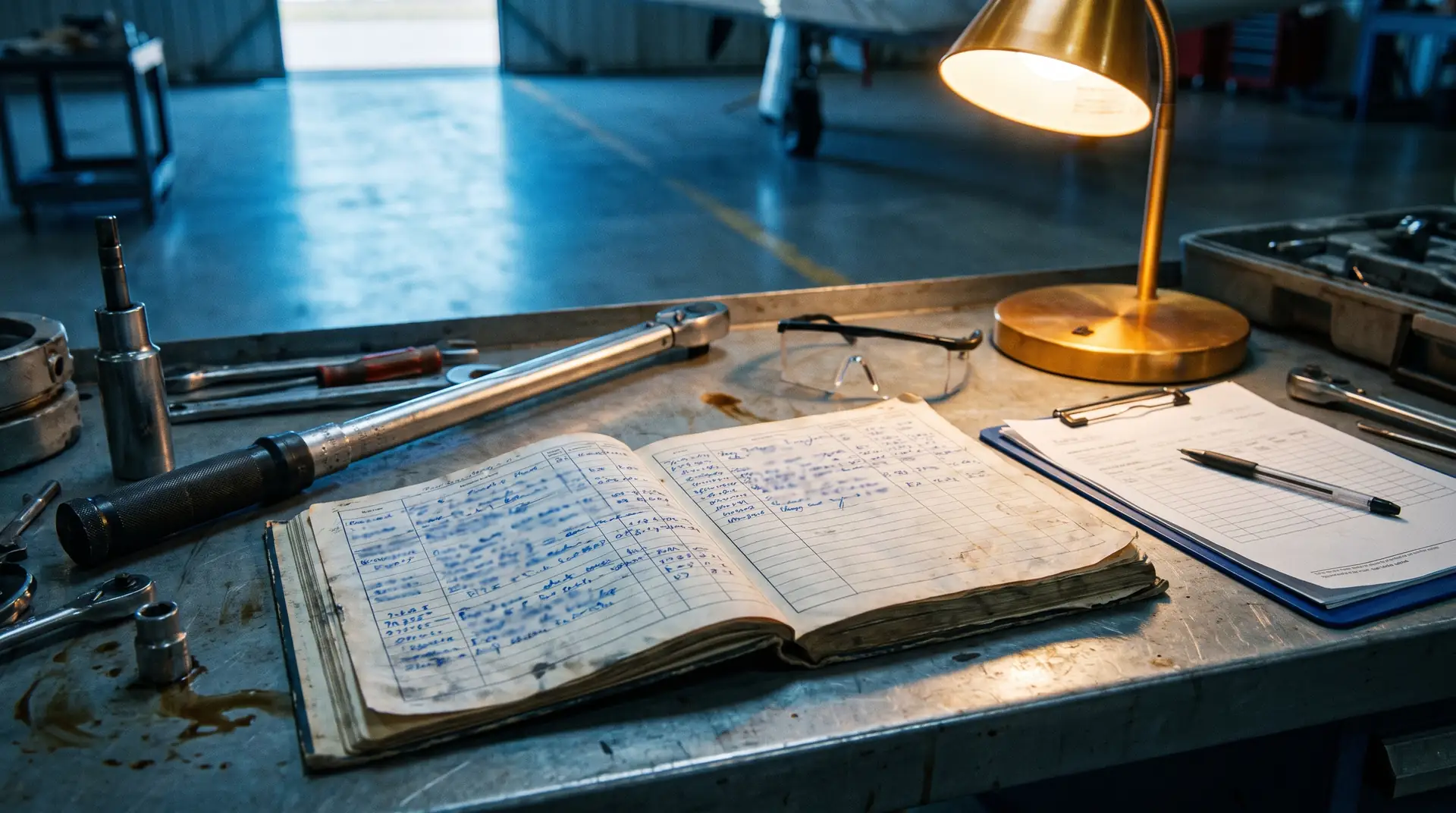
The real records in the film and on this page come from one airframe, Challenger 350 (BD-100-1A10) serial 20577, registered N395PD and earlier N575MW: the FAA Form 337 of 9 Apr 2026, the work order of the same day that records the tail change, and the work package of 15 Jul 2026, plus AD, part and 8130-3 records from the same logbooks. The owner, the shops, the operator, names, signatures and certificate numbers are redacted. The D085 page, its example rows and the fleet ticker are illustrations with generic tails; nothing here says when or whether this aircraft was added to any certificate. The app screens come from a Radar sandbox account with sample data. The hangar and records photographs are illustrations, not this aircraft.
KEEP READING
SOURCES
GET A DEMO
Build the package from records Radar already read.
Send us the aircraft’s logbooks. Radar reads every page, suggests the pages for each tab of the conformity package, and locks the package when you send it, with every aircraft that was ever on your D085 in one history.
This page explains the rules in general terms. Your district office, operations specifications, maintenance program and aircraft can add requirements.