In brief
Aircraft loan approval requires two complete files: one proving repayment capacity and one proving the aircraft’s value, identity, condition, title, and recoverability. Requirements vary by lender and transaction, but missing information in either file can delay or stop the loan.
Tools for this decision
Run the numbers while you read.
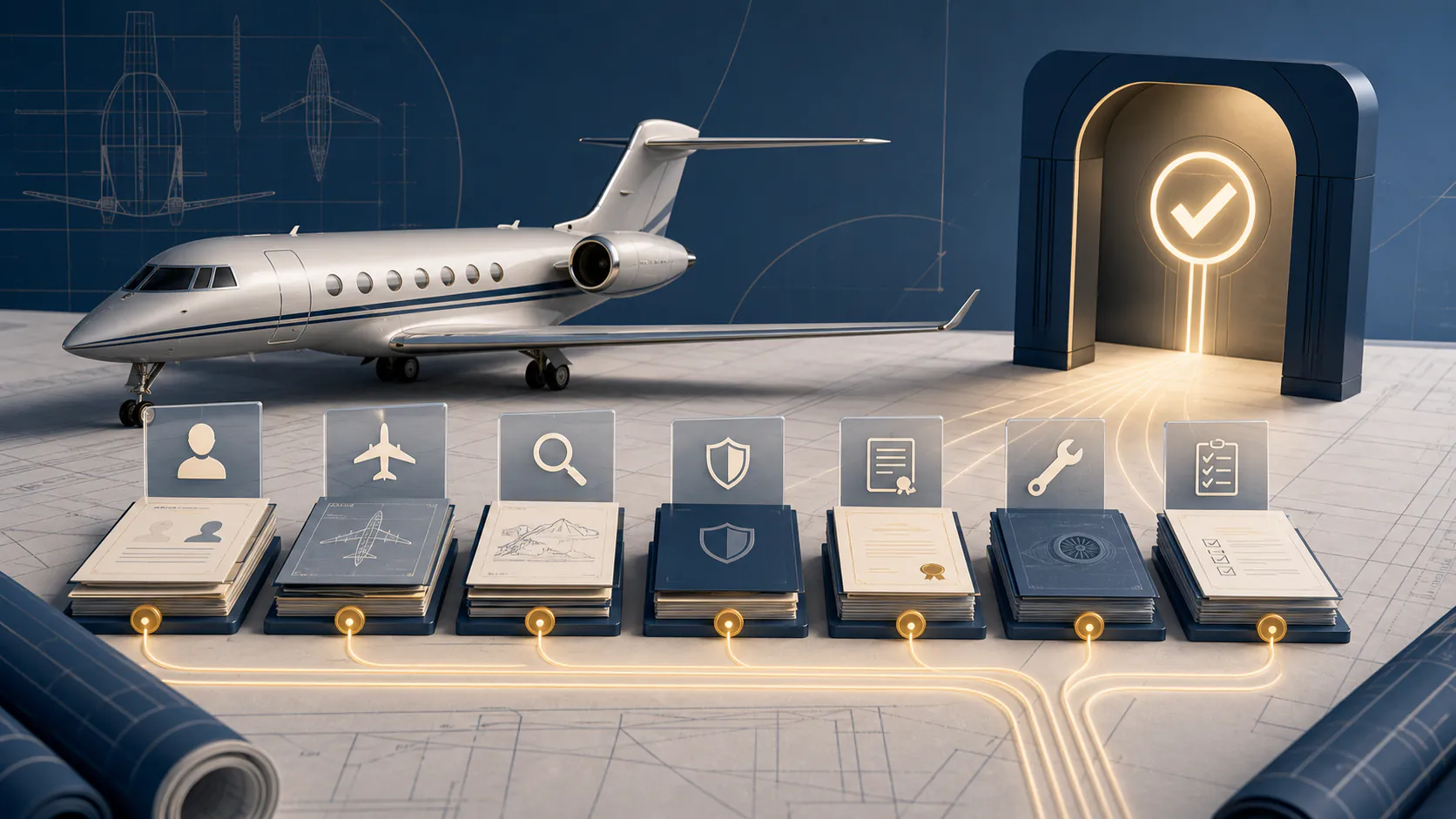
Aircraft loan requirements are not a single credit-score test. The lender must approve the borrower, the aircraft, the loan structure, and the closing conditions as one transaction.
Prepare two parallel packages from the beginning:
- Credit file: who is borrowing or guaranteeing, how the debt will be repaid, and how much liquidity remains after closing.
- Collateral file: what aircraft secures the loan, what it is worth, whether its condition and history are supported, and whether the lender can obtain the intended security interest.
Radar organizes the collateral evidence. It does not make credit decisions, arrange loans, or replace lender, legal, tax, insurance, appraisal, or maintenance professionals.
The aircraft loan approval framework
| Approval area | Lender question | Typical evidence |
|---|---|---|
| Borrower | Can the obligation be repaid? | Application, financial statements, tax returns, credit, debt schedule |
| Liquidity | Can the borrower close and absorb volatility? | Bank and brokerage statements, liquidity schedule, reserves |
| Aircraft | Is the collateral eligible and marketable? | Specification, serial number, logs, maintenance status, inspection |
| Value | Does accepted value support the advance? | Appraisal, desktop valuation, comparables, maintenance-adjusted analysis |
| Structure | Does the loan reduce risk appropriately? | LTV, down payment, amortization, maturity, guarantees, covenants |
| Title and closing | Can the security interest be perfected? | Title report, ownership documents, lien releases, insurance, filings |
Approval in one area does not cure failure in another. A strong guarantor cannot turn an unsupported aircraft history into predictable collateral.
Borrower and guarantor requirements
For an individual, lender requests may include:
- Completed application and authorization.
- Government identification.
- Personal financial statement.
- Personal tax returns.
- Current income evidence.
- Bank, brokerage, and retirement statements.
- Real-estate and business ownership schedules.
- Existing debt and contingent-liability schedule.
- Explanation of material credit events.
- Aviation ownership and operating experience.
For a business or ownership entity, expect some combination of:
- Formation and good-standing documents.
- Organizational chart and beneficial ownership.
- Operating agreement, bylaws, or resolutions.
- Business financial statements and tax returns.
- Interim balance sheet and income statement.
- Debt schedule and lender references.
- Cash-flow support for aircraft use.
- Personal or parent guarantees.
- Management or dry-lease agreements.
Requirements depend on the lender and whether the financing is consumer, business-purpose, asset-based, recourse, or nonrecourse.
Credit, cash flow, and liquidity
Credit approval generally evaluates more than a score:
- Payment history and unresolved delinquencies.
- Stability and diversity of income.
- Recurring cash flow relative to debt service.
- Existing leverage and contingent obligations.
- Net worth and concentration risk.
- Liquid assets after the down payment and closing costs.
- Ability to fund insurance, crew, hangar, fuel, maintenance, and reserves.
Do not present retirement assets, restricted stock, concentrated securities, or business value as though each were immediately available cash. A lender will apply its own liquidity and valuation rules.
Down payment and loan-to-value
The required aircraft down payment is the difference between transaction cost and the amount the lender will advance, plus fees and costs not financed.
The lender may calculate the advance against:
- Purchase price.
- Appraised value.
- Desktop or internal value.
- The lower of purchase price and accepted value.
- A borrowing-base value after maintenance or condition adjustments.
If an aircraft is purchased above the lender’s accepted value, the buyer may need to fund the entire difference in addition to the policy equity.
Aircraft eligibility requirements
Before treating a credit approval as usable, confirm that the lender accepts:
- Aircraft make, model, serial number, and year.
- Experimental, limited, restricted, or standard category as applicable.
- Piston, turboprop, jet, helicopter, or other product type.
- Personal, business, instructional, rental, charter, or commercial use.
- Domestic or international registration.
- Aircraft age and total time.
- Damage and major-repair history.
- Planned ownership and operating structure.
- Base location and jurisdiction.
Some programs are designed for common piston aircraft; others focus on business jets or commercial assets. “Aircraft loan approved” is incomplete until the exact aircraft is approved.
The aircraft records package
A lender or its technical advisor may request:
- Airframe, engine, propeller, and APU logbooks.
- Current total times and cycles.
- Inspection and maintenance status.
- Airworthiness Directive status.
- Life-limited-part and component history.
- Engine, APU, and maintenance-program evidence.
- Major repairs, alterations, STCs, and FAA Form 337 records.
- Damage, incident, corrosion, and repair history.
- Recent work orders and return-to-service evidence.
- Equipment list, weight and balance, and configuration documents.
- Records inventory and exception schedule.
Use the aircraft records audit to identify gaps before the lender receives the file. A neatly labeled data room is not enough if the underlying status cannot be traced to source.
Valuation and appraisal requirements
The lender may use an internal value, published market reference, desktop opinion, certified appraisal, or physical inspection. The appropriate level depends on value, complexity, policy, and exceptions.
A useful valuation identifies:
- Exact serial-number configuration.
- Comparable aircraft and adjustments.
- Engine and major-event status.
- Program enrollment and transferability.
- Damage and modification history.
- Records quality and missing evidence.
- Market liquidity and expected remarketing time.
Read the aircraft valuation guide for the evidence behind a defensible conclusion, then use the aircraft valuation projection model to test how current value and depreciation assumptions change the financing case.
Pre-buy and technical diligence
Credit approval should not pressure a buyer to waive technical diligence. The aircraft pre-buy inspection checklist should coordinate the physical inspection with the records review.
The lender may require findings to be:
- Corrected before funding.
- Escrowed.
- Accepted with a value adjustment.
- Covered by a reserve.
- Addressed through a covenant.
- Deemed a collateral disqualifier.
The purchase agreement should allocate access, scope, cost, correction rights, rejection rights, and enough time to complete this work.
Title, ownership, and insurance
Closing requirements commonly include:
- Ownership entity approval.
- FAA registration documents.
- Aircraft title search.
- Lien and security-interest releases.
- New security agreement and filing documents.
- International Registry work when applicable.
- Insurance binder with required coverages and lender clauses.
- Escrow instructions and funds-flow statement.
- Executed bill of sale and loan documents.
An aircraft title search is not the same as a maintenance-record review. Both are needed because title and technical provenance answer different risks.
Requirements for refinance
An aircraft refinance removes the seller and purchase agreement but does not remove collateral diligence. Expect:
- Current payoff and lien-holder information.
- Current aircraft value.
- Updated title and registration evidence.
- Current insurance.
- Current maintenance and records status.
- Explanation of cash-out or improvement use.
- Correct release and replacement of security interests.
If value, utilization, location, condition, or ownership changed since the existing loan closed, prepare to explain the change.
Submission checklist
- Confirm lender appetite for the exact aircraft and use.
- Build a current borrower and guarantor package.
- Separate liquid assets from illiquid net worth.
- Document the ownership and operating structure.
- Inventory and audit the aircraft records.
- Complete valuation and technical diligence.
- Resolve title, lien, registration, and insurance conditions.
- Compare the complete loan terms.
- Maintain a written closing checklist with owners and due dates.
- Preserve the final accepted collateral baseline after funding.
Sources and further reading
Common questions
Frequently asked questions
What credit score is required for an aircraft loan?
There is no universal score. Lenders evaluate the complete borrower or guarantor profile, including credit history, liquidity, cash flow, leverage, loan size, aircraft, and proposed structure. Published minimums apply only to specific programs.
How much liquidity do aircraft lenders require?
Liquidity requirements vary with borrower strength, aircraft, loan size, use, and lender policy. The lender may evaluate cash needed for the down payment and closing plus post-closing debt service, operating costs, and maintenance exposure.
Will a lender finance an aircraft with missing logbooks?
Possibly, but the gap can reduce supported value, restrict lender options, require more equity or technical work, and create a decline. The consequence depends on what is missing and whether credible evidence can reconstruct the history.
Is a pre-buy inspection required for aircraft financing?
Requirements differ. A lender may request an inspection, records review, appraisal, or other diligence based on aircraft value, age, complexity, use, and policy. The purchase agreement should allow enough time to satisfy those conditions.
Keep researching
Related aircraft guides



Make the aircraft history decision-ready
Turn aircraft paperwork into evidence you can use.
Radar digitizes, connects, and verifies the maintenance history behind buying, financing, operating, and selling an aircraft.