
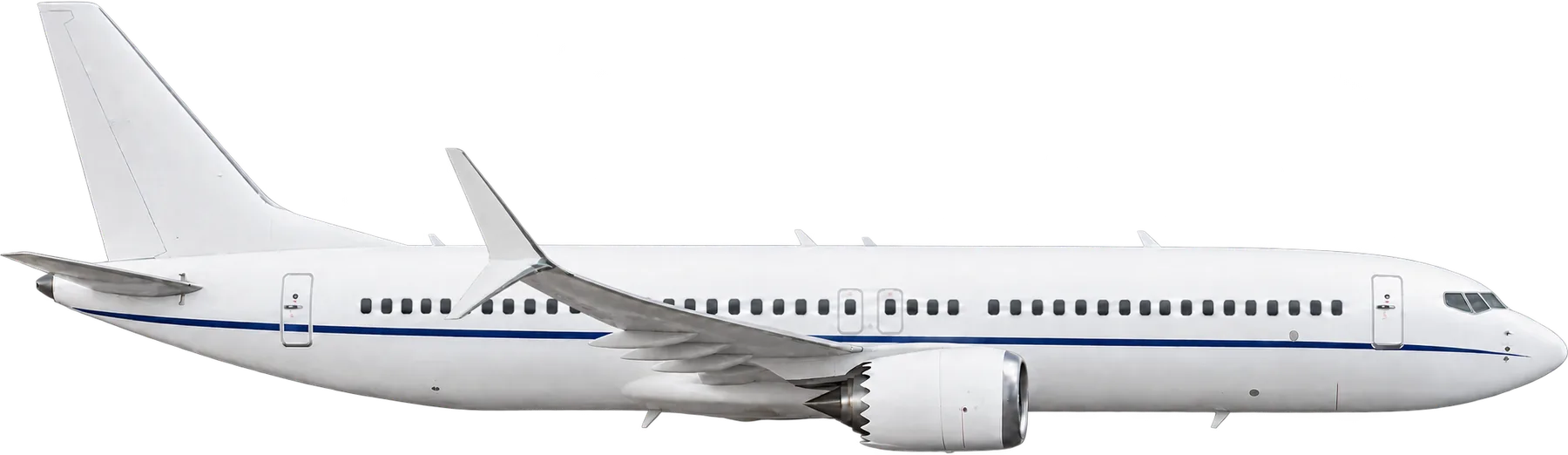
N17321 2023 Boeing 737-8
- 2023Built
- 166Seats
- 3,550 nmRange
- 453 ktCruise
- 41,000 ftCeiling
SPECIFICATIONS
Boeing 737-8 specs
Published figures for the type, from public sources. A given aircraft varies with its completion, weight and mods.
- Model
- Boeing 737-8
- Year
- 2023
- Serial number
- 67577
- Engines
- 2 × CFM International LEAP-1B
- Thrust
- 29,320 lbf each
- Seats
- Up to 166
- Range
- 3,550 nm
- Cruise
- 453 ktas
- Published Mach
- 0.79
- Ceiling
- 41,000 ft
- Fuel capacity
- 6,820 US gal
- ICAO type
- B38M
- Exterior
- White (United fuselage livery with blue tail)
THE AIRCRAFT’S LIFE
N17321, from delivery to today.
Registration events from FAA records, compiled November 2025. Maintenance, damage and component history live in the logbooks, not the registry.
-
Continental Airlines
N17321 previously used on a Boeing 707-321C in the 1960s (photo dated 1964).
FAA registry -
Continental Airlines
Historic assignment of N17321 to a Boeing 737-3T0, MSN 23372 (delivered 1986).
FAA registry -
United Airlines
N17321 used on a Boeing 737-300 originally operated by Continental Airlines; registration noted as transferred/merged into United's fleet in 2011.
FAA registry -
United Air Lines, Inc.
Delivered to United Airlines (MSN 67577) and placed into mainline service; aircraft noted leased from a lessor (lessor not disclosed).
FAA registry
FAA REGISTRATION
Registration details
- Registration
- N17321
- Mode S code (hex)
- A1270A
- Aircraft category
- Fixed-wing multi-engine
- Weight class
- Over 20,000lbs
From FAA registry data as of November 2025. Check the FAA registry for the current record.
OWNERSHIP
Registered owner
United Air Lines, Inc.
ESTIMATED VALUE
What N17321 might be worth
EstimateAbout $52 million
A rough market estimate compiled in November 2025 from public listings and market reports for the type and year. It is not an appraisal. It does not account for this aircraft's total time, engine program, damage history or the state of its logbooks, which can move a price by millions.
Open the aircraft value toolEQUIPMENT AND HISTORY
As reported in public sources
- Cabin
- United two-class MAX 8 typical layout: 16 First / 54 Economy Plus / 96 Economy (166 total).
- Interior
- United 'signature interior' on MAX 8: seat-back screens on many aircraft, larger overhead bins, in-seat power/USB, ViaSat/KA-band Wi-Fi on factory-delivered United MAX 8s.
- Reported incidents
- Historic tail reuse note: N17321 was involved in a non-fatal accident record (B737-300, msn 23372) on 1999-03-17 with no fatalities; older usage includes Boeing 707 in 1964. Current MAX 8 (MSN 67577) no public accident record found.
Listings and registries are not the logbooks. A pre-buy confirms equipment, program status and damage history from the records themselves.
RESEARCH NOTES
About N17321
Compiled with AI assistance from the public sources listed below, November 2025. Not checked against the aircraft's logbooks.
Overview
This airframe, registration N17321, is a Boeing 737-8 (737 MAX 8) completed in 2023 with manufacturer serial number 67577. The airframe is owned by United Air Lines, Inc. (a corporation based in the United States) and is registered in the US; entered service in 2023 under United's fleet would represent its primary operational timeline.
Operations & Cabin
The cabin of this specific airframe follows United's two-class MAX 8 typical layout with 16 First / 54 Economy Plus / 96 Economy (166 total) seats, providing a mix of premium and high-density economy seating tailored to domestic and transcontinental trunk routes. With a maximum cruise speed of 453 kts and a range of 3,550 nm, the aircraft is suited to medium-haul missions including coast-to-coast, transcontinental, and select short international services from United’s hubs in the United States. Avionics and specific fitment are per Boeing delivery standards for the 737-8; maintenance planning will focus on LEAP-1B engine care cycles and OEM structural inspections consistent with a 2023-build airframe. Routine heavy maintenance and line checks are performed under United’s corporate maintenance program and applicable US registry oversight.
Model & Market Context
The Boeing 737-8 (737 MAX 8) occupies the short- to medium-range single-aisle market niche, competing primarily against narrowbody types such as the Airbus A320neo family. With two CFM LEAP-1B engines and a typical two-class 166-seat layout, it targets airlines seeking improved fuel efficiency and lower per-seat operating costs compared with previous-generation 737s. Buyer demand and resale considerations for a 2023-built MAX 8 remain strong, though operators weigh aftermarket engine support and scheduled LEAP-1B maintenance as key lifecycle cost drivers.
MOVEMENTS
Last reported flights
| Date | From | To |
|---|---|---|
| PHLIH Lihue Airport | KSFO San Francisco International | |
| KSJC Norman Y. Mineta San Jose International | KSFO San Francisco International | |
| KDEN Denver International Airport | PANC Ted Stevens Anchorage International | |
| KPHL Philadelphia International | KSFO San Francisco International | |
| KIAD Washington Dulles Intl | MSLP El Salvador Intl |
Public ADS-B and spotter reports up to November 2025. Not a live track.
SOURCES
Where this page comes from
Built from FAA registry records, manufacturer specifications, and public flight-tracking and market data, compiled November 2025. Values come from Radar’s aircraft value model. Owners and operators can ask for a correction or removal.
BUYING, SELLING OR FINANCING
What to check before a deal
- Pre-buy records reviewWhat to read in the logbooks before you sign
- Aircraft title searchLiens, registrations and the chain of title
- Aircraft valuationHow records, time and programs move the price
- Aircraft maintenance recordsWhat a complete records package holds
Own or manage N17321? Put its logbooks in Radar.
Radar reads every logbook page, typed or handwritten, and builds one searchable record for the aircraft: times, inspections, ADs and components, each tied to the page it came from.
N17321 is not a Radar customer record. This page is built from public sources as of November 2025. Owners and operators can ask for a correction or removal.