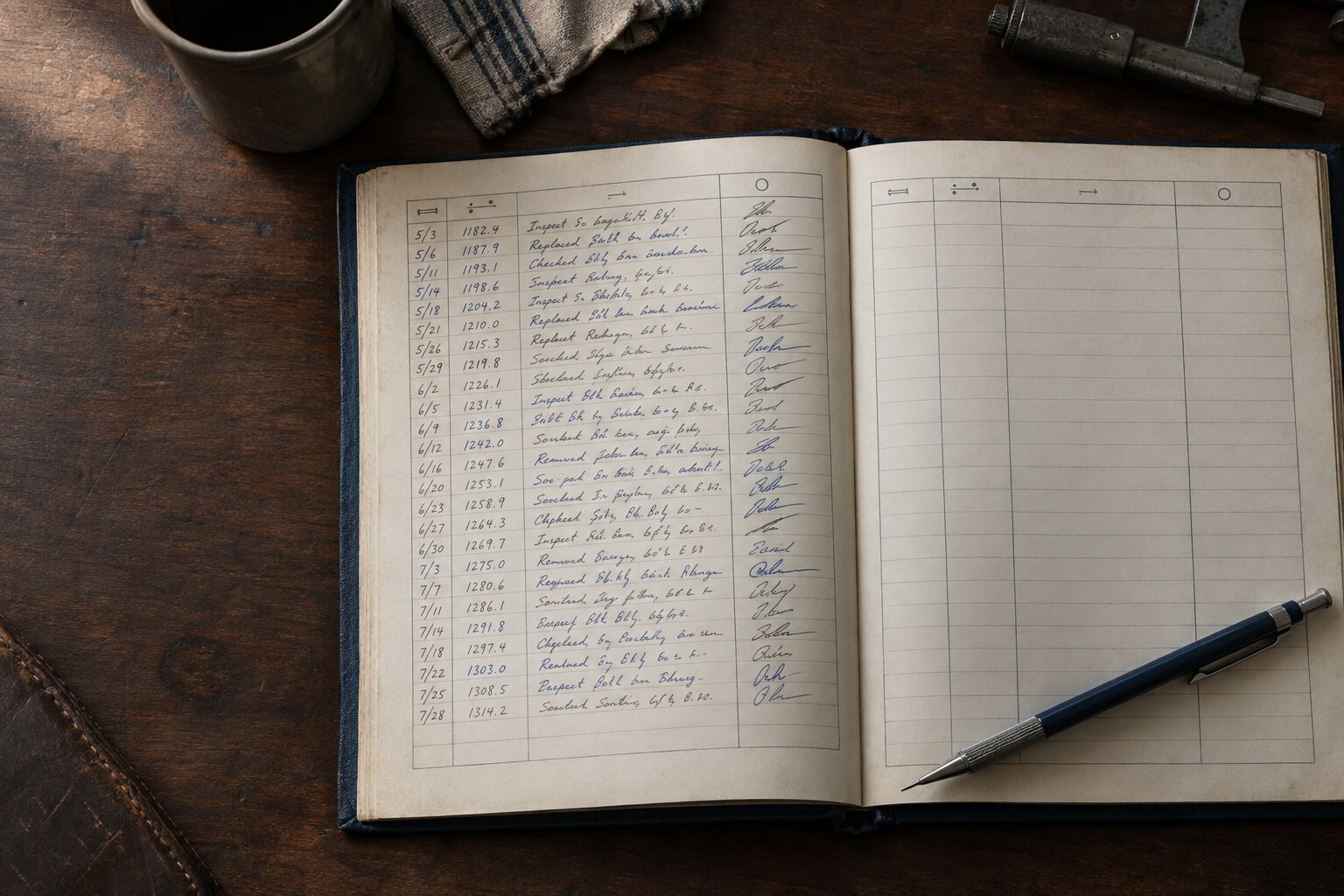
Follow the Problem Through the Maintenance Record
When a discrepancy returns, the team needs to know what happened last time. Connect the original report to troubleshooting, corrective action, parts removed and installed, and the aircraft’s subsequent performance.
That sequence helps distinguish a repeat defect from a new problem and gives maintenance and engineering teams a starting point for investigation. Start with:
- The discrepancy and operating context.
- The aircraft, system, component, and installed configuration.
- The tests, work performed, and supporting work package.
- The return-to-service entry and subsequent reports.
Records support the investigation. Aircraft reliability also depends on maintenance planning, engineering, qualified labor, parts supply, and physical inspection. Use the records alongside those controls.
Define the Metric Before Comparing Aircraft
Define the population and calculation before comparing dispatch reliability.
Before comparing a percentage, document:
- What counts as a scheduled departure.
- The delay threshold.
- Whether cancellations are included.
- Which events count as maintenance-caused.
- Whether unavailable aircraft generate scheduled events.
- Fleet type, size, age, mission, and measurement period.
- Whether substitutions or charter recovery change the result.
A fleet can show high dispatch reliability while experiencing substantial unavailable time if trips were never scheduled against an unavailable aircraft. Conversely, an operation with aggressive utilization may record more disruptions while producing more flying.
Use multiple measures: dispatch reliability, technical dispatch interruptions, maintenance cancellations, aircraft availability, AOG duration, repeat discrepancies, deferred-item aging, mean time between removals, and schedule completion. The right set depends on the operating objective.
What Good Records Contribute
Reliable records allow a team to:
- Confirm current aircraft and component status.
- Identify repeated discrepancies and prior corrective actions.
- Compare removals, repairs, and failures by part and serial number.
- Calculate task and component due points.
- Understand installed configuration and modification effectivity.
- Find the work package behind a summary entry.
- Support warranty, program, and vendor claims.
- Reconstruct the conditions surrounding an event.
These capabilities improve decisions only when the data is accurate, timely, and connected to source evidence. Check disputed values against the original record before using them in the analysis.
Verify the Component and Its Release Documents
When FAA Form 8130-3 is part of a component record, review the purpose and status recorded on that particular form.
FAA Order 8130.21 defines authorized uses of the form, including approval for return to service for eligible articles and certain production, conformity, and export purposes. The form:
- Can represent different statuses depending on the blocks completed.
- Must be read with its issuer, article identity, work status, and remarks.
- Does not by itself establish that an article is eligible for installation on a particular aircraft.
- Does not replace receiving inspection, configuration review, life-status review, or installation approval.
Verify the article and the document together. Match part and serial numbers, issuer, approval references, work performed, limitations, and the aircraft’s eligibility requirements.
Build a Defensible Receiving Process
For serialized or otherwise controlled articles, a receiving process includes:
- Confirm the supplier and purchasing channel.
- Inspect packaging, identification, condition, and tamper evidence.
- Match the article to the release documentation.
- Review the form’s purpose and completion.
- Check part number, serial number, modification status, and effectivity.
- Review life limits, overhaul status, storage, and preservation where applicable.
- Resolve alterations, erasures, inconsistent fonts, missing fields, or implausible chronology.
- Quarantine unresolved items.
- Preserve the source document and verification record.
Combine supplier controls, approved-source practices, document review, receiving inspection, regulator information, and technical eligibility checks.
Connect Reliability Data to Maintenance Decisions
A useful reliability loop connects:
- The operational interruption or discrepancy.
- Aircraft, system, component, and configuration.
- Troubleshooting and corrective action.
- Parts removed and installed.
- Work package and return-to-service entry.
- Subsequent performance.
- Engineering or program action when a pattern is established.
Without that chain, teams can count events but cannot test whether a corrective action worked. With it, they can distinguish a repeat defect from a new problem and compare performance by component, shop, repair source, or modification status.
Do not let correlation become a maintenance conclusion. A component associated with more removals may be installed on the highest-utilization aircraft, exposed to a different mission, or represented by better records. Reliability analysis needs exposure data and technical review.
What to Preserve During an AOG
An AOG creates pressure to move fast and document later. Preserve the minimum evidence needed to prevent the event from becoming untraceable:
- Time, location, aircraft, and operating context.
- Crew and maintenance discrepancy descriptions.
- Fault messages and test results.
- Troubleshooting steps and data used.
- Parts requested, received, removed, and installed.
- Deferral, ferry, or operating authority when applicable.
- Work performed and return-to-service record.
- Follow-up inspection or monitoring requirement.
Complete the record while the people and evidence are still available. The goal is enough structured context to support compliance, troubleshooting, and later analysis. Keep the record specific enough for another reviewer to reconstruct the event.
Close the Loop After Corrective Action
After the work, check whether the discrepancy returns and preserve the evidence for the next review.
A mature program combines:
- Accurate source records.
- Controlled current status.
- Qualified maintenance and engineering.
- Physical inspection and testing.
- Supply and vendor controls.
- Defined reliability metrics.
- Root-cause review.
- Closed-loop corrective action.
Give each follow-up action an owner and record the evidence used to close it.
Sources and Further Reading
- FAA Order 8130.21J, Procedures for Completion and Use of FAA Form 8130-3
- FAA AC 20-62E, Eligibility, Quality, and Identification of Aeronautical Replacement Parts
- FAA Suspected Unapproved Parts Program
- Radar FAA Form 8130-3 guide
- Radar aircraft maintenance records guide
Talk with Radar to organize the fleet records behind your next maintenance review.